
Ancient Origins in the Indian Subcontinent

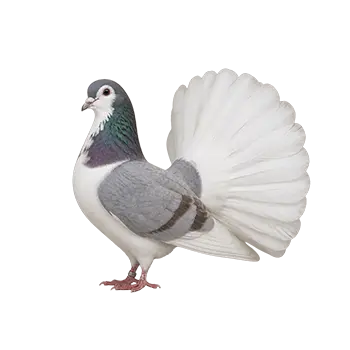
The Fantail Pigeon is widely regarded as one of the oldest breeds of domesticated fancy pigeon, with roots stretching deep into the history of the Indian subcontinent. While precise dates of origin are impossible to establish, historical evidence and scholarly consensus place the breed's initial development somewhere between 1,500 and 2,000 years ago, making it among the earliest known ornamental pigeon varieties. The wild rock dove (Columba livia), ancestor of all domestic pigeon breeds, provided the genetic foundation upon which generations of Indian breeders would sculpt the Fantail's defining characteristic: a broad, upright tail composed of far more feathers than any wild pigeon carries.

Ancient Indian texts and artistic depictions suggest that pigeon keeping was a well-established practice among the nobility and merchant classes of the subcontinent long before the breed reached foreign shores. Pigeons appear in Sanskrit literature and in the decorative arts of Hindu and Buddhist traditions, often symbolizing devotion, peace, and the soul's capacity for transcendence. Within this cultural framework, the selective breeding of pigeons for unusual plumage, posture, and tail carriage was not merely a pastime but an expression of aesthetic refinement and spiritual appreciation for the diversity of living forms.

The Fantail's distinctive fan-shaped tail, carried erect and spread in a semicircular or nearly circular display, likely emerged through patient selection over many generations. Breeders in the courts and urban centers of ancient India would have chosen birds exhibiting slightly broader tails and more erect carriage, gradually amplifying these traits across successive breeding cycles. The result was a pigeon whose tail feather count expanded from the standard twelve to fourteen found in wild rock doves to the thirty or more feathers characteristic of modern Fantails, creating the visually striking display that defines the breed.

The geographic diversity of the Indian subcontinent, with its many regional courts and semi-independent kingdoms, likely contributed to the early proliferation of Fantail sub-varieties. Different regions developed their own preferences for size, color, and tail spread, laying the groundwork for the range of types that would eventually reach breeders in the Middle East and Europe. This decentralized development is a common pattern in the history of domestic animal breeds and helps explain the Fantail's remarkable variety even within a single breed classification.

Spread Along Trade Routes & Into the Middle East

The Fantail Pigeon's journey beyond India followed the great overland and maritime trade routes that connected South Asia to the Middle East, Central Asia, and eventually the Mediterranean world. Arab and Persian traders, who maintained extensive commercial networks reaching into the Indian interior, are believed to have been among the first to carry Fantail Pigeons westward. The Islamic world had its own deep tradition of pigeon keeping, and the arrival of the Fantail would have been met with keen interest by established fanciers in cities like Baghdad, Isfahan, and Damascus.

Pigeon culture in the Middle East was both sophisticated and widespread during the medieval period. Selective breeding for flight performance, color, and form had a long history in the region, and the introduction of the Fantail added a dramatic new form to an already diverse roster of breeds. Middle Eastern breeders contributed their own refinements to the Fantail, selecting for traits such as smoother head carriage, more compact body type, and specific color patterns that reflected regional aesthetic preferences. Some historians of the pigeon fancy believe that the ancestors of the modern Indian Fantail and the later English-style Fantail diverged during this period, as breeders in different cultural zones pursued different ideals.

The Ottoman Empire, which controlled vast territories stretching from southeastern Europe through the Middle East and North Africa, served as a particularly important conduit for the Fantail's westward migration. Pigeon keeping was a popular pursuit at every level of Ottoman society, from the sultan's court to the urban rooftop lofts of merchants and artisans. Ottoman-era manuscripts and miniature paintings occasionally depict pigeons that appear to display the fanned tail characteristic of the breed, suggesting that the Fantail was an established presence in the region by at least the 15th or 16th century.

The sea routes connecting the Indian Ocean to the Red Sea and the Mediterranean provided an additional pathway for the Fantail's dispersal. Portuguese, Dutch, and later British maritime traders operating in Indian ports would have encountered Fantail Pigeons in the markets and aviaries of coastal cities, and some birds almost certainly traveled aboard ships as curiosities, gifts, or personal stock. This dual pathway of overland and maritime transmission ensured that the Fantail reached a broad geographic audience, setting the stage for its adoption by European pigeon fanciers.

European Adoption & the Rise of the Pigeon Fancy

The Fantail Pigeon arrived in Europe during a period of rapidly expanding interest in natural history and the breeding of domestic animals for specific traits. By the 16th and 17th centuries, Fantails were documented in the aviaries of European aristocrats and natural historians, and the breed began to appear in the early literature of what would become the organized pigeon fancy. Ulisse Aldrovandi, the Italian naturalist whose monumental Ornithologiae (1599) catalogued the birds known to European science, included descriptions and illustrations of pigeon varieties that scholars have identified as early Fantails, confirming the breed's presence on the continent by the late Renaissance.

England emerged as the epicenter of Fantail development in Europe during the 18th and 19th centuries. British breeders, building on stock imported from India and the Middle East, began to refine the Fantail toward a specific exhibition ideal that emphasized a compact, rounded body, a broad and well-spread tail carried high over the back, and a trembling or shaking motion of the neck and body that became a hallmark of quality in the English Fantail type. This process of refinement was part of the broader Victorian enthusiasm for livestock exhibitions and breed standards, which transformed pigeon keeping from an informal pastime into a structured competitive pursuit.

Charles Darwin, himself an avid pigeon fancier, devoted considerable attention to the Fantail in his landmark work The Variation of Animals and Plants Under Domestication (1868). Darwin used the Fantail as one of his primary examples of the power of artificial selection, noting the dramatic divergence between the breed's elaborate tail and the modest plumage of the wild rock dove. His detailed observations on the Fantail's skeletal structure, feather count, and behavioral peculiarities contributed to his broader argument that domestic variation and natural selection operated through analogous mechanisms. The Fantail's role in Darwin's thinking cemented its place not only in avicultural history but in the history of evolutionary biology.

The formation of pigeon breed clubs and the codification of breed standards during the latter half of the 19th century gave the Fantail a formal identity within the competitive exhibition world. National pigeon organizations in Britain, Germany, the Netherlands, and elsewhere established detailed standards for the ideal Fantail, specifying tail feather count, body proportions, carriage, and acceptable color varieties. These standards provided a framework for judging and breeding that would shape the Fantail's development for the next century and beyond.

Cultural Symbolism & Ceremonial Roles

The Fantail Pigeon's striking appearance has long made it a symbol of beauty, celebration, and peace across multiple cultural traditions. In India, white Fantails have historically been released during weddings, religious festivals, and other auspicious occasions, their fanned tails creating a dramatic visual spectacle as the birds take flight. This ceremonial use reflects the broader cultural association between doves and pigeons and concepts of love, fidelity, and spiritual purity that pervades Hindu, Buddhist, and Jain traditions on the subcontinent.

In the Western world, the Fantail's visual resemblance to the stylized doves of Christian iconography has contributed to its popularity in ceremonial contexts. White Fantails are frequently used as release birds at weddings, memorial services, and public celebrations in Europe and the Americas, often standing in for the more abstract idea of the dove of peace. The breed's relatively tame disposition and willingness to return to a home loft after release have made it practical for such events, though animal welfare concerns about release practices have prompted increased scrutiny in recent decades.

Beyond ceremony, the Fantail has served as a muse and decorative motif in a variety of artistic and design traditions. The breed's silhouette, with its upswept tail and compact body, has appeared on textiles, ceramics, and architectural ornamentation in both Eastern and Western contexts. In Japanese and Chinese decorative arts, where pigeon and dove imagery carries its own set of symbolic meanings, the Fantail form has been adopted and reinterpreted to suit local aesthetic sensibilities, further extending the breed's cultural footprint.

The Fantail's symbolic versatility reflects a deeper truth about the relationship between humans and ornamental animals: breeds that combine visual drama with docile temperament tend to accumulate layers of cultural meaning over time. The Fantail's journey from Indian courtyard to global symbol of celebration illustrates how a single domestic breed can serve as a canvas onto which successive cultures project their own values, aspirations, and ideas about the natural world.

Development of Regional Types & Varieties

Over the centuries of its dispersal and refinement, the Fantail Pigeon has diversified into several recognized regional types, each reflecting the aesthetic priorities and breeding philosophies of different fancier communities. The Indian Fantail, sometimes called the Indian Fancy Fantail, retains many features associated with the breed's ancestral form, including a prominent crest, feathered feet (grouse muffs), and a somewhat more upright and elongated posture compared to its Western counterparts. Indian Fantails are prized for their regal carriage and elaborate head furnishings, and they remain a centerpiece of the pigeon fancy throughout South Asia.

The English Fantail, developed primarily in Britain during the 18th and 19th centuries, represents a different breeding ideal. English breeders selected for a very broad, nearly circular tail display, a compact and rounded body, and the characteristic trembling or vibrating motion of the neck and upper body. The English Fantail's tail feather count typically ranges from thirty to forty or more, and the best exhibition specimens display a tail so broad and upright that it frames the bird's head when viewed from behind. This type has been enormously influential in international competition and has served as the foundation for many national breed standards.

The American Fantail, while derived largely from English stock, has developed its own distinct character through decades of selective breeding by North American fanciers. American standards have historically emphasized a slightly more upright carriage and a pronounced chest, along with the broad tail and smooth head that distinguish the Western Fantail from its Indian cousin. Regional preferences within the United States and Canada have further diversified the breed, with some fanciers favoring larger birds and others selecting for compactness and refinement.

In addition to these major types, Thai Fantails, Garden Fantails, and other regional variants have emerged in various parts of the world, each adapted to local showing traditions and breeder preferences. The proliferation of types within a single breed name speaks to the Fantail's enduring appeal and to the creative energy that pigeon fanciers have invested in shaping the breed across cultures and centuries. Color varieties within each type add yet another dimension of diversity, with recognized colors including white, black, blue, red, yellow, silver, dun, and a range of patterned and laced variants.

The Breed Today & Its Place in Modern Aviculture

The Fantail Pigeon remains one of the most widely recognized and frequently exhibited pigeon breeds in the world. National and international pigeon shows regularly feature Fantail classes that draw competitive entries from dedicated breeders, and the breed consistently ranks among the most popular choices for newcomers to the pigeon fancy. Organizations such as the National Pigeon Association in the United States, the National Pigeon Society in the United Kingdom, and their counterparts across Europe, Asia, and Australia maintain active Fantail specialty clubs that promote the breed through shows, publications, and mentorship programs.

Modern Fantail breeding is guided by detailed written standards that specify ideal proportions, tail spread, feather count, body carriage, and color for each recognized type. Judging at competitive shows evaluates birds against these standards, rewarding specimens that most closely approach the ideal while penalizing faults such as low tail carriage, crooked keels, or insufficient feather count. The pursuit of the perfect Fantail drives breeders to maintain meticulous records, plan pairings with care, and invest years in developing lines that consistently produce high-quality offspring.

Beyond the competitive exhibition circuit, the Fantail enjoys widespread popularity as an ornamental and companion bird. Its calm temperament, manageable size, and visually dramatic appearance make it well suited to backyard lofts and garden aviaries, and many hobbyists keep Fantails purely for the pleasure of watching them display. The breed's relative hardiness compared to some of the more extreme fancy pigeon varieties also contributes to its accessibility, as Fantails generally adapt well to a range of climates and management systems.

The Fantail's historical significance continues to resonate in contemporary aviculture. As one of the breeds that Charles Darwin used to illustrate the principles of artificial selection, the Fantail occupies a unique position at the intersection of science and hobby. Modern breeders are the inheritors of a tradition that stretches back millennia, connecting the lofts of twenty-first-century fanciers to the aviaries of ancient India through an unbroken chain of selective breeding, cultural exchange, and passionate dedication to a singular and remarkable bird.

Always consult a qualified professional before making any health-related decisions. This content is provided for informational reference only and should not replace professional guidance specific to your animal.