
In Fine Art & Illustration

The Fantail Pigeon has been a subject of artistic fascination for centuries, appearing in paintings, engravings, and decorative illustration across multiple cultural traditions. In Mughal miniature painting, which flourished on the Indian subcontinent from the 16th through the 19th centuries, pigeons were a common subject, and birds displaying the broad, fanned tail characteristic of the Fantail appear in court scenes and garden compositions alongside emperors, courtiers, and exotic flora. These miniatures, rendered with extraordinary precision and richness of color, document not only the existence of the breed in Indian royal aviaries but also the high esteem in which pigeon keeping was held as a courtly art.

European natural history illustration provided another important venue for the Fantail's artistic representation. The great illustrated ornithologies and livestock compendia of the 17th, 18th, and 19th centuries frequently featured the Fantail as one of the most visually distinctive domestic pigeon varieties. Artists working in the tradition of scientific illustration, including those who contributed to works by naturalists such as Ulisse Aldrovandi and later John Moore, depicted the Fantail with careful attention to its tail spread, body posture, and color, producing images that served simultaneously as scientific documents and works of art.

During the Victorian era, when the pigeon fancy reached its cultural peak in Britain and much of Europe, the Fantail became a staple of poultry and livestock art. Chromolithographs and steel engravings of champion Fantails appeared in breed books, periodicals, and exhibition catalogs, creating a visual record of the breed's development that remains invaluable to historians and fanciers today. Some of these prints achieved a level of artistic quality that elevated them beyond mere documentation, and original examples are now sought by collectors of antique natural history art.

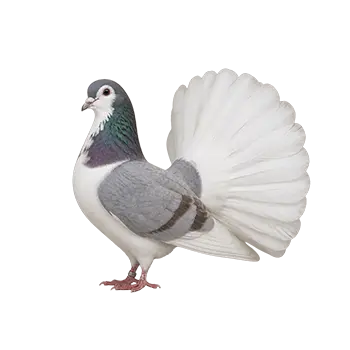
In contemporary fine art, the Fantail continues to attract attention from painters, sculptors, and mixed-media artists drawn to its dramatic form. The breed's silhouette, with its upswept tail framing the body in an almost peacock-like display, offers rich possibilities for composition and symbolism. Modern artists working in realistic, impressionistic, and even abstract idioms have used the Fantail as a vehicle for exploring themes of beauty, domestication, and the human impulse to reshape nature according to aesthetic ideals.

Literature & Poetry

Pigeons and doves have occupied a prominent place in world literature for millennia, and the Fantail, as one of the most visually recognizable pigeon breeds, has earned its own share of literary attention. In classical Indian literature, references to ornamental pigeons kept in palace gardens and temple grounds are woven into narrative poetry, devotional texts, and courtly prose. While these references seldom name specific breeds by modern standards, descriptions of pigeons with elaborate tail displays almost certainly point to ancestors of the modern Fantail, placing the breed at the edges of some of the oldest literary traditions in the world.

In English-language literature, the Fantail appears most prominently in the writings of pigeon fanciers and natural historians from the 18th century onward. Charles Darwin's detailed treatment of the breed in The Variation of Animals and Plants Under Domestication is perhaps the most influential literary engagement with the Fantail, transforming a hobbyist's bird into a cornerstone of evolutionary theory. Darwin's prose descriptions of the Fantail's physical characteristics, behavioral quirks, and breeding history brought the breed to the attention of readers who might never have visited a pigeon loft, embedding it permanently in the literature of science.

Poets and essayists have drawn on the pigeon's broader symbolism, with the Fantail occasionally serving as a specific point of reference for themes of vanity, display, and the tension between nature and artifice. The breed's exaggerated tail, so far removed from the modest plumage of its wild ancestor, invites reflection on the human desire to craft beauty from living material. In some works, the Fantail functions as a gentle satire of human preoccupation with appearance; in others, it serves as an emblem of the creative possibilities inherent in the partnership between breeder and bird.

Children's literature and educational books about animals have also featured the Fantail, often using its distinctive appearance as an entry point for discussions about animal breeding, genetics, and the diversity of domestic species. The breed's approachable character and unmistakable form make it an effective illustration for young readers encountering the concepts of selective breeding and variation for the first time, continuing a pedagogical tradition that traces back to Darwin's own use of the Fantail as a teaching example.

Photography & Visual Media

The Fantail Pigeon's photogenic qualities have made it a perennial favorite among animal photographers and visual media producers. From the earliest days of photography in the mid-19th century, when pigeon fanciers began commissioning portraits of their champion birds, the Fantail's dramatic tail display and poised stance have translated exceptionally well to the camera. Early black-and-white photographs of exhibition Fantails, often posed on pedestals against plain backdrops, established a visual convention that persists in modern show photography, emphasizing the clean lines and symmetry of the breed's form.

The advent of color photography and later digital imaging expanded the visual possibilities for capturing the Fantail's appeal. The breed's wide range of plumage colors, from pure white through blues, blacks, reds, and intricate patterned varieties, provides photographers with a rich palette, while the fan-shaped tail offers a naturally striking compositional element. Professional animal photographers and dedicated hobbyists alike have produced portfolios of Fantail images that circulate through breed publications, photography competitions, and online galleries, contributing to the breed's visibility far beyond the pigeon fancy itself.

In stock photography and commercial visual media, the white Fantail Pigeon has become something of a visual shorthand for the concept of the dove or pigeon in general. When advertisers, publishers, or web designers need an image conveying peace, celebration, or natural beauty, a white Fantail is frequently the bird selected, its ornate tail lending a sense of elegance that a common rock dove might not convey. This commercial usage has made the Fantail one of the most widely reproduced pigeon breeds in the visual media landscape, even if viewers do not always recognize it by name.

Documentary and educational video producers have also turned to the Fantail as a subject. Nature programs and online video channels covering domesticated animals, genetic diversity, or the science of selective breeding regularly feature the Fantail as a case study, using close-up footage of the tail display and comparative shots with wild rock doves to illustrate the transformative power of human-directed breeding. These visual narratives extend the breed's reach into classrooms, living rooms, and mobile screens around the world.

Film, Television & Stage

While pigeons as a group appear frequently in film and television, the Fantail's specific role in screen media is shaped by its distinctive appearance and its cultural associations with ceremony and beauty. White Fantails have been used as live props in wedding scenes, period dramas, and fantasy sequences, where their fanned tails and graceful flight add visual poetry to key moments. Directors and production designers seeking a more refined or symbolic avian presence often select Fantails over common pigeons, recognizing that the breed's silhouette reads as more deliberate and visually intentional on screen.

In period films and television series set in eras when pigeon keeping was a widespread aristocratic and middle-class pursuit, Fantails may appear as part of the background detail that establishes setting and social milieu. Productions depicting Victorian England, Mughal India, or Ottoman court life have occasionally included Fantails in garden and courtyard scenes, lending historical texture and visual authenticity to the mise-en-scene. While these appearances are typically brief, they reflect the breed's genuine historical presence in the cultures being depicted.

Animated productions and illustrated media have also drawn on the Fantail's form. The breed's exaggerated tail and compact body lend themselves well to stylized and caricatured depictions, and animated pigeons with fan-shaped tails have appeared in children's programming, short films, and advertisements. The visual clarity of the Fantail silhouette makes it easy to recognize even in simplified or abstracted renderings, giving animators and illustrators a distinctive avian character that audiences can identify at a glance.

On the theatrical stage, live doves and pigeons have a long tradition as props and effects, particularly in magic acts and ceremonial tableaux. Fantails, with their docile temperament and dramatic appearance, have been favored by stage magicians and theatrical producers who require birds that are visually impressive, trainable, and calm under the bright lights and noise of a live performance. This theatrical niche, while specialized, has contributed to the Fantail's broader public recognition and its association with spectacle and wonder.

Symbolism & Iconography in Design

The Fantail Pigeon's distinctive silhouette has transcended its role as a living bird to become a widely used motif in graphic design, branding, and decorative arts. The fan-shaped tail, rendered in profile or from behind, is instantly recognizable and carries associations with elegance, celebration, and peace that make it a versatile design element. Pigeon breed clubs, avicultural societies, and exhibition organizations frequently incorporate the Fantail silhouette into their logos and promotional materials, leveraging its visual impact to represent the pigeon fancy as a whole.

In broader commercial and institutional design, the Fantail form appears on everything from wedding invitations and event programs to architectural ornaments and garden statuary. The white Fantail in particular has become closely linked with the iconography of weddings and memorial services, where its image is used alongside other symbols of love and remembrance. Greeting card companies, stationery designers, and event planners routinely draw on the Fantail's form to evoke a sense of occasion and refinement that a generic bird shape would not achieve.

The breed has also found a place in the visual language of peace and diplomacy. While the abstract dove of peace, often rendered with an olive branch, is the most universally recognized avian peace symbol, real-world representations of peace doves frequently take the form of Fantails, whose fanned tails add visual weight and specificity to the symbol. Public monuments, commemorative stamps, and institutional publications have all employed Fantail imagery in this context, blurring the line between the specific breed and the broader symbolic tradition of the dove.

Digital design and social media have extended the Fantail's iconographic reach still further. Emoji, vector illustration libraries, and icon sets commonly include stylized pigeon or dove images that borrow heavily from the Fantail's proportions, even when they are not labeled as such. The breed's influence on how the general public visualizes the concept of a pigeon or dove is thus both pervasive and largely invisible, shaping popular imagination in ways that most people never consciously recognize.

The Digital Age & Online Community

The rise of the internet and social media has transformed the Fantail Pigeon's presence in popular culture, connecting breeders, admirers, and casual viewers across geographic and linguistic boundaries. Online forums dedicated to the pigeon fancy, many of which have been active since the early days of the web, provide spaces for Fantail enthusiasts to share breeding advice, post photographs of their birds, and discuss the finer points of breed standards with a global audience. These communities have democratized access to expertise that was once available only through local clubs and printed periodicals.

Social media platforms have amplified the Fantail's visual appeal to audiences far beyond the traditional pigeon fancy. Accounts dedicated to ornamental pigeons regularly attract followers numbering in the tens of thousands, and viral images and videos of Fantails displaying their tails have introduced the breed to viewers who may have had no prior awareness of fancy pigeons as a hobby. The shareable nature of visual content on these platforms has made the Fantail an ambassador of sorts for the broader pigeon-keeping community, sparking curiosity and conversation about domestic pigeon diversity.

Video-sharing platforms have proven especially effective at showcasing the Fantail's appeal. Short-form videos of Fantails strutting, displaying, and interacting with their keepers accumulate significant view counts, and longer documentary-style content exploring the breed's history, care requirements, and exhibition culture has found a dedicated audience among animal enthusiasts and hobbyists. The ability to see the Fantail's tail display in motion, rather than in a static photograph, adds a dimension of appreciation that still images cannot fully convey.

Online marketplaces and classified platforms have also changed the landscape of Fantail acquisition and exchange. Breeders can now advertise available birds to a national or international audience, and prospective buyers can research bloodlines, view photographs, and communicate directly with sellers before committing to a purchase. While this expanded marketplace has broadened access to quality breeding stock, it has also raised questions about the ethics of shipping live birds over long distances and the reliability of online sales, issues that the Fantail community continues to navigate as digital commerce evolves.

Always consult a qualified professional before making any health-related decisions. This content is provided for informational reference only and should not replace professional guidance specific to your animal.