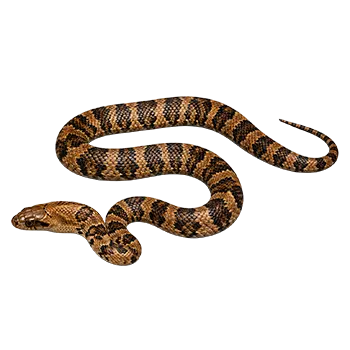

Enrichment for captive snakes is a concept that has gained significant traction in herpetological husbandry over the past two decades, driven by a growing body of research demonstrating that reptiles — far from the sensory-limited, instinct-driven automatons they were once assumed to be — are cognitively engaged animals that benefit measurably from environmental complexity and novelty. The False Water Cobra is among the best candidates for enrichment programming in the snake world because of its high activity level, pronounced exploratory drive, and evident responsiveness to changes in its surroundings. Keepers who invest in enrichment for this species consistently report more natural behavioral repertoires, reduced stress indicators, better feeding responses, and improved overall condition compared to animals maintained in minimally furnished enclosures.
The concept of enrichment for snakes differs fundamentally from enrichment for mammals or birds. Snakes do not play with objects in the way a dog fetches a ball or a parrot manipulates a puzzle toy. Instead, snake enrichment focuses on environmental complexity — providing a habitat that encourages the animal to make choices, explore spatial configurations, and engage its sensory systems in ways that approximate the challenges and stimuli of its natural environment. For the False Water Cobra, this means creating an enclosure that offers varied terrain, multiple microhabitats, aquatic access, novel scent opportunities, and physical structures that the snake must navigate actively rather than passively occupying.
The behavioral indicators that distinguish an enriched False Water Cobra from an under-stimulated one are readily observable. A well-enriched animal explores its enclosure regularly, utilizes multiple hide options and resting locations throughout the day, engages with its water feature, tongue-flicks actively while investigating new or rearranged items, and maintains a healthy feeding response. An under-enriched animal, by contrast, tends to select a single resting spot and remain there for extended periods, may develop repetitive behaviors such as nose-rubbing along the enclosure walls or glass-surfing along transparent panels, and may show diminished interest in food despite being in good physical health. These behavioral differences are not trivial — they reflect the animal's psychological state and correlate with measurable differences in stress hormone levels.
It is important to note that enrichment must be implemented thoughtfully and incrementally, particularly with newly acquired animals or individuals with unknown histories. Introducing too many novel elements at once can overwhelm a snake that is still acclimating to its environment, producing the opposite of the intended effect. Starting with a well-designed baseline habitat that includes the essential structural elements — appropriate hides, a water feature, varied substrate depth, and temperature gradients — and then layering in additional enrichment items over subsequent weeks allows the keeper to observe how the individual animal responds and adjust accordingly.