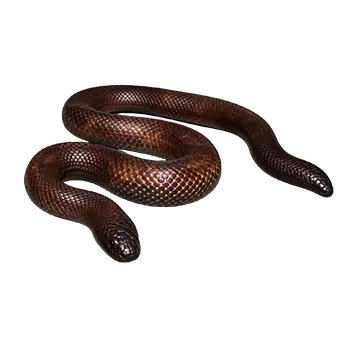

Enrichment for the Calabar Python demands a fundamentally different approach than what most snake keepers are accustomed to providing. The conventional enrichment strategies designed for semi-arboreal or actively foraging snake species — climbing branches, dangling vines, elevated platforms — hold little relevance for an animal that spends upward of ninety percent of its life underground. Calabaria reinhardtii is a specialist burrower native to the forest floors of West and Central Africa, where it navigates a three-dimensional world of root tangles, decomposing leaf litter, and loose tropical soil. Meaningful enrichment for this species must engage the snake within and through its substrate, not above it.
The misconception that snakes do not benefit from enrichment at all has been steadily eroded by behavioral research over the past two decades. Studies across multiple snake species have demonstrated that environmental complexity, novelty, and the opportunity to perform species-typical behaviors such as burrowing, exploring, and hunting contribute to reduced stress, improved immune function, and more consistent feeding responses. For the Calabar Python, a bare enclosure with a single hide and shallow substrate represents a profoundly impoverished environment compared to the intricate subterranean landscape it has evolved to navigate. Enrichment is not a luxury for this species — it is a core component of responsible husbandry.
The key to effective enrichment for the Calabar Python lies in understanding what constitutes a stimulating environment from the snake's sensory perspective. This species relies primarily on chemoreception and tactile feedback rather than vision. Its reinforced, blunt head is built for pushing through substrate, and its body is covered in smooth, tightly overlapping scales that provide constant sensory input about the texture, moisture, and density of the material it moves through. Enrichment strategies that manipulate substrate composition, introduce novel textures and scents, and create a varied subsurface architecture are far more meaningful to this animal than any visually elaborate decoration placed on the enclosure surface.
It is also important to recognize that the Calabar Python's definition of engagement looks nothing like that of a more active species. A Ball Python exploring a new branch or a Corn Snake climbing the enclosure walls provides visible evidence of enrichment engagement. A Calabar Python interacting with a new tunnel structure or investigating a scent trail does so entirely out of sight, beneath several inches of substrate. Keepers must accept that the evidence of enrichment success in this species is indirect — consistent feeding responses, clean sheds, occasional surface exploration, and the absence of stress behaviors such as glass surfing or prolonged refusal to burrow.