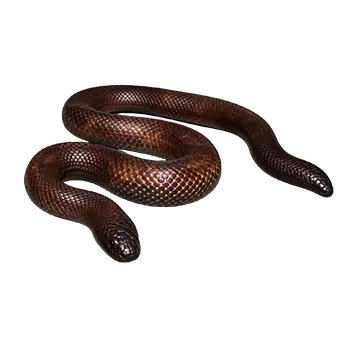

The Calabar Python's housing requirements are shaped fundamentally by its fossorial nature. Calabaria reinhardtii spends the vast majority of its life below ground or wedged into tight spaces beneath logs and leaf litter on the tropical forest floor of West and Central Africa. This behavioral profile means that floor space and substrate depth matter far more than vertical climbing area. A standard glass terrarium, a front-opening reptile enclosure, or a well-ventilated plastic tub system can all serve as suitable housing, but the enclosure must prioritize horizontal area and accommodate at least four to six inches of substrate depth to allow the snake to engage in its natural burrowing behavior.
For a single adult Calabar Python, an enclosure with a footprint of approximately thirty-six inches long by eighteen inches wide provides ample room for thermoregulation, exploration, and burrowing. Larger enclosures are welcome and can support a more naturalistic setup with varied substrate depths and multiple microhabitats, but going smaller than these minimum dimensions restricts the keeper's ability to establish a proper thermal gradient and limits the snake's behavioral repertoire. Neonates and juveniles can be started in smaller setups — a ten- to fifteen-gallon terrarium or an appropriately sized plastic tub — and graduated to adult-sized housing as they grow.
Front-opening enclosures offer significant practical advantages for Calabar Python keepers. Because this species spends most of its time buried, accessing the snake from above can be disruptive and stressful, requiring the keeper to dig through substrate to locate the animal. A front-opening door allows for water dish maintenance, spot cleaning, and visual checks without disturbing the substrate layer from the top. Glass terrariums with front-opening doors also retain humidity more effectively than screen-topped aquariums, which is a critical consideration for a species that requires consistently elevated moisture levels.
Plastic tub systems, commonly used by breeders and keepers with multiple reptiles, are another excellent housing option. Tubs naturally retain heat and humidity better than glass enclosures, they are lightweight, easy to clean, and inexpensive to replace. The main drawback is reduced visibility, which matters to keepers who want to observe their snake's above-ground activity. For this species, however, above-ground activity is infrequent enough that the practical benefits of tub housing often outweigh the aesthetic limitations. Ventilation holes must be adequate to prevent stagnant air and the mold growth that accompanies it, but not so numerous or large that they undermine humidity retention.