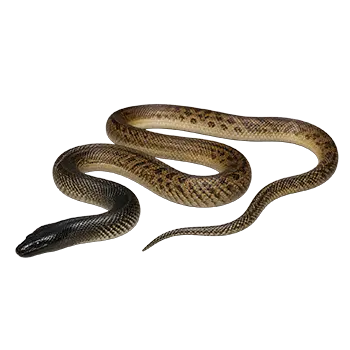

Black-Headed Pythons are moderately large, ground-dwelling snakes that require enclosures emphasizing floor space over height. An adult specimen of five to eight feet in length needs an enclosure with a footprint that allows it to stretch out along at least one dimension and thermoregulate effectively by moving between warm and cool zones. As a general guideline, an enclosure measuring at least six feet long by two feet deep is appropriate for most adults, though larger is always better when space permits.
Hatchlings and juveniles should not be placed directly into a full-sized adult enclosure. A smaller setup — such as a tub or tank in the range of ten to twenty gallons — provides a sense of security and makes it easier for the young snake to find its food and water. Overly large enclosures can stress small snakes, leading to refusal to feed and difficulty maintaining proper environmental gradients. As the snake grows, it can be gradually transitioned into larger enclosures.
The enclosure must provide a clear thermal gradient, with a warm basking zone at one end and a cooler retreat at the other. This requires enough linear distance that the temperature differential is meaningful — cramped enclosures make it nearly impossible to establish distinct microclimates. When evaluating products, prioritize enclosures that offer sufficient length and depth rather than those that are tall and narrow, which are better suited to arboreal species.
Ventilation is another critical factor influenced by enclosure dimensions. Black-Headed Pythons come from regions with relatively low humidity, and stagnant, overly humid air in a poorly ventilated enclosure can lead to respiratory infections and skin conditions. Ensure that whatever housing you choose has adequate airflow without creating drafts that could destabilize temperatures.