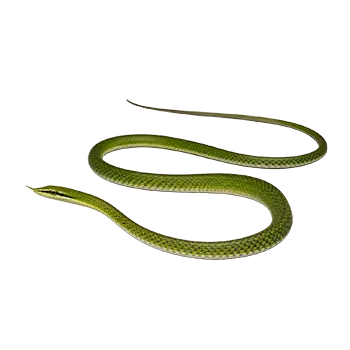

Accurate temperature monitoring is the foundation of environmental management for the Asian Vine Snake, and the monitoring system must account for the vertical thermal stratification that characterizes tall arboreal enclosures. Heat rises, and in an enclosure that is taller than it is wide, the temperature difference between the substrate level and the top of the enclosure can exceed ten degrees Fahrenheit — a gradient that would be negligible in a low-profile terrestrial setup but represents the full usable range of the vine snake's thermoregulatory behavior. A single thermometer placed at one point in the enclosure provides a dangerously incomplete picture of the thermal environment the snake actually experiences.
Digital thermometers with remote probe sensors are the minimum acceptable monitoring tool for this species. A setup with two probes — one positioned at the basking perch on the warm side and one at a mid-height perch on the cool side — provides the two most critical data points for assessing whether the thermal gradient is within the target range of eighty-five to eighty-eight degrees at the basking point and seventy-five to eighty degrees at the cool zone. Wireless probe systems that transmit readings to a display unit mounted outside the enclosure eliminate the need to open enclosure doors for visual checks and reduce disturbance to the snake during routine monitoring.
Infrared temperature guns offer a supplemental monitoring capability that complements probe-based systems by providing instant surface temperature readings at any point in the enclosure. A quick scan with an infrared gun across branch surfaces, background panels, and glass walls reveals the actual contact temperatures the snake encounters as it moves through the enclosure — data that air-temperature probes cannot capture. Surface temperatures often differ significantly from ambient air temperatures, particularly on branches directly below or adjacent to heat sources, and an infrared reading can identify localized hot spots that a probe positioned even a few inches away would miss entirely.
Data-logging thermometers represent the most sophisticated monitoring option and provide information that real-time displays cannot. These devices record temperature readings at configurable intervals — typically every one to fifteen minutes — and store them in onboard memory or transmit them to a connected smartphone application. Reviewing logged data reveals temperature trends over twenty-four-hour cycles, identifies overnight temperature drops that may exceed safe minimums, and documents the thermal impact of room heating and cooling systems that cycle on and off throughout the day. For a species with narrow thermal tolerances and no tolerance for sustained temperature extremes, the historical perspective that a data logger provides is invaluable for detecting problems before they become crises.
Probe placement and maintenance are details that significantly affect the accuracy and usefulness of any monitoring system. Probes should be secured to perch surfaces with small cable clips or silicone adhesive — dangling probes read air temperature rather than the branch-surface temperature the snake contacts, and they can be displaced by the snake's movement through the enclosure. Probes should be checked monthly against a known-accurate reference thermometer, as sensor drift over time can introduce errors of two to three degrees that accumulate unnoticed and result in the keeper maintaining temperatures outside the target range while the display shows apparently correct readings.