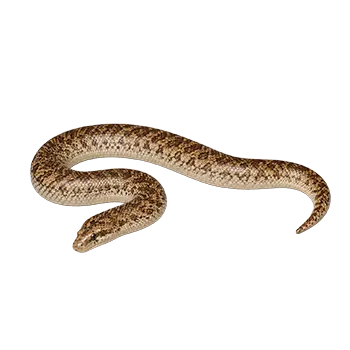

Enrichment for snakes has historically received less attention than enrichment for mammals or birds, but modern herpetological care recognizes that even small, sedentary species like the Arabian Sand Boa benefit significantly from environmental complexity and behavioral stimulation. Enrichment is not about teaching tricks or providing objects the snake plays with in the way a dog interacts with a ball. Instead, reptile enrichment focuses on creating conditions that allow the animal to express its full repertoire of natural behaviors — burrowing, exploring, ambush-hunting, thermoregulating, and choosing between multiple microhabitats.
For a fossorial species like the Arabian Sand Boa, the concept of enrichment is inseparable from habitat design. A bare tank with a thin layer of substrate and a single hide is a sensory desert that offers the snake almost no behavioral choices. By contrast, a thoughtfully designed enclosure with deep substrate, varied terrain, multiple hide options, and periodic changes in layout gives the snake a cognitively richer life that more closely approximates the decision-making complexity of its wild existence. Studies on captive reptile welfare consistently show that animals in enriched environments display lower stress hormone levels, more natural behavior patterns, and better overall health.
The Arabian Sand Boa's enrichment needs are defined by its ecology. This is a species that spends virtually all of its time beneath the sand surface, navigating a three-dimensional underground world by feel and chemical sense. Enrichment strategies should target these subterranean behaviors rather than attempting to impose terrestrial or arboreal activity patterns that are irrelevant to the species. The most effective enrichment for this snake happens below the substrate line, in the substrate itself, and at the interface between substrate and surface.
Keepers should approach enrichment as an ongoing practice rather than a one-time setup. A static environment, no matter how well designed initially, becomes predictable and cognitively flat over time. Periodic changes to the layout, substrate texture, and obstacle placement refresh the snake's environment and prompt renewed exploration — the underground equivalent of an animal encountering new territory.