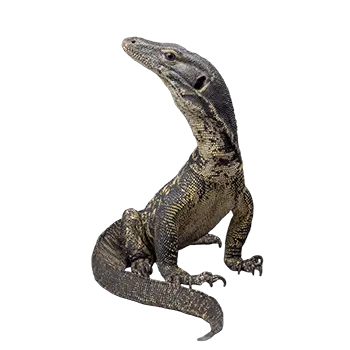

Asian Water Monitors are among the most cognitively advanced reptiles in private keeping, possessing problem-solving capabilities, spatial memory, and behavioral flexibility that place them closer to mammalian intelligence benchmarks than to the stereotypical image of a passive, instinct-driven lizard. In the wild, this intelligence is exercised constantly through navigating complex riparian habitats, locating and capturing diverse prey, avoiding predators, and negotiating social hierarchies with other monitors. A captive environment that provides only food, water, heat, and shelter meets the animal's physiological needs while leaving its cognitive and behavioral needs almost entirely unaddressed.
The consequences of chronic under-stimulation in intelligent reptiles are well documented. Stereotypic behaviors such as repetitive pacing along enclosure walls, glass surfing, excessive digging in the same corner, and self-directed aggression including tail-biting are all indicators of an animal whose behavioral repertoire has been compressed into a handful of displacement activities. These behaviors are not quirks or personality traits; they are welfare failures that signal the animal is unable to express natural behaviors in its current environment.
Enrichment is the systematic practice of introducing stimuli that encourage species-typical behavior, and for water monitors it spans physical, sensory, feeding, and cognitive categories. Effective enrichment does not require expensive equipment or constant keeper intervention. It requires understanding what the animal would be doing in the wild and finding ways to approximate those activities within the constraints of captivity. A monitor that spends its day foraging, exploring novel objects, navigating climbing structures, and interacting with water features is a monitor whose intelligence is engaged rather than wasted.
The return on enrichment investment extends beyond welfare. Enriched monitors are calmer during handling, more predictable in their behavior, and less prone to the defensive aggression that often develops in under-stimulated large monitors. They maintain healthier body condition because physical activity is built into their daily routine rather than absent from it. For a species that can live twenty-five years in captivity, the difference between an enriched life and a barren one compounds over decades.