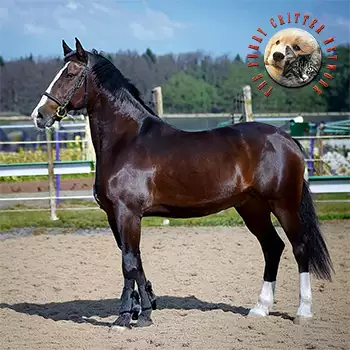

Play Style & Mental Needs

The Swedish Warmblood is an intelligent, curious breed that was selectively developed for trainability and responsiveness. These same cognitive traits that make them exceptional partners in the dressage arena or over a show jumping course also mean they are prone to boredom when their minds are not adequately engaged. A bored Swedish Warmblood does not simply stand quietly — it invents its own entertainment, which frequently manifests as stall vices such as cribbing, weaving, wood chewing, or pawing. Understanding your horse's play style and mental needs is the first step in selecting enrichment strategies that actually work.

Horses are naturally designed to spend 16 to 18 hours per day foraging, walking, and engaging in social interactions with herd mates. The modern management of sport horses — stall confinement for much of the day, controlled feeding schedules, and limited turnout — compresses these natural behaviors into a fraction of the time the horse's brain expects to spend on them. Enrichment products and strategies are not luxuries; they are compensatory tools that help fill the behavioral and cognitive void created by domesticated management practices.

Swedish Warmbloods tend to be mouthy, investigative horses that enjoy manipulating objects with their lips and teeth. They are also generally bold enough to approach novel items without excessive fear, which makes them good candidates for a wide range of enrichment devices. Observing your individual horse's response to different types of stimulation — does it prefer pushing and rolling objects, or does it enjoy quieter problem-solving like extracting treats from a dispenser? — allows you to tailor your enrichment program to what genuinely engages that specific horse rather than relying on a one-size-fits-all approach.

Rotation is a key principle in any enrichment program. Just as a puzzle that has already been solved holds little interest for a person, a toy that remains in the same spot in the stall day after day eventually becomes invisible to the horse. Maintaining a rotation of four to six different enrichment items and swapping them in and out on a weekly basis keeps each item feeling relatively novel and maintains the horse's engagement over time.

Treat-Dispensing & Puzzle Toys

Treat-dispensing toys are among the most effective enrichment tools for horses because they tap directly into the foraging instinct. These products require the horse to manipulate an object — rolling it, pushing it, flipping it, or working a mechanism — to release small amounts of feed or treats. The process of working for food extends the time the horse spends engaged in feeding behavior, which is precisely the type of time-filling activity that prevents boredom-driven vices.

Large treat balls designed for equine use are the most common entry point into this category. These are heavy-duty spheres, typically 10 to 15 inches in diameter, with adjustable openings that release pellets or small treats as the horse pushes the ball around the stall or paddock. The difficulty can be adjusted by changing the size of the opening — a larger opening releases treats easily for a horse new to the concept, while a smaller opening provides a more sustained challenge for an experienced problem-solver. Look for balls made from durable, non-toxic polyethylene that can withstand being stepped on by a 1,200-pound animal.

Wall-mounted puzzle feeders offer an alternative for horses that tend to lose interest in ground-level toys or for stall environments where a rolling ball might get trapped in corners. These devices typically feature sliding panels, rotating discs, or hinged compartments that the horse must figure out how to open. They provide cognitive stimulation that is qualitatively different from simply pushing a ball — the horse must remember the specific manipulation required and execute it with the precision of its lips and muzzle, which engages different neural pathways than brute-force rolling.

Slow-feed hay nets and bags, while primarily a nutritional management tool, also function as enrichment by extending the time the horse spends eating. A tightly woven small-hole hay net can stretch a flake of hay that would be consumed in 30 minutes of free feeding into two or more hours of engaged nibbling. For Swedish Warmbloods that spend significant time in stalls between training sessions, a combination of a slow-feed hay net for baseline foraging engagement and a treat-dispensing toy for active problem-solving creates a layered enrichment approach.

Stall & Stable Toys

Stall toys designed specifically for horses are built to withstand the unique combination of forces that equine play involves — powerful jaw pressure, sharp incisors, heavy hooves, and the general mass of a thousand-pound animal leaning, pushing, or stepping on the object. Products designed for other species, no matter how durable they appear, are rarely appropriate for horse stalls. Dog toys, children's toys, and general sporting goods can break into sharp fragments, present choking hazards, or contain materials that are toxic if ingested.

Hanging stall toys are a popular category because they remain at an accessible height, cannot be lost under bedding, and provide a satisfying swinging motion when the horse nudges them. These range from simple rubber or apple-scented balls on a snap clip to more elaborate designs with multiple dangling elements. The swinging motion provides visual and tactile stimulation, and many horses develop a habit of pushing the toy during idle moments in the stall. Position hanging toys at approximately chest height for your horse — high enough that it cannot get a leg over the attachment rope, and low enough to be easily reached without straining.

Textured lick-and-chew blocks represent a different modality of stall enrichment. Unlike treat dispensers that require problem-solving, lick blocks provide a simple, repetitive activity that satisfies the horse's oral fixation needs. Salt blocks and mineral blocks serve this purpose while also contributing to the horse's nutritional intake. Flavored lick blocks in apple, molasses, or peppermint varieties add palatability without significant caloric contribution and can keep a horse engaged for extended periods.

Mirrors installed in stalls have shown promising results in research studies as a means of reducing stress behaviors in isolated horses. The horse perceives its reflection as a companion, which can decrease weaving, calling, and other signs of social distress. However, mirrors must be installed with safety as the primary consideration — using polished stainless steel or acrylic mirror panels rather than glass, securely mounted flush against the wall with no edges or gaps the horse could catch a lip or tooth on.

Paddock & Outdoor Enrichment

Outdoor enrichment takes advantage of the larger space available in paddocks and pastures to offer activities that would not be practical or safe inside a stall. Large equine play balls — heavy-duty spheres 25 to 42 inches in diameter — are designed for paddock use and allow the horse to push, chase, and kick the ball across open ground. These mega balls satisfy the horse's desire for physical play in a way that stall toys cannot, and many horses develop a genuine enthusiasm for pushing them at speed. Choose a ball size appropriate for your horse — it should be large enough that the horse cannot bite it and too large to get a leg over.

Traffic cones, barrels, and other ground-level obstacles placed in the turnout area create an interactive landscape that encourages exploration and movement. Simply rearranging the placement of these objects every few days changes the horse's environment enough to stimulate curiosity. Some Swedish Warmbloods will voluntarily navigate around, between, and over low obstacles out of pure investigative interest, which has the added benefit of building confidence and body awareness that translates to better performance under saddle.

Paddock track systems, sometimes called equine track or Paddock Paradise setups, represent a more comprehensive approach to outdoor enrichment. These systems use fencing to create a track around the perimeter of the turnout area rather than allowing access to the full interior. Multiple enrichment stations — hay stations, water points, scratching posts, varied footing surfaces — are placed at intervals around the track, encouraging the horse to move continuously between them. This mimics the natural movement patterns of wild equines and can dramatically increase daily step counts compared to traditional rectangular paddock turnout.

Natural enrichment features should not be overlooked. Safe trees or large shrubs provide shade, wind protection, and sensory stimulation through leaves, bark, and branches. Varied terrain including gentle hills, different ground surfaces, and shallow water crossings offers both physical conditioning and environmental complexity. Even something as simple as a sturdy log placed in the paddock gives horses something to investigate, step over, and rub against.

Social Enrichment & Companions

No manufactured toy can fully replicate the enrichment value of social interaction with other equines. Horses are deeply social herd animals, and the Swedish Warmblood's willing, gregarious temperament makes social contact particularly important for this breed's psychological welfare. Whenever possible, housing and turnout arrangements should allow for direct physical contact with at least one compatible companion. Mutual grooming, play, shared grazing, and simple proximity to another horse fulfill social needs that no amount of stall toys or puzzles can address.

For facilities where direct turnout with other horses is not possible due to injury risk, limited space, or incompatible herd dynamics, shared fence lines that allow nose-to-nose contact provide a meaningful compromise. Stall designs with grille or mesh partitions between neighboring horses allow ongoing visual and limited tactile interaction throughout the stall confinement period. Even the simple ability to see other horses in the barn aisle or across a paddock contributes to the horse's sense of social security.

Companion animals from other species can provide supplemental social enrichment, particularly for horses that must be housed individually. Goats are the most traditional equine companion species — they are hardy, social, and generally safe around horses. Miniature horses and donkeys can also serve as companions, though introductions should be supervised and the size disparity between a full-sized Swedish Warmblood and a miniature equine should be considered when designing shared housing. Some horses also form bonds with barn cats, chickens, or other animals that share their environment.

Structured social enrichment also includes the human-horse relationship. Grooming sessions that go beyond functional maintenance — spending time on scratching itchy spots, gentle massage, and relaxed handling — serve as bonding and enrichment activities. Ground work, liberty training, and hand-walking on varied routes all provide cognitive stimulation through the social channel. A Swedish Warmblood that receives thoughtful, varied interaction from its human handlers is a more content and mentally balanced horse than one whose human contact is limited to tacking up and riding.

DIY & Budget Enrichment

Effective enrichment does not require expensive commercial products. Many of the most engaging enrichment items for horses can be assembled from inexpensive or repurposed materials with minimal effort. The key principles are safety — no sharp edges, no small parts that could be swallowed, no toxic materials — and durability sufficient to withstand equine strength. A little creativity combined with an understanding of what motivates your horse can produce enrichment solutions that rival or exceed the engagement value of commercial products.

A simple treat-dispensing toy can be made from a large, heavy-duty plastic jug with holes drilled in the sides. Fill the jug with a small amount of pellets or chopped carrots, replace the cap securely, and place it in the stall or paddock. The horse rolls and pushes the jug to release the food inside. The cost is essentially zero, the construction takes minutes, and the concept is identical to commercial treat balls. Replace the jug when it shows signs of cracking or when the horse has chewed the openings too large for the treats to remain inside.

Frozen treat blocks offer a seasonal enrichment option that is particularly welcome during hot weather. Fill a bucket with water, add apple slices, carrot chunks, and a small amount of apple juice or peppermint extract for flavor, then freeze overnight. The resulting ice block can be placed in a feed tub in the stall or paddock, and the horse will spend extended time licking and nibbling at the block to access the embedded treats. This provides both enrichment and a modest cooling benefit on warm days.

Variety in routine is itself a form of enrichment that costs nothing. Changing the order of daily activities, introducing new walking routes to and from turnout, varying the location of hay placement in the stall, or simply spending an extra ten minutes hand-grazing in a different area of the property all contribute to environmental novelty. Horses notice and respond to changes in their routine and surroundings, and these small variations accumulate into a meaningfully richer daily experience. For the intelligent Swedish Warmblood, a life of total predictability is a life of tedium — small surprises and variations keep the mind engaged and the temperament even.

Always consult a qualified professional before making any health-related decisions. This content is provided for informational reference only and should not replace professional guidance specific to your animal.