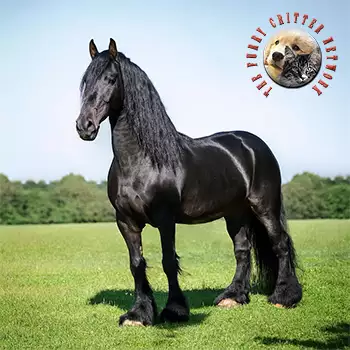

Play Style & Mental Engagement

Friesians are intelligent, curious horses with a gentle disposition that lends itself well to interactive play and problem-solving. Unlike some hot-blooded breeds that channel excess energy into flight responses, Friesians tend to express boredom through more methodical behaviors — pawing, cribbing, weaving, or systematically disassembling anything within reach of their lips. Enrichment for this breed should target their investigative nature rather than simply burning off physical energy.

The breed's trainability is actually a clue to what kind of enrichment works best. Friesians enjoy tasks with clear cause-and-effect relationships — push this, get a treat; roll that, find food inside. They respond well to novelty but are rarely spooked by new objects the way more reactive breeds might be, which means you can introduce new toys and environmental changes without extensive desensitization.

Stall-kept Friesians have the highest enrichment needs. A horse that spends twelve or more hours per day confined to a twelve-by-twelve space with nothing but hay and water is a horse that will find ways to entertain itself, and those self-directed activities are rarely constructive. Strategic enrichment reduces stereotypic behaviors, lowers stress hormones, and creates a calmer, more focused horse during training and handling sessions.

Enrichment should be thought of as a daily requirement rather than an occasional luxury. Just as you would not skip feeding or turnout, mental stimulation deserves a regular place in the management routine. Rotating toys and activities on a weekly basis prevents habituation and keeps the Friesian engaged over the long term.

Treat-Dispensing & Puzzle Toys

Treat-dispensing toys are among the most effective enrichment tools for stall-bound Friesians. These products typically require the horse to manipulate an object — rolling, tipping, or pressing — to release small amounts of feed or treats. The foraging behavior this mimics is deeply satisfying for horses, whose digestive systems and behavioral drives evolved around near-constant grazing.

Ball-style dispensers that roll across the stall floor work well for Friesians, though the ball must be appropriately sized. Products designed for horses should be at least ten inches in diameter to prevent the horse from picking them up in its mouth and potentially choking. The ball should be heavy enough to resist being flung but light enough that the horse can nudge it with its muzzle or hoof.

Wall-mounted puzzle feeders add vertical engagement to the stall environment. These devices require the horse to slide panels, press levers, or rotate discs to access compartments containing feed. They are particularly useful for horses that tend to paw at floor-level toys, as the wall-mounted position redirects energy upward and engages different muscle groups.

When filling treat dispensers, choose low-sugar options — hay cubes, a small amount of pelleted feed, or commercial low-calorie treats. The Friesian's metabolic efficiency means that enrichment feeding still counts toward daily caloric intake. If you are using multiple dispensers throughout the day, reduce the concentrate portion of regular meals accordingly to prevent inadvertent overfeeding.

Durable Stall Toys

Not all stall toys involve food. Many Friesians enjoy manipulating objects simply for the sensory feedback they provide. Hanging toys — rubber or plastic shapes suspended from a chain or rope at chest height — give the horse something to nudge, bite, and swing. The movement and noise provide ongoing stimulation, and the suspended design keeps the toy off the bedding where it would quickly become soiled.

Rubber toys designed for horses need to withstand significant bite force. Friesians are not typically destructive chewers, but any horse can fragment a poorly made rubber product, and ingested rubber pieces can cause intestinal blockages. Look for toys made from solid, non-toxic rubber that is rated for equine use rather than repurposed dog toys or general-purpose rubber balls, which may not withstand a horse's jaw pressure.

Traffic cones, large rubber buckets, and heavy-duty jolly balls serve as simple, inexpensive enrichment options for both stall and paddock use. The Friesian's inquisitive personality means many will pick up, carry, or toss these objects voluntarily. Supervision during initial introduction is wise to ensure the horse does not become entangled or startled, but most Friesians adapt quickly.

Mirrors mounted in stalls have gained popularity as enrichment tools and can be particularly effective for Friesians housed individually. Research has shown that stall mirrors reduce weaving and other stereotypic behaviors by providing the visual stimulus of apparent equine company. Use acrylic or polished metal mirrors rather than glass, and mount them securely at the horse's eye level with no exposed edges.

Paddock & Outdoor Enrichment

Outdoor enrichment takes advantage of the Friesian's natural curiosity in a space where movement is unrestricted. Large, heavy-duty balls designed for horse play — typically twenty to forty inches in diameter and made from burst-resistant material — provide excellent paddock entertainment. Many Friesians will push, chase, and even attempt to mount these balls, making them a source of both mental and physical exercise.

Trail obstacles set up in a paddock or designated play area offer structured enrichment that doubles as training preparation. Platforms for stepping onto, pool noodle curtains to walk through, tarps to cross, and ground poles to navigate all engage the Friesian's problem-solving instincts while building confidence and body awareness. These obstacles are especially valuable for young horses being prepared for riding or driving careers.

Sandpits or designated rolling areas provide a natural behavior outlet that horses find deeply satisfying. A level area of clean sand, roughly ten by ten feet, gives Friesians a comfortable spot to roll without the injury risk of uneven or rocky ground. Rolling helps horses scratch itches, distribute skin oils, and simply express contentment — it is one of the clearest indicators of a relaxed, comfortable horse.

Environmental variety itself counts as enrichment. Changing the location of water troughs, placing hay in different areas of the paddock, or adding natural elements like large logs or boulders creates a more complex environment that encourages exploration. Even something as simple as relocating a ground pole every few days gives the Friesian a reason to investigate and reassess its surroundings.

Social Enrichment

No toy or puzzle replaces the enrichment value of equine companionship. Friesians are herd animals with strong social drives, and isolation is one of the most potent triggers for behavioral problems in this breed. Even horses that seem calm when kept alone often show measurable reductions in cortisol and heart rate when provided with a companion.

If a second horse is not feasible, companion animals from other species can partially fill the social gap. Goats, donkeys, and miniature horses are the most common equine companions, and many Friesians form genuine bonds with these animals. The companion should be calm, healthy, and comfortable around a large horse. Housing them in adjacent areas with a shared fence line allows interaction without the risk of accidental injury.

Mutual grooming — the behavior where two horses stand side by side and scratch each other's withers and necks with their teeth — is one of the most important social behaviors in the equine repertoire. It reduces stress, strengthens social bonds, and provides physical comfort. If your Friesian is housed with a compatible partner, you may notice favorite grooming spots developing, usually along the withers, crest, and rump.

Human interaction also qualifies as social enrichment, particularly for Friesians that have been raised with regular handling. Grooming sessions, in-hand walking, liberty work, and simply spending quiet time in the horse's presence all contribute to mental wellbeing. The Friesian's people-oriented temperament means most individuals actively seek out and enjoy human company rather than merely tolerating it.

DIY & Budget Options

Effective enrichment does not require expensive commercial products. Many of the best enrichment tools can be assembled from materials already on hand at most horse properties. A plastic milk jug with a few holes cut in the sides and a handful of hay cubes inside creates a perfectly functional treat dispenser. A knotted rope hung from a safe anchor point provides swinging, tugging stimulation. A cardboard box filled with hay encourages foraging behavior and can be replaced at no cost when destroyed.

Slow-feed hay nets serve double duty as both a feeding tool and an enrichment device. By extending the time it takes to consume a hay ration from thirty minutes to several hours, they mimic natural grazing patterns and provide ongoing oral and mental engagement. Nets with smaller openings increase the challenge, and hanging them at different heights or locations around the stall or paddock adds variety.

Frozen treats are a simple warm-weather enrichment idea. A bucket of water with apples, carrots, and hay cubes frozen into a block gives the Friesian a licking and nibbling project that can occupy a considerable amount of time while also providing hydration encouragement on hot days. Use a flexible bucket so the ice block can be easily removed and placed in a feed tub or directly on the ground.

Rotation is the key principle that makes any enrichment program sustainable on a budget. Even the most engaging toy loses its appeal after constant exposure. By maintaining a collection of six to eight items and rotating two or three into the environment every few days, each reintroduction feels novel. This approach costs nothing extra once the initial collection is assembled and keeps the Friesian consistently engaged without requiring a constant supply of new purchases.

Always consult a qualified professional before making any health-related decisions. This content is provided for informational reference only and should not replace professional guidance specific to your animal.