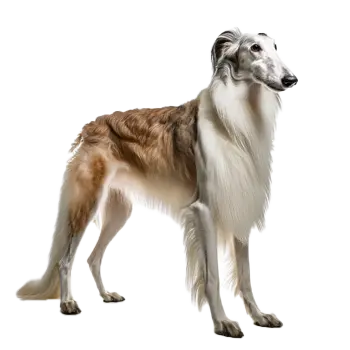

The Borzoi's distinctive anatomy — a long, narrow head tapering to a slender neck — makes collar selection one of the most important gear decisions for this breed. Standard flat collars sized by neck circumference alone can slip right over a Borzoi's head if the dog backs up or startles, because their skull is narrower than their neck. Martingale collars, which gently tighten when the dog pulls and loosen when tension is released, are the standard recommendation for sighthounds. They provide security without the constant pressure of a choke chain and cannot be backed out of when properly fitted.
Wide martingale collars — typically two to three inches across — distribute pressure across a larger area of the neck, which is both more comfortable and safer for a breed with a relatively delicate throat structure. Many sighthound specialty suppliers offer beautifully crafted wide martingales in a variety of materials and designs. The collar should be loose enough to be comfortable at rest but snug enough when tightened that it cannot pass over the widest part of the skull.
Harnesses can be useful for Borzoi that pull during walks, as they redirect pressure from the neck to the chest and shoulders. However, finding a harness that fits a Borzoi's deep, narrow chest is notoriously difficult. Most harnesses are designed for barrel-chested breeds and sit awkwardly on a sighthound's frame, chafing at the armpits or riding up behind the shoulders. Look for harnesses specifically designed for deep-chested or sighthound breeds, or consider adjustable models with multiple sizing points that can accommodate the Borzoi's unique proportions.
Leashes for Borzoi should be strong, comfortable in hand, and long enough to allow some freedom of movement without being so long that you lose control. A six-foot leather or biothane leash is a good standard choice. Retractable leashes are generally discouraged for sighthounds — a Borzoi that spots a squirrel can reach sprinting speed before you can engage the brake mechanism, and the thin cord can cause serious rope burns or snap under the sudden load of a 100-pound dog at full acceleration.