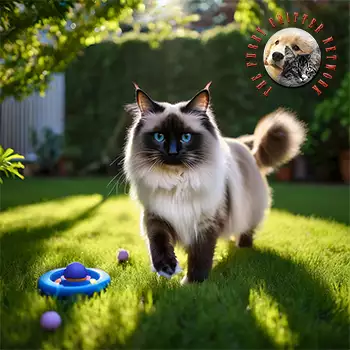

Play Style & Drive

Ragdolls have a distinctly gentle, moderate play style that sets them apart from high-energy breeds like the Abyssinian or Bengal. They tend to engage in short, focused bursts of activity followed by extended rest periods rather than sustained high-intensity play. Understanding this rhythm is essential for choosing toys that actually get used — a toy designed for an athletic, prey-driven cat will often sit ignored by a Ragdoll that prefers slower, more investigative interactions.

Despite their laid-back reputation, Ragdolls do possess hunting instincts, and these instincts are the foundation of meaningful play. They respond well to toys that mimic the movement patterns of small prey — fluttering, dragging along the ground, or making unpredictable small movements. The key difference is pacing: where a Bengal might want a toy whipped through the air at top speed, a Ragdoll engages best when the toy moves slowly and pauses frequently, giving them time to stalk and pounce.

Social play is a major component of a Ragdoll's enrichment needs. This breed strongly prefers interactive play with their owner over solo toy engagement. Wand toys, teaser sticks, and any toy that requires a human on the other end consistently outperform battery-operated or stationary toys in holding a Ragdoll's attention. Plan for at least two fifteen-minute interactive play sessions per day to maintain physical fitness and strengthen your bond.

Age and weight influence play preferences considerably. Kittens and young Ragdolls under two years are noticeably more energetic and will engage with a wider range of toys. As they mature and reach their full size, many Ragdolls become more selective, gravitating toward toys that require less physical exertion but offer mental stimulation. Adapting your toy selection as your cat ages keeps enrichment effective throughout their lifespan.

Interactive & Puzzle Toys

Puzzle toys address the cognitive side of enrichment, which is especially important for an indoor breed that does not face the mental challenges of an outdoor environment. Food-dispensing puzzle toys are the most effective entry point — they tap into the natural foraging instinct and provide a tangible reward that sustains interest. Start with simple designs that require basic pawing or batting to release treats, then progress to more complex multi-step puzzles as your Ragdoll builds problem-solving skills.

Slider puzzles and compartment boards challenge a cat to move pieces, lift covers, or reach into openings to access hidden treats. Ragdolls tend to approach these with patience and deliberation rather than brute force, making them well-suited to puzzles that reward careful manipulation. Avoid puzzles with very small compartments or tight spaces, as a Ragdoll's larger paws can make fine motor tasks frustrating rather than enriching.

Rotation is critical for maintaining interest in puzzle toys. Cats habituate quickly to solved puzzles, and a toy that was engaging last week may be ignored once the solution is memorized. Keep three or four puzzle toys in rotation, introducing one while the others are stored away. This creates novelty without requiring a constantly expanding collection.

Interactive electronic toys that move unpredictably can supplement owner-led play, particularly during times when you are away from home. Look for products with variable speed settings and automatic shutoff timers. A toy that runs continuously becomes background noise within a day; one that activates periodically throughout the day maintains the element of surprise that triggers investigation. Battery life and noise level are practical factors — a loud motorized toy in an otherwise quiet home can startle a noise-sensitive Ragdoll.

Chew Toys & Durability

Ragdolls are not aggressive chewers compared to breeds like the Siamese, but many individuals do enjoy gentle mouthing and carrying toys in their mouths. Soft plush toys in an appropriate size — large enough not to be swallowed but small enough to be carried — are perennial favorites. Look for plush toys with reinforced stitching and double-layered fabric, as even gentle chewing will eventually open poorly constructed seams, exposing stuffing that poses an ingestion hazard.

Catnip-infused toys add an extra dimension to play for the approximately sixty to seventy percent of cats that respond to catnip. Ragdolls that are catnip-sensitive often exhibit a playful, rolling response that is entertaining and provides good exercise. If your cat responds, keep catnip toys sealed in an airtight container between uses to preserve potency, and limit exposure to a few times per week to prevent habituation.

Silvervine and valerian root are alternative attractants for cats that do not respond to catnip. These plant-based stimulants activate different receptors and can produce a play response in cats that are genetically non-responsive to catnip. Products containing silvervine or valerian are increasingly available and worth trying if standard catnip toys fail to generate interest.

Toy safety requires ongoing attention regardless of material. Inspect toys regularly for loose parts — eyes, bells, ribbons, and small plastic components — that could be swallowed. Feathers attached to toys should be supervised-only items, as ingested feather shafts can cause gastrointestinal damage. String, yarn, and ribbon toys should never be left accessible unsupervised, as linear foreign bodies are among the most dangerous and surgically complicated ingestion emergencies in cats.

Fetch & Active Play Toys

Ragdolls are one of the cat breeds most likely to learn and enjoy fetch, which is both an excellent exercise tool and a bonding activity. Lightweight foam balls, crinkle balls, and small soft toys are ideal fetch objects — heavy or hard toys can hurt a cat's teeth during pickup. Start by tossing the toy a short distance while your Ragdoll watches, and reward any retrieval behavior with praise or a small treat. Many Ragdolls take to fetch naturally and will initiate games by bringing toys to their owner.

Wand toys remain the gold standard for active play with any cat, and Ragdolls are no exception. A wand with a feather, fabric, or lightweight attachment at the end allows you to control speed, direction, and movement pattern to match your cat's energy level and interest. Drag the toy along the ground for stalking play, flutter it in short arcs for pouncing practice, and always end a session by slowing the toy and letting your cat make a satisfying final capture — ending abruptly with the toy whisked away can cause frustration.

Laser pointers are popular but should be used with caution for Ragdolls. The inability to physically capture the light dot can cause frustration and anxiety in some cats, particularly breeds that are sensitive to routine satisfaction like the Ragdoll. If you use a laser, always finish the session by landing the dot on a physical toy or treat that the cat can catch and hold. This provides the capture payoff that the laser itself cannot deliver.

Kicker toys — elongated stuffed toys designed for cats to grab with their front paws and kick with their hind legs — provide an outlet for the bunny-kick behavior that many Ragdolls enjoy. Choose kicker toys that are at least as long as your cat's torso so they can fully engage in the grabbing and kicking motion. These toys are particularly useful for solo play when you are unavailable for interactive sessions.

Comfort & Companion Toys

Ragdolls are among the most attachment-oriented cat breeds, and comfort toys can provide emotional support during periods of owner absence. Soft plush toys that are roughly cat-sized give some Ragdolls a cuddling companion for nap time. While not every cat bonds with a comfort toy, those that do often carry the toy to their sleeping area and groom it — behaviors that indicate genuine attachment rather than simple play interest.

Scent plays a major role in a comfort toy's effectiveness. Rubbing a new plush toy against your clothing or bedding transfers your scent, which can make the toy more appealing to a Ragdoll that is closely bonded to you. Some owners keep a dedicated comfort toy in their bed for a few nights before offering it to their cat, ensuring a strong scent association. This technique is especially helpful during transitions like moves, boarding, or the introduction of a new household member.

Heated comfort toys that contain microwaveable inserts mimic the warmth of another body and can soothe anxiety in cats that are distressed by solitude. These products are available in various animal shapes and typically retain warmth for several hours. Always follow heating instructions precisely — overheating can cause burns or damage the toy's internal components — and check the surface temperature before giving it to your cat.

For Ragdolls that experience separation anxiety, the combination of a comfort toy, a worn item of the owner's clothing, and calming pheromone diffusers can meaningfully reduce stress behaviors like excessive grooming, vocalization, or destructive scratching. These tools work best as a system rather than individually, and the comfort toy often serves as the physical anchor around which the other calming elements are organized.

DIY & Budget Options

Some of the most effective cat toys cost nothing. A crumpled ball of paper, a cardboard box, or a paper bag with the handles removed can provide extended entertainment for a Ragdoll. Cardboard boxes are particularly valuable — they serve as hiding spots, scratching surfaces, and ambush points simultaneously. Cut entry holes in multiple sides of a large box to create an interactive fort, and replace it when it is worn out since the cost is zero.

Toilet paper and paper towel tubes make excellent treat-dispensing puzzles when the ends are folded shut with a few treats inside. This is a simple, disposable puzzle toy that takes seconds to assemble and provides mental stimulation as your cat figures out how to extract the reward. Increase difficulty by nesting a smaller tube inside a larger one or placing the sealed tube inside a box with paw-sized openings.

DIY wand toys can be assembled from a wooden dowel, a length of cord, and a fabric scrap or feather tied to the end. The advantage of homemade wands is that you can customize the attachment to whatever movement pattern your specific Ragdoll finds most engaging. Replace the attachment frequently to maintain novelty, and always store wand toys out of reach after play — unsupervised string and cord access is a serious ingestion risk.

Fleece braids and knotted sock toys are durable, washable, and simple to make. Old athletic socks filled with a small amount of catnip or silvervine and knotted at the end produce a toy that many Ragdolls will carry, kick, and sleep with. Rotate homemade toys through the same novelty cycle as purchased ones — store unused toys in a sealed container for a week or two before reintroducing them to reset your cat's interest.

Always consult a qualified professional before making any health-related decisions. This content is provided for informational reference only and should not replace professional guidance specific to your animal.