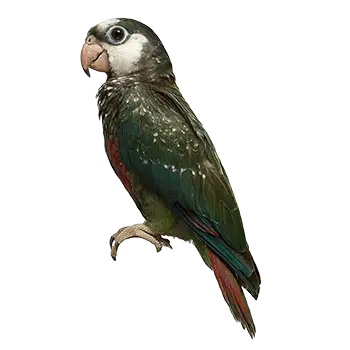

Why Enrichment Matters

Wild White-Capped Pionus parrots spend the majority of their waking hours engaged in purposeful activity. Foraging for food across highland forests, navigating complex canopy structures, maintaining social bonds within their flock, and scanning for predators occupy virtually every moment of the day. In captivity, food arrives in a dish, the environment is static, and threats are absent. Without deliberate enrichment to fill the behavioral vacuum that captive life creates, a Pionus parrot's intelligence turns inward, often manifesting as feather-destructive behavior, repetitive movements, excessive screaming, or apathetic withdrawal.

The White-Capped Pionus is generally described as a calm and gentle species, and this temperament can mask early signs of boredom or psychological distress. Unlike a cockatoo that will scream incessantly or a caique that will become physically hyperactive, a bored Pionus may simply become quiet and still, plucking feathers or over-preening without obvious drama. Owners sometimes mistake this subdued response for contentment, missing the opportunity to intervene with enrichment before the behavior becomes entrenched. A bird that ignores its toys, sits motionless on the same perch for hours, or engages in repetitive beak grinding outside of normal settling-down contexts may be signaling a need for greater environmental complexity.

Effective enrichment addresses multiple dimensions of the bird's behavioral needs. Physical enrichment encourages climbing, swinging, and manipulating objects. Cognitive enrichment challenges the bird to solve problems and discover rewards. Social enrichment provides interaction with humans, other birds, or even reflective and responsive toys. Sensory enrichment introduces novel textures, sounds, and visual stimuli. A well-designed enrichment program rotates across all four dimensions rather than relying on a single category, ensuring that the bird encounters novelty regularly and is motivated to engage with its environment.

Toy spending does not need to be excessive to be effective. Many of the most engaging enrichment items can be made from inexpensive household materials or foraged natural items. A paper bag stuffed with shredded paper and a few hidden treats, a clean pine cone threaded with dried pasta, or a cardboard tube packed with crumpled paper and pellets costs almost nothing and provides genuine foraging stimulation. The key is variety and rotation rather than expense.

Foraging Toys and Puzzle Feeders

Foraging toys are the single most valuable category of enrichment for any captive parrot, and the White-Capped Pionus responds particularly well to them because of the species' natural inclination to work patiently for food rather than rushing or giving up. In the wild, obtaining a meal requires effort: stripping bark, cracking seed hulls, reaching into crevices, and sorting through vegetation. Foraging toys replicate this effort-reward cycle by requiring the bird to manipulate, shred, or solve its way to a food reward.

Entry-level foraging toys wrap food in paper, palm leaf, or corn husk layers that the bird must peel apart to reach the reward inside. These are ideal for birds new to foraging enrichment because the barrier between the bird and the food is thin enough to be overcome quickly, building confidence and establishing the concept that toys contain rewards worth pursuing. Wrapping a favorite treat in a small piece of plain paper and twisting the ends creates a simple starter foraging device that can be made fresh each day.

Intermediate foraging devices introduce mechanical barriers such as sliding doors, rotating covers, or stackable compartments that must be moved aside to reveal food. Acrylic foraging wheels that the bird must spin to align an opening with a dispensing chute, and foraging boxes with multiple lids that each require a different action to open, challenge the bird's problem-solving abilities while maintaining an achievable difficulty level. The White-Capped Pionus has the cognitive capacity and the patience to work through multi-step foraging puzzles that would frustrate more impulsive species.

Advanced puzzle feeders designed for larger parrots can sometimes be adapted for the White-Capped Pionus if the hardware is not too heavy or the mechanisms too stiff for the bird's beak and foot strength. Multi-chamber puzzle boxes, drawers that must be pulled open, and screw-top containers that require rotational manipulation all provide high-level cognitive engagement. Introducing advanced puzzles gradually, after the bird has mastered simpler versions, prevents frustration and maintains the bird's willingness to engage. If a bird abandons a puzzle repeatedly without making progress, the difficulty should be stepped back until competence and confidence rebuild.

Chew Toys and Shreddable Materials

Chewing is a fundamental behavioral need for all parrots, serving purposes that extend well beyond beak maintenance. The act of destroying a destructible object provides psychological satisfaction, channels energy that might otherwise be directed toward feather plucking or cage hardware, and exercises the jaw muscles and beak in ways that maintain proper beak alignment and condition. A White-Capped Pionus without access to appropriate chewing materials will find alternatives, often targeting cage components, perches, or its own feathers.

Soft to medium-density wood is the ideal primary chewing material for this species. Balsa, yucca, sola, and untreated pine blocks are soft enough for the Pionus's moderately strong beak to destroy satisfyingly without being so hard that the bird gives up. Many commercial bird toy manufacturers produce hanging toys that incorporate stacked wooden blocks, beads, and shapes on stainless steel or vegetable-tanned leather strings. Selecting toys sized for medium parrots ensures the components are manageable for the bird's foot and beak dimensions.

Shreddable materials provide a different textural experience than wood and appeal to the bird's instinct to strip and tear. Palm leaf strips, corn husks, coconut fiber pads, and raffia bundles are all safe, natural materials that the White-Capped Pionus typically engages with enthusiastically. Seagrass mats woven into shapes or rolled into tubes combine shreddability with structural manipulation, as the bird pulls apart the weave strand by strand. Paper-based shreddables such as crinkle paper bundles and corrugated cardboard shapes are inexpensive options that can be refreshed frequently.

Safety evaluation of chew toys should be thorough before offering any new item. Check that all hardware is stainless steel rather than zinc-plated. Confirm that any dyes used are vegetable-based and non-toxic. Verify that leather components are vegetable-tanned rather than chrome-tanned, as chrome-tanned leather contains heavy metals that are toxic if ingested. Rope components should be natural cotton or sisal, not synthetic materials, and should be monitored for fraying that could entangle the bird. Remove and replace any toy once it has been chewed down to its hardware or support structure, as exposed metal components and small remnant pieces become entanglement and ingestion hazards.

Swings, Ladders, and Climbing Structures

White-Capped Pionus parrots are confident climbers that use their feet and beak in coordinated fashion to navigate vertical and horizontal surfaces. Swings, ladders, and climbing structures capitalize on this natural ability by providing physical exercise opportunities within and outside the cage. A swing mounted near the top of the cage gives the bird a dynamic perching option that engages core muscles and balance as the bird adjusts to the motion. Many Pionus parrots adopt a swing as their preferred resting spot once accustomed to it.

Wooden swings with natural branch perches are preferable to plastic or acrylic alternatives for both grip quality and chewing satisfaction. The perch diameter on the swing should match the recommended range for the species, allowing the foot to wrap approximately three-quarters of the way around the perch without fully closing. Swings hung from a single attachment point offer more movement range than those hung from two points, but some birds find the greater instability unsettling at first. Starting with a dual-point swing and transitioning to a single-point model allows the bird to build confidence gradually.

Ladders provide structured climbing routes between different cage levels and can serve as bridges connecting play areas outside the cage. Wooden ladder rungs with natural bark still attached offer better grip and chewing interest than sanded or painted dowel rungs. Rope ladders introduce a flexibility element that challenges the bird's balance and coordination more than rigid ladders, though they require the same fraying-monitoring precautions as rope perches. Positioning a ladder at an angle rather than perfectly vertical makes it more accessible and encourages regular use.

Freestanding play gyms and tabletop climbing structures expand the bird's activity space beyond the cage itself. These structures typically combine perches, ladders, swings, and toy-hanging stations on a raised platform with a tray beneath to catch droppings and debris. For a White-Capped Pionus, a medium-sized play gym with multiple levels and several attachment points for rotating toys provides an engaging out-of-cage activity center. The play gym should be positioned in the same social area as the cage so the bird can participate in household activity while exercising and exploring.

Boing-style spiral rope perches add a bouncing, springy element to climbing that many Pionus parrots find irresistible. These coiled ropes can be mounted vertically or diagonally inside the cage or hung from a play gym, and the bird's weight causes them to bounce gently as it climbs. The motion provides subtle core and balance training with each step. As with all rope products, regular inspection for fraying is essential, and boings should be replaced at the first sign of significant wear.

Sound and Sensory Enrichment

Auditory and visual stimulation contribute to a well-rounded enrichment program and address sensory needs that physical toys alone cannot satisfy. White-Capped Pionus parrots are attentive listeners and often respond to music, nature recordings, and household sounds with increased vocalization and animated body language. Playing varied music genres at moderate volume during the day provides a changing auditory backdrop that prevents the sensory monotony of a silent room.

Toys that produce sound through the bird's own actions offer interactive sensory feedback that passive sound sources do not. Bells sized appropriately for medium parrots, with clappers that cannot be detached and swallowed, provide a ringing response to the bird's contact. Stainless steel bell cups are safer than traditional jingle bells, which can trap toes in the narrow slot openings. Acrylic toys containing small beads or pellets that rattle when manipulated combine auditory feedback with physical manipulation, appealing to the bird's curiosity about cause and effect.

Mirrors are a polarizing enrichment item in avian care, and their appropriateness depends on the individual bird's response. Some White-Capped Pionus parrots engage with their reflection in healthy, playful ways, vocalizing and posturing briefly before moving on to other activities. Others become obsessively bonded to the mirror image, treating it as a mate and becoming aggressive or withdrawn when separated from it. Mirror use should be monitored carefully during the first several days, and the mirror should be permanently removed if the bird shows signs of obsessive fixation, territorial aggression around the mirror, or regurgitation directed at its reflection.

Visual enrichment extends to the bird's view from its cage. Positioning the cage where the bird can watch outdoor activity through a window, observe foot traffic in the room, or see a television screen playing nature documentaries provides changing visual input throughout the day. A window bird feeder mounted outside a nearby window creates a live avian program that captivates many indoor parrots. Care should be taken to ensure that outdoor views do not include frequent sightings of predatory birds, which can trigger persistent stress responses in a caged parrot with no means of escape.

Toy Rotation and Maintenance

Rotating toys on a regular schedule is one of the simplest and most effective strategies for maintaining a White-Capped Pionus's interest in its enrichment program. Even a favorite toy loses its appeal after constant exposure, and a bird surrounded by the same objects for weeks or months at a time will eventually disengage from all of them. Maintaining a reserve of toys and swapping two or three items in and out of the cage every five to seven days introduces novelty without the expense of constantly purchasing new items.

The number of toys in the cage at any one time should balance stimulation with space. Three to five toys is typically appropriate for a standard Pionus cage, providing variety without overwhelming the interior or restricting the bird's movement between perches. Each rotation should include at least one foraging toy, one chewing or shreddable item, and one manipulative or movement-based toy. This ensures that multiple behavioral needs are addressed simultaneously even if the bird gravitates primarily toward one category.

Cleaning and inspecting toys before returning them to the rotation extends their lifespan and maintains safety standards. Acrylic and stainless steel toys can be washed with hot water and bird-safe soap and dried thoroughly. Wooden toys that are still structurally sound but soiled can be scrubbed with a diluted vinegar solution and allowed to dry completely in open air. Rope and fabric components should be inspected for fraying, staining, and odor; if they cannot be cleaned effectively, they should be replaced rather than returned to service.

Keeping a toy log, whether written or digital, helps owners track which items the bird engages with, which it ignores, and which have been retired due to wear. Over time, patterns emerge that reveal the bird's material preferences, size preferences, and complexity tolerance. Some White-Capped Pionus parrots prefer shreddable textures over hard wood, while others gravitate toward mechanical puzzles. Building future toy selections around these documented preferences reduces wasted purchases and increases the likelihood that new items will be used.

DIY toy making allows owners to supplement commercial products with custom creations tailored to their bird's preferences. Stringing untreated wooden beads, leather strips, and palm leaf pieces on a stainless steel skewer or vegetable-tanned leather cord creates a customizable hanging toy at minimal cost. Stuffing a small paper bag with crumpled paper, dried herbs, and hidden treats produces a one-use foraging toy that costs nearly nothing. Cardboard boxes with holes cut in the sides and treats hidden inside offer destructible foraging challenges that the bird can reduce to confetti over the course of a day.

Safety Considerations

Toy safety deserves constant vigilance because the risks evolve as the bird interacts with and destroys its enrichment items. A toy that is perfectly safe when new can become hazardous once partially chewed, as exposed hardware, sharp edges, and small fragments emerge from the destruction. Owners should develop the habit of inspecting every toy in the cage daily during routine feeding and cleaning, checking for loose parts, splintered wood, frayed rope, and exposed metal components.

Size appropriateness is a fundamental safety factor. Toys designed for small birds like budgies and cockatiels may contain components small enough for a White-Capped Pionus to swallow or choke on, including tiny beads, small bells, and thin chain links. Conversely, toys built for large macaws and cockatoos may have hardware that is too heavy for a Pionus to manipulate safely and components large enough to trap a smaller bird's head or foot. Selecting toys specifically labeled for medium-sized parrots ensures that the components fall within a safe range for the species.

Certain toy materials and construction methods pose specific hazards. Jingle bells with narrow slits can trap toes or beak tips. Split-ring connectors like those used on keychains can open under beak pressure and injure the bird. Chain links should be welded closed rather than simply bent, as open links catch toes and beaks. Spring-loaded clips used to attach toys to cage bars should be the quick-link style that screws shut rather than the pressure-clip style that a bird can open and swallow or become entangled in.

Textile and fiber components require ongoing monitoring throughout their service life. Cotton rope, sisal twine, and fabric strips all degrade under the combined assault of beak chewing, foot gripping, and moisture exposure. Loose fibers can wrap tightly around toes, cutting off circulation in minutes and potentially resulting in digit loss if not discovered quickly. Some birds develop a compulsive habit of pulling and ingesting fibers, which can accumulate in the crop or lower digestive tract and cause a life-threatening impaction. Any toy with fiber components should be considered a supervised-use item for birds known to ingest non-food materials.

New toys should be introduced one at a time and observed during the bird's initial interactions. Some birds are neophobic and will panic at the sudden appearance of an unfamiliar object in their cage. Placing the new toy near the cage rather than inside it for a day or two, then mounting it in a peripheral location before moving it closer to the bird's core territory, allows gradual acclimation without triggering a fear response. Forcing interaction by placing a frightening toy directly next to the bird's primary perch or food station is counterproductive and can create a lasting aversion.

Always consult a qualified professional before making any health-related decisions. This content is provided for informational reference only and should not replace professional guidance specific to your animal.