
Enrichment Needs

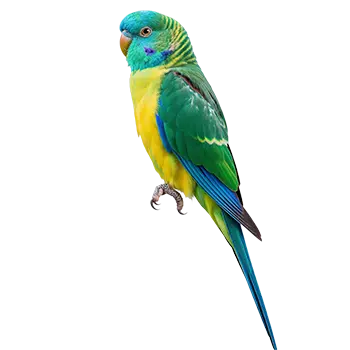
Turquoisine Parakeets are not the acrobatic, puzzle-solving birds that many people associate with the parrot family. Their enrichment needs differ fundamentally from those of larger, more cognitively driven species like African Greys or cockatoos. In the wild, Neophema pulchella spends the vast majority of its active hours engaged in ground-level foraging, moving steadily through grass and low vegetation in search of seeds, sprouts, and plant material. Captive enrichment that mirrors this natural behavioral repertoire, emphasizing foraging, gentle exploration, and flight, will be far more engaging for the species than complex mechanical toys or loud, flashy playthings.

The gentle, somewhat reserved temperament of the Turquoisine means that new toys and enrichment items should be introduced gradually. Many Turquoisines exhibit a pronounced neophobic response, becoming frightened of unfamiliar objects placed suddenly in their enclosure. A toy that terrifies the bird is worse than no toy at all, as the stress of sharing space with a feared object suppresses normal behavior. The most effective introduction strategy is to place new items near but outside the cage for several days, then attach them to the exterior of the cage, and finally move them inside once the bird has demonstrated curiosity or indifference rather than fear.

Enrichment serves multiple purposes beyond entertainment. Appropriate toys and activities prevent the behavioral problems that arise from boredom and understimulation, including repetitive pacing, excessive preening, feather-picking, and lethargy. While Turquoisines are less prone to the severe feather-destructive behaviors seen in some larger parrot species, chronic boredom still takes a toll on their physical and psychological wellbeing. A thoughtfully enriched environment encourages the full range of natural behaviors, including foraging, flying, bathing, preening, and social interaction, that collectively define quality of life for a captive bird.

The scale of enrichment items matters enormously for this small species. Toys designed for cockatiels, conures, or larger parrots are frequently too large, too heavy, and too mechanically complex for a Turquoisine to interact with meaningfully. The bird may simply ignore an oversized toy, or worse, be intimidated by it. Selecting toys sized for budgerigars, small parakeets, or finches ensures that the Turquoisine can physically manipulate and engage with the item.

Foraging Toys & Puzzle Feeders

Foraging enrichment is the single most valuable category of stimulation for a Turquoisine Parakeet. In the wild, finding food occupies the majority of the bird's waking hours. In captivity, food appears in a dish with no effort required, eliminating the behavioral drive that structures the wild bird's entire day. Foraging toys restore a portion of that natural challenge by requiring the bird to work for its food, extending feeding time and providing cognitive engagement that a food bowl cannot.

Simple foraging strategies are the most effective starting point for this species. Scattering seed over a shallow tray of clean pebbles, crumpled paper, or shredded paper forces the bird to search for individual seeds among the substrate, closely mimicking natural ground foraging. This approach requires no special equipment and can be implemented immediately. As the bird becomes proficient, the substrate can be made deeper or more complex to increase the challenge. A shallow dish of clean, washed sand with seeds buried throughout provides an especially naturalistic foraging experience for a ground-feeding species.

Commercial foraging toys designed for small birds offer more structured challenges. Acrylic foraging wheels and rotating discs require the bird to manipulate a mechanism to access seeds placed inside. Paper-based foraging cups and wrapped seed bundles allow the bird to tear and shred to reach the food within, combining destructive enrichment with foraging motivation. When selecting commercial foraging toys, choose models that are transparent or semi-transparent so the bird can see the food inside. A Turquoisine that cannot see a reward will often abandon the puzzle before solving it, while visible food sustains motivation.

Sprouted seeds and seeding grass heads serve as both nutritional supplements and foraging enrichment simultaneously. Offering a pot of growing wheatgrass or a bundle of seeding ryegrass requires the bird to harvest individual seed heads from the stalk, engaging fine motor skills and extending feeding time well beyond what a dish of loose seed allows. This type of enrichment is particularly valuable because it combines nutritional benefit with behavioral engagement and closely replicates the bird's natural feeding ecology.

Chew Toys & Natural Materials

While Turquoisine Parakeets are not heavy chewers compared to larger parrot species, they do engage in moderate chewing and shredding behavior that benefits from appropriate outlets. The beak of a Neophema is designed for husking small seeds, not for demolishing wooden blocks, so chew toys should be lightweight and easy to manipulate rather than dense and challenging. Softwood pieces, thin balsa strips, and compressed paper shapes are all suitable chewing substrates for this species.

Natural materials harvested from the bird's environment offer some of the best chewing and shredding enrichment. Branches from bird-safe trees such as apple, willow, eucalyptus, and bottlebrush provide textured surfaces for beak conditioning and the satisfaction of stripping bark. These branches should be collected from unsprayed areas and washed thoroughly before introduction to the cage. The variety of textures, including smooth bark, rough bark, and exposed wood, that a natural branch offers is more stimulating than uniform commercial dowels.

Palm leaf and coconut fiber toys are excellent choices for Turquoisines that enjoy shredding. The fibrous texture of palm leaf strips and coconut husk fragments satisfies the destructive impulse without producing dangerous splinters or small hard pieces that could be swallowed. Many commercial bird toy manufacturers produce small shredding toys made from dyed palm leaves, woven seagrass, and sisal that are safe for small parakeets. When purchasing dyed products, confirm that the dyes used are food-grade and non-toxic.

Mineral and calcium chew items serve a dual purpose. Cuttlebone, mineral blocks, and lava stone perches provide beak-conditioning surfaces while also delivering calcium and trace minerals. These items should be considered part of the bird's standard cage furnishing rather than optional toys, as they fulfill both behavioral and nutritional needs. The grinding and scraping activity involved in using these surfaces helps maintain proper beak shape and length, reducing the likelihood of beak overgrowth that would otherwise require veterinary intervention.

Swings, Ladders & Climbing Structures

Swings are among the most universally enjoyed toys for Turquoisine Parakeets. A simple wooden or rope swing positioned at the highest comfortable point in the cage provides a dynamic perching surface that engages the bird's balance and core musculature. Many Turquoisines develop a clear preference for sleeping on their swing, choosing the gentle rocking motion over a stationary perch for roosting. Swings should be sized appropriately for the bird's foot span, with a perch diameter of approximately three-eighths to one-half inch, and should be hung with enough clearance that the bird can swing freely without striking cage walls or other furnishings.

Ladders provide a navigational pathway between different levels of the cage and encourage climbing activity that Turquoisines engage in less naturally than zygodactyl parrots. A wooden ladder angled against the cage wall or connecting a lower perch to a higher one gives the bird an accessible route that does not require flight, which is useful in smaller cages where flight distance is limited. Rope ladders with wooden rungs offer a more dynamic climbing experience, introducing a slight instability that challenges the bird's coordination.

Boing-style coiled rope perches combine the properties of a perch, a swing, and a climbing structure. Hung vertically or at an angle, these springy coils bounce and sway as the bird moves along them, providing exercise and balance training. For Turquoisines, select the smallest diameter boing available, as models designed for cockatiels and larger birds are too thick for comfortable gripping. The bouncing motion appeals to many Turquoisines, and these perches often become favored resting spots.

Playground structures and tabletop play gyms designed for small birds extend enrichment opportunities beyond the cage. During supervised out-of-cage time, a small play stand with multiple perch levels, a swing, and a few attached toys gives the Turquoisine a designated activity area outside its enclosure. These structures should be stable enough not to tip when the bird lands and should be placed on an easy-to-clean surface, as droppings and discarded food will accumulate beneath them. The play gym also serves as a training station where the bird can be rewarded for stepping up, recalling, and other desired behaviors.

Interactive & Sensory Toys

Interactive toys that produce gentle sounds or visual effects can enrich the sensory environment of a Turquoisine Parakeet, though selection must account for the species' sensitivity to startling stimuli. Small bells with clappers that produce a soft chime rather than a loud ring are well-tolerated by most Turquoisines and provide auditory feedback that encourages repeated interaction. Avoid bells with sharp-edged openings or gaps large enough to trap a toe or tongue, which are common design flaws in inexpensive bird bells.

Mirror toys occupy a debated position in avian enrichment. For solitary Turquoisines without a conspecific companion, a small mirror can provide the illusion of social presence that reduces isolation stress. However, prolonged mirror fixation can lead to behavioral abnormalities, including regurgitation directed at the reflection, territorial aggression toward the perceived intruder, and reduced interest in interacting with human caretakers. If a mirror is offered, it should be one element in a rotation of enrichment items rather than a permanent fixture, and the bird's behavior around it should be monitored for signs of obsessive engagement.

Textured toys that engage the bird's tactile senses add another dimension to enrichment. Woven straw balls, knotted leather strips, and textured wooden beads strung on leather or cotton cord invite manipulation with the beak and feet. The variety of surface textures, from smooth to rough to fibrous, holds the bird's interest longer than uniform materials. Small foot toys that the bird can pick up, carry, and manipulate on a flat surface tap into a playful behavior that many Turquoisines exhibit during out-of-cage time.

Water-based sensory enrichment is often overlooked but highly effective. A shallow misting from a spray bottle produces fine droplets that most Turquoisines will actively bathe in, fluffing their feathers and spreading their wings to maximize water contact. A shallow ceramic dish of lukewarm water placed on the cage floor or on an external play surface invites bathing behavior that serves both hygiene and enrichment functions. Some keepers add a few drops of aloe vera juice to the bath water, which may help condition feathers, though this practice should be discussed with an avian veterinarian.

Toy Rotation & Safety

Rotating toys on a regular schedule prevents habituation, the process by which a bird loses interest in familiar objects that no longer provide novelty. A practical rotation schedule involves maintaining three to four toys in the cage at any given time and swapping one or two of them every week. The removed toys are cleaned, inspected for damage, and stored until their next rotation. This system ensures that each toy feels relatively fresh when it reappears, extending the useful life of the enrichment inventory and maintaining the bird's engagement over time.

Safety inspection should accompany every rotation. Small parakeets are vulnerable to entanglement in frayed rope fibers, entrapment in gaps between toy components, and ingestion of small parts that break free during play. Before returning any toy to the cage, check rope elements for fraying and trim or discard as needed. Test moving parts for smooth operation and ensure that no gaps have opened through wear that could trap a toe, wing, or beak. Remove any toy that has developed sharp edges, loose hardware, or detached small components.

Material safety extends beyond the toy itself to the fasteners and attachment hardware used to hang it in the cage. Quick-link connectors made from stainless steel or nickel-plated steel are the safest attachment option. Avoid toys hung with split rings, key rings, or open hooks that can trap toenails. String and rope hangers should be short enough that the bird cannot become entangled if it climbs along the suspension line. Plastic components should be bird-safe acrylic or food-grade plastic, not brittle polystyrene that can shatter into sharp fragments.

The overall density of toys in the cage requires balance. Too few toys leave the bird under-stimulated, while too many clutter the cage interior and restrict flight paths. For a standard flight cage housing one or two Turquoisines, three to four toys of different types, positioned to leave the primary flight line unobstructed, provides adequate enrichment without compromising mobility. Toys should be distributed throughout the cage at varying heights rather than clustered in one area, encouraging the bird to move through its entire living space.

DIY Enrichment Ideas

Homemade enrichment items are cost-effective and allow the keeper to customize activities specifically for their Turquoisine Parakeet's preferences and abilities. One of the simplest and most effective DIY foraging toys is a small paper cup or cupcake liner filled with a tablespoon of seed mix and then loosely crumpled shut. The bird must tear through the paper to access the food inside, combining shredding satisfaction with foraging motivation. The paper should be plain, undyed, and free of adhesives or coatings.

Piece-of-produce skewers made from stainless steel or food-grade wooden skewers offer foraging and chewing enrichment simultaneously. Threading small pieces of leafy greens, carrot slices, and apple wedges onto a skewer and suspending it inside the cage forces the bird to work for each piece rather than picking from a static dish. This format is particularly effective for encouraging reluctant birds to try fresh foods, as the novel presentation often sparks curiosity that a regular food bowl does not.

Natural branch arrangements harvested from safe tree species can be assembled into custom play structures. Several branches of varying thickness and angle, lashed together with cotton twine or fitted into a stable base, create a unique climbing and perching environment that commercial products cannot replicate. The irregular surfaces, bark textures, and occasional leaf buds provide sensory richness that manufactured dowels lack. Branches should be baked at a low temperature for approximately an hour to eliminate parasites and pathogens before installation.

Rotating the cage's physical environment itself constitutes enrichment. Periodically rearranging perch positions, moving food stations to different locations, and changing the substrate type introduces environmental novelty that stimulates exploration and cognitive engagement. This should be done gradually and with sensitivity to the species' neophobic tendencies. Moving one perch at a time rather than completely reconfiguring the cage overnight allows the bird to adapt without experiencing the stress of an entirely unfamiliar environment. The goal is to create gentle surprises that encourage investigation, not wholesale disruption that provokes anxiety.

Always consult a qualified professional before making any health-related decisions. This content is provided for informational reference only and should not replace professional guidance specific to your animal.