
Enrichment Needs

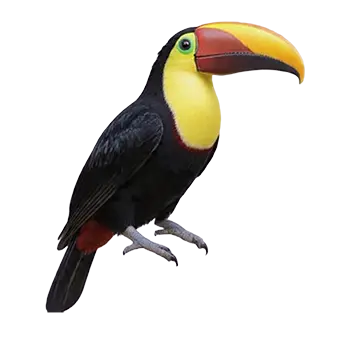
Swainson's Toucans are highly intelligent, naturally curious birds whose cognitive and physical wellbeing depends on consistent environmental enrichment. In the wild, these ramphastids spend a significant portion of their waking hours engaged in complex foraging behavior, social interaction with flock members, exploration of their arboreal habitat, and play. Captive toucans deprived of opportunities to express these behaviors develop stress-related problems including feather destructive behavior, repetitive pacing, excessive vocalization, and aggression. Providing a thoughtful rotation of toys and enrichment devices is not a supplementary luxury but a core component of responsible toucan husbandry.

The play style of a Swainson's Toucan differs fundamentally from that of parrots, and this distinction should guide every product choice. Parrots use their strong, curved beaks and dexterous feet to grip, shred, and dismantle objects. Toucans, by contrast, use their long, lightweight bills primarily for picking up, tossing, and catching items. Their zygodactyl feet provide a stable perching platform but lack the manipulative dexterity of a parrot's feet. The result is a play vocabulary built around flicking, batting, throwing, and retrieving rather than the methodical destruction that characterizes parrot interaction with toys.

Novelty is a critical factor in maintaining a toucan's interest in enrichment. These birds are quick learners that habituate to familiar objects rapidly. A toy that captivates a Swainson's Toucan for hours on its first introduction may be completely ignored within a few days. Effective enrichment management requires a rotation system in which toys are introduced, removed after a period of use, stored out of sight for several weeks, and then reintroduced as if new. Maintaining a library of fifteen to twenty suitable items allows a rotation cycle long enough that each item regains novelty value before its next appearance.

Safety considerations for toucan toys overlap with but are not identical to those for parrot toys. Because toucans do not chew with the destructive force of a parrot, materials that would be quickly demolished by a macaw or cockatoo may last indefinitely in a toucan enclosure. Conversely, small components that a parrot would ignore may be picked up, tossed, and accidentally swallowed by a toucan experimenting with an unfamiliar object. All toys should be evaluated for small parts, sharp edges, entanglement hazards from strings or chains, and the presence of zinc, lead, or other toxic metals before introduction.

Foraging Toys and Puzzle Feeders

Foraging enrichment is the single most effective category of toys for Swainson's Toucans because it directly engages the behavioral drive that occupies the greatest portion of a wild toucan's day. Simple foraging opportunities can be as basic as hiding fruit pieces inside crumpled paper, tucking blueberries into the crevices of a natural wood perch, or threading fruit onto stainless steel skewers that require the bird to work each piece free. These low-cost approaches can be implemented immediately and serve as a foundation upon which more complex foraging devices are layered.

Commercially produced foraging toys designed for medium to large parrots can often be adapted for toucan use with minor modifications. Acrylic foraging boxes with lids that slide, rotate, or lift to reveal food rewards challenge the bird's problem-solving ability and extend feeding time. When selecting these products, prioritize designs with openings large enough to accommodate the toucan's bill, which is significantly longer and differently shaped than a parrot's beak. A puzzle feeder with small access holes designed for a conure's compact beak will frustrate rather than engage a toucan, so sizing is a critical evaluation criterion.

Natural foraging substrates offer a different type of enrichment that appeals to the toucan's exploratory instincts. A shallow tray filled with untreated dried leaves, clean straw, or shredded paper with fruit pieces scattered throughout encourages the bird to sift and search for food items, simulating the experience of foraging through forest canopy debris. This type of enrichment is inexpensive and infinitely variable, as different substrates and food items create a new experience each time. The tray should be monitored and removed once the food items have been consumed to prevent the bird from ingesting soiled substrate material.

Escalating difficulty is an important principle in foraging enrichment design. A toucan that masters a particular puzzle quickly should be presented with the next level of challenge rather than the same device repeatedly. Some keepers achieve this by wrapping food items in progressively more layers of paper, using increasingly complex foraging boxes, or combining multiple foraging challenges in sequence so that solving one reveals the location of the next. This progressive approach keeps the bird intellectually engaged and prevents the learned helplessness that can develop when enrichment becomes either too easy to be stimulating or too difficult to be rewarding.

Tossing and Manipulation Toys

The bill-toss behavior that defines toucan play makes lightweight, grippable objects the ideal manipulation toys for a Swainson's Toucan. Small balls made from bird-safe materials such as vegetable-dyed wood, woven rattan, vine balls, and food-grade silicone are among the most consistently popular toy types with this species. The bird picks up the ball at the tip of its bill, flicks its head, and sends the ball flying across the enclosure, then hops or flies to retrieve it and repeat the process. This self-directed fetch game can occupy a motivated toucan for extended periods and provides both physical exercise and mental engagement.

Woven and wicker toys offer textural interest that appeals to the toucan's tactile curiosity. Small baskets, woven rings, and palm-leaf bundles can be hung from the cage ceiling or placed on a platform where the bird can pick them up and toss them. Because toucans do not chew with the intensity of parrots, these items last considerably longer than they would in a parrot cage, though they should still be inspected regularly for loose fibers that could wrap around toes or be ingested. Replacing woven toys at the first sign of structural deterioration prevents entanglement injuries.

Bells and noise-making toys attract many Swainson's Toucans, though individual preferences vary. Stainless steel bells large enough to prevent the clapper from being swallowed, typically one inch in diameter or larger, can be hung at bill height where the bird can strike them during play. Some toucans develop elaborate routines of ringing bells at specific times or in response to household sounds, which suggests a level of intentional interaction with the sound-producing object. Plastic bells and jingle bells with small openings should be avoided, as the toucan's bill tip can become wedged in narrow gaps.

Interactive toys that the keeper and bird use together strengthen the social bond and provide enrichment that solitary toys cannot replicate. Rolling a small ball across a table toward a toucan perched on the edge, offering items for the bird to toss back, or playing gentle games of keep-away with a lightweight object engages the bird's social instincts and builds trust. These interactive sessions should be short, positive, and terminated before the bird loses interest, so that each session ends on a rewarding note that encourages future participation.

Swings, Ladders, and Climbing Structures

Swings are a popular enrichment category for many bird species, and Swainson's Toucans often enjoy them, though the product must be appropriately scaled and constructed. A toucan swing should have a perching surface at least ten to twelve inches wide to accommodate the bird's body length and tail, with ropes or chains rated for the bird's weight plus the dynamic force of swinging. Natural wood perch swings provide better grip than plastic or metal alternatives and are more readily accepted by most toucans. The swing should be hung with enough clearance that the bird's tail does not contact the cage walls or ceiling during motion.

Ladders occupy a somewhat different role in toucan enclosures than in parrot setups. Parrots use ladders as climbing highways, gripping each rung with beak and feet in an alternating progression. Toucans are less inclined to climb in this fashion, as their bills are not designed for load-bearing grip, but they will sometimes walk up gently angled ladders or use horizontal ladder structures as alternative perching surfaces. Wide-rung ladders made from natural wood, positioned at a gentle angle rather than vertically, are more likely to see regular use than steep or narrow designs.

Branch-based climbing structures that replicate the complexity of natural tree canopy provide enrichment through environmental variety rather than through direct interaction with a single toy. A large, multi-branched section of manzanita, java wood, or grapevine secured inside the enclosure creates a three-dimensional landscape that the bird navigates differently each time. These structures encourage hopping between branches at varying heights and angles, which exercises different muscle groups and foot positions compared to the uniform perches found in most commercial cages.

Rope perches and bungee-style hanging perches add a dynamic, unstable element that challenges the toucan's balance and coordination. Sisal or cotton rope perches of appropriate diameter can be strung across the enclosure at various angles, creating flexible pathways that sway and bounce as the bird moves along them. This instability engages the bird's proprioceptive system and provides physical enrichment that static perches cannot. However, all rope products must be inspected frequently for fraying, as loose rope fibers pose a serious entanglement and ingestion risk. Toucans that show any tendency to pick at or consume rope fibers should not have access to these products.

Water and Bathing Enrichment

Swainson's Toucans are enthusiastic bathers that derive significant enrichment from access to water features beyond their drinking supply. In the wild, toucans bathe regularly in rainwater collected in tree hollows and broad leaves, and captive birds retain this strong drive to immerse and splash. Providing dedicated bathing opportunities satisfies this behavioral need while also supporting feather health and hygiene. A shallow ceramic or stainless steel dish filled with clean, room-temperature water and placed on the cage floor or on a low platform invites bathing behavior in most toucans.

The bathing dish should be large enough for the bird to stand in comfortably and splash without immediately emptying it, but shallow enough that the water level does not exceed the bird's belly height. A dish measuring approximately fourteen to eighteen inches in diameter and two to three inches deep works well for an adult Swainson's Toucan. Heavy ceramic or weighted stainless steel prevents the dish from tipping when the bird enters or during vigorous splashing. The dish should be placed in an area of the enclosure where water spray will not saturate food dishes, bedding, or electrical components such as lighting fixtures.

Misting systems and spray bottles offer an alternative or supplementary bathing experience that many toucans enjoy. A gentle mist from a clean spray bottle directed above the bird, allowing the droplets to fall like rain, often triggers wing-spreading, feather-ruffling, and other bathing behaviors. Some keepers install automated misting systems on timers that provide brief daily mist sessions, which simultaneously contributes to maintaining the humidity levels that this tropical species requires. Water used for misting should be clean and free of additives, as the bird will inevitably ingest small amounts during the process.

Bathing enrichment can be enhanced by varying the experience across sessions. Occasionally placing a few floating berries or small leaf pieces in the bathing dish combines water play with foraging behavior. Moving the bathing station to different locations within the enclosure periodically adds novelty. On warm days, outdoor bathing in natural sunlight allows the bird to preen and dry in UV-rich conditions that benefit feather health. Regardless of the method used, bathing water must be removed and the dish cleaned promptly after each session to prevent bacterial contamination, as the warm, moist environment created by a used bath dish is an ideal medium for microbial growth.

DIY Enrichment and Rotation Strategy

Some of the most effective enrichment items for Swainson's Toucans can be constructed from inexpensive, readily available materials, which allows keepers to maintain a large and varied enrichment library without significant ongoing expense. Untreated paper bags stuffed with crumpled paper and a few hidden fruit pieces create a foraging challenge that the bird dismantles by reaching into the bag's opening and extracting contents. Cardboard tubes from paper towel or toilet paper rolls can be crimped at the ends with fruit inside, creating simple puzzle toys that are discarded after a single use and therefore always novel.

Natural materials collected from safe, pesticide-free sources offer enrichment that closely replicates the bird's wild environment. Clean, dry pine cones of appropriate size can be placed in the enclosure for the bird to manipulate and toss. Bundles of safe, non-toxic leaves tied loosely with cotton string provide objects to pick apart and explore. Short sections of untreated bamboo with treats hidden in the hollow interior create engaging foraging challenges. All natural materials should be thoroughly inspected for insects, mold, and contaminants, and sourced from areas known to be free of pesticide and herbicide application.

The rotation strategy itself is as important as the individual items in the enrichment library. A structured rotation plan assigns each toy a schedule: three to five days in the enclosure, followed by two to four weeks in storage before reintroduction. This interval is long enough that the bird does not remember the specific item and approaches it with renewed curiosity. Keeping a simple log of which toys are currently in use, which are in storage, and when each was last rotated helps maintain consistency and prevents the common mistake of leaving the same items in the enclosure until the bird has lost all interest.

Observing the bird's response to each enrichment item provides the data needed to refine the rotation over time. Some items consistently generate high engagement while others are ignored regardless of novelty. Recording which toys elicit the most interaction, which are used for the longest duration, and which are abandoned quickly allows the keeper to retire ineffective items and invest in more of what works. Individual toucans develop distinct play preferences, and a rotation tailored to the specific bird's interests delivers far more behavioral benefit than a generic selection based solely on what is marketed as a toucan toy.

Seasonal and environmental enrichment adds another layer of variety that keeps the captive environment stimulating across longer timescales. Rotating not just individual toys but entire enrichment themes, such as a week focused on foraging challenges followed by a week emphasizing physical play, followed by a week centered on water and sensory enrichment, creates macro-level novelty that prevents the overall environment from feeling stagnant even when individual items are recycled through the rotation.

Always consult a qualified professional before making any health-related decisions. This content is provided for informational reference only and should not replace professional guidance specific to your animal.