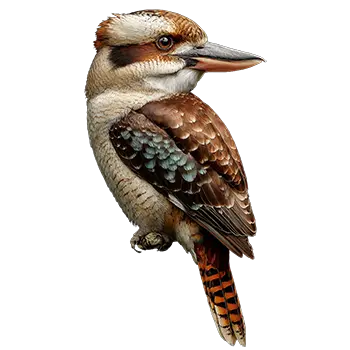

Understanding Kookaburra Play Behavior

Enrichment for a Kookaburra must begin with an understanding of how this species interacts with its environment, because the behavioral repertoire of a terrestrial kingfisher bears almost no resemblance to that of a parrot. Parrots manipulate objects with their feet, disassemble structures with their curved beaks, and engage in prolonged tactile exploration. Kookaburras do none of these things. Their play and exploratory behavior centers on prey capture, prey processing, and territorial vigilance — watching, striking, seizing, and beating objects against hard surfaces. Any enrichment strategy that fails to account for these fundamental behavioral patterns will produce toys the bird ignores.

The most distinctive Kookaburra behavior relevant to enrichment is prey-bashing. When a wild Kookaburra catches a snake, lizard, or large insect, it carries the prey back to a perch and beats it repeatedly against the branch until the prey is stunned, dead, and softened for swallowing. Captive Kookaburras perform this behavior with food items, non-food objects, and essentially anything they can pick up in their heavy bills. This is not aggression or frustration — it is a hardwired motor pattern that the bird is compelled to express. Enrichment items that can be safely grasped, carried, and beaten against perches satisfy this drive and reduce the likelihood of the bird redirecting it toward cage furnishings or the keeper's hands.

Visual tracking and ambush behavior are equally important components of the Kookaburra behavioral profile. Wild birds spend substantial portions of their day motionless on perches, watching for movement below them with intense concentration. This sit-and-wait hunting strategy is not laziness — it is the bird's primary method of prey detection and represents a cognitively demanding state of sustained attention. Enrichment that incorporates unpredictable movement, whether through live insects, mechanical devices, or wind-activated elements, taps into this attentional system and provides cognitive stimulation that static objects cannot.

Social calling is another behavior that shapes enrichment needs. Kookaburras are among the most vocal of all kingfisher species, and their iconic laughing call serves territorial and social bonding functions. In captivity, solitary birds may vocalize in response to recorded calls, ambient sounds, or even musical stimuli. While this is not strictly a toy-and-enrichment consideration, auditory stimulation is a legitimate component of environmental enrichment that is often overlooked in favor of physical objects.

Prey-Simulation Toys

The most engaging toys for Kookaburras are those that simulate prey items in size, texture, and movement. Small rubber or silicone objects in the one-inch to three-inch size range — roughly the dimensions of the lizards, large insects, and small mammals that constitute wild prey — elicit the strongest investigative and strike responses. These items should be firm enough to withstand repeated bashing against a perch without fragmenting, yet soft enough that the bird can grip them securely in its bill without excessive jaw strain.

Rubber fishing lures without hooks or hardware are an unexpected but highly effective enrichment item for Kookaburras. Soft plastic worms, grubs, and crawfish imitations designed for bass fishing are produced in sizes and shapes that closely resemble natural prey, and many are manufactured from durable, non-toxic plastics that withstand the repetitive strike-and-bash behavior. The key safety consideration is ensuring that any hooks, split rings, swivels, or weighted inserts are completely removed before offering the lure, and that the item is large enough to prevent accidental swallowing. Lures smaller than two inches should be avoided entirely, as they present a choking and impaction hazard.

Leather strips and rawhide pieces cut to snake-like proportions tap into the Kookaburra's instinctive response to elongated prey. Untreated vegetable-tanned leather in strips roughly four to six inches long and half an inch wide can be draped over perches or tied loosely to enclosure fixtures where the bird can discover, seize, and bash them. These items are consumable and should be replaced when they become worn, frayed, or soiled. Chrome-tanned leather and dyed or treated hides should be avoided due to chemical residues that become a concern when the bird mouths and manipulates the material.

Motion-activated toys designed for cats can be adapted for Kookaburra use with appropriate safety modifications. Battery-powered devices that produce erratic movement across the enclosure floor — wiggling, darting, or vibrating — trigger the predatory tracking response and motivate the bird to descend from its perch and strike. These devices should be used under supervision until the keeper is confident that the bird cannot disassemble the mechanism and access the battery compartment, as battery ingestion is a medical emergency. Removing the battery cover and securing it with bird-safe adhesive or cable ties adds an important safety layer.

Foraging and Puzzle Enrichment

Foraging enrichment for a Kookaburra must be reconceived from the parrot-centric model that dominates the commercial bird toy market. Parrot foraging toys typically require the bird to manipulate latches, unscrew bolts, or extract food through small openings using feet and curved beaks — actions that are within a parrot's dexterous capabilities but entirely outside a Kookaburra's behavioral repertoire. A Kookaburra does not use its feet to manipulate objects, and its straight, dagger-shaped bill is designed for striking and gripping, not for the fine motor work that puzzle feeders demand. Effective Kookaburra foraging enrichment must work with the bird's natural motor patterns rather than against them.

Scatter feeding is the simplest and most reliable form of foraging enrichment. Live insects released onto the enclosure floor, into substrate material, or among leaf litter force the bird to visually locate, track, and capture individual prey items — exactly the cognitive and physical sequence the bird would perform in the wild. The enrichment value scales with difficulty: releasing crickets onto a bare floor is trivially easy for a Kookaburra, while scattering them into a deep bed of leaf litter or bark mulch transforms the feeding event into a genuine foraging challenge that can occupy the bird for an extended period.

Concealment-based foraging devices that hide food under or within objects the bird must flip, move, or strike to access are the most Kookaburra-appropriate puzzle enrichment available. Overturned cups, small cardboard boxes, crumpled paper bundles, and sections of PVC pipe with food items placed inside all require the bird to apply its bill as a tool to reach the reward. The mechanical action involved — flipping, striking, tearing — aligns with natural prey-processing behavior and does not demand the fine manipulation that would frustrate the bird. Start with transparent or partially open containers so the bird can see the food and learn the cause-and-effect relationship, then progress to opaque containers as the bird gains confidence.

Ice enrichment provides a unique combination of foraging challenge and sensory stimulation. Freezing prey items — mealworms, small pieces of fish, crickets — into blocks of ice and placing them in the enclosure forces the bird to wait, peck, and work at the ice as it melts to access the food. This enrichment works best in warm weather when the ice melts at a pace that maintains the bird's interest without causing frustration, and it provides incidental hydration and cooling. The ice should be made from clean water only, without any additives or colorings, and the melting area should be positioned over a draining surface to avoid creating a standing puddle.

Destructible and Disposable Items

Destructible enrichment items satisfy the Kookaburra's drive to strike, break, and process objects without the durability concerns that apply to permanent toys. The understanding that these items are meant to be destroyed — not preserved — is an important mental shift for keepers accustomed to investing in long-lasting parrot toys. A cardboard tube that a Kookaburra reduces to fragments in twenty minutes has served its purpose completely. The behavioral engagement during those twenty minutes is the product, not the tube.

Cardboard and paper products offer inexpensive, readily available destructible enrichment. Toilet paper and paper towel rolls, small cardboard boxes, paper bags, and crumpled newspaper can be placed in the enclosure for the bird to investigate, strike, and tear apart. Wrapping food items inside paper or cardboard adds a foraging dimension to the destruction. Avoid glossy or heavily printed materials that may contain inks or coatings not intended for animal contact, and remove any adhesive tape, staples, or metal fasteners before offering paper products to the bird.

Soft wood items like balsa blocks, untreated pine dowels, and sections of dried corncob provide satisfying targets for bill strikes that produce visible damage — a feature that seems to reinforce the behavior and extend the bird's engagement. Balsa wood in particular shatters satisfyingly when struck by a Kookaburra's bill, and the fragments are generally too large and fibrous to present a significant ingestion hazard. These items can be suspended from perches at bill height to encourage the bird to strike from its natural perch position, or placed on the enclosure floor as ground-level targets.

Pinecones, coconut shell halves, and dried palm fronds represent natural destructible materials that provide complex textures and varied resistance to the bill. Pinecones are especially versatile because food items can be wedged between the scales for a foraging component, and the layered structure gives the bird multiple surfaces to explore and pry apart. Coconut shell halves are durable enough to withstand multiple sessions of moderate bill work while still yielding gradually to sustained effort. All natural materials should be clean and pesticide-free, and items collected from the wild should be baked at a low temperature or frozen for forty-eight hours before use to eliminate parasites and insects.

Swings, Ropes, and Moving Enrichment

Moving enrichment items introduce an element of unpredictability that static objects cannot provide, engaging the Kookaburra's prey-tracking instincts and encouraging physical activity. Swings and suspended perches that move when the bird lands or shifts its weight provide vestibular stimulation and challenge the bird's balance and coordination. A heavy-duty swing constructed from a natural hardwood branch suspended by stainless steel chain or untreated sisal rope at both ends creates a dynamic perching surface that many Kookaburras find genuinely appealing once they overcome their initial wariness.

Suspended objects that move in air currents — feathers, leather strips, sections of natural fiber rope, lightweight wooden shapes — catch the Kookaburra's visual attention and trigger investigation. These items should be hung at bill height from perch level, where the bird can observe them swaying and choose to strike or interact. Avoid thin strings, threads, or yarn that could wrap around the bird's neck, legs, or bill, and ensure that any suspension hardware is bird-safe and cannot be disassembled by bill manipulation. Stainless steel quick links and pear clips designed for aviary use are preferable to zinc-plated hardware.

Rope products marketed for parrots require careful evaluation before use with Kookaburras. Cotton and sisal rope perches and boings are popular in parrot husbandry, but they present different risks for a bird that strikes objects rather than chewing them. A Kookaburra's bill can shear through rope fibers and produce loose strands that are easily ingested. Ingested rope fibers can accumulate in the digestive tract and cause impaction or obstruction, a life-threatening condition. If rope products are used, they should be made from tightly woven natural fibers and inspected daily for fraying. Any rope item showing loose or separated fibers should be removed immediately.

Wind-driven enrichment works exceptionally well in outdoor aviaries. Pinwheels, wind socks, and lightweight mobiles that rotate or flutter in natural breezes provide continuously varying visual stimulation without requiring batteries or keeper intervention. The unpredictable movement patterns produced by variable wind conditions are inherently more engaging than the repetitive motion of battery-powered devices. These items should be positioned where the bird can observe them from its preferred perching stations but not so close that they startle the bird during rest periods. Seasonal rotation of wind-driven items prevents habituation and maintains their novelty value.

Environmental Enrichment and Habitat Features

Environmental enrichment extends beyond individual toys to encompass the overall complexity and variability of the enclosure habitat. A sterile enclosure with bare walls, uniform perches, and no visual barriers is an impoverished environment that fails to meet the cognitive and behavioral needs of an intelligent predatory bird. Adding structural complexity — dense vegetation in one area, open ground in another, varied perch heights and orientations, visual barriers that create separate zones — transforms the enclosure from a container into a habitat.

Live or artificial plants within the aviary serve multiple enrichment functions. They provide visual barriers that allow the bird to move out of sight of perceived threats, they create shaded microclimates, they attract insects in outdoor settings, and they add textural complexity to the visual field. In outdoor aviaries, hardy non-toxic shrubs and grasses planted within the enclosure can establish a self-sustaining miniature ecosystem that harbors insects and provides continuous low-level foraging opportunities. Indoor enclosures can use robust artificial plants secured firmly to prevent the bird from dislodging them, though these provide visual complexity without the ecological benefits of living vegetation.

Substrate variation across different zones of the enclosure encourages exploration and ground-level activity. A section of river pebbles, an area of bark mulch, a patch of sand or soil, and a section of short grass or moss each present different tactile and visual experiences and may harbor different types of scattered food items. This kind of microhabitat diversity is a hallmark of professional zoological enrichment programs and is equally applicable to private aviculture. Rotating the substrate arrangement periodically — moving the leaf litter section to a different corner, replacing the bark mulch with fresh material — introduces novelty without requiring new equipment.

Novel object introduction is a straightforward enrichment strategy that leverages the Kookaburra's naturally curious and investigative disposition. Placing an unfamiliar object in the enclosure — a mirror, a ball, a stainless steel bell, a piece of driftwood — prompts the bird to assess, approach, and interact with the new stimulus. The object itself need not be specifically designed for birds; household items like stainless steel measuring cups, wooden spoons, or small ceramic pots can all serve as novel objects. The key is regular rotation: an object that the bird has thoroughly investigated loses its enrichment value, and a consistent schedule of removal and replacement keeps the environment psychologically stimulating.

Visual access to the outside world is itself a form of enrichment that is easy to provide but often undervalued. Kookaburras are territorial surveillance specialists, and a clear sightline to outdoor activity — other birds, passing wildlife, human movement, vehicle traffic — provides continuous visual stimulation that occupies the bird's attention during the long sit-and-wait periods that constitute normal Kookaburra behavior. Positioning the enclosure where the bird can observe external activity, or providing a window or clear panel in an indoor flight cage, gives the bird something meaningful to watch during the hours when it is not actively engaged with food or toys.

Safety Considerations and Toy Maintenance

The force and speed of a Kookaburra's bill strike impose safety requirements that go beyond those applicable to most companion bird species. A Kookaburra can shatter brittle plastic, splinter thin wood, and deform soft metals with a single focused strike. Any enrichment item that can be reduced to swallowable fragments under this kind of mechanical stress is a potential foreign-body hazard. The general rule is that if a toy can be broken into pieces smaller than the bird's bill opening — roughly one inch for a Laughing Kookaburra — it should be considered a potential choking or impaction risk and either replaced with a more durable alternative or offered only under direct supervision.

Material toxicity is an ever-present concern that requires ongoing vigilance. Zinc, lead, and copper are toxic to birds and are found in a surprising range of household and hardware items. Galvanized metals, brass fittings, lead-weighted objects, and chrome-plated hardware all present heavy metal poisoning risks if the bird mouths or strikes them repeatedly. Stainless steel and powder-coated aluminum are the safest metal options. Plastics should be food-grade or known to be free of phthalates and BPA, particularly for items the bird will mouth or bash against perches. When in doubt about a material's safety, do not offer it — the enrichment value of any single item is not worth a toxicosis emergency.

Inspection and rotation schedules keep enrichment items safe and effective. Every toy and enrichment device in the enclosure should be inspected at least weekly for wear, damage, and contamination. Items showing sharp edges, loose hardware, frayed fibers, or structural degradation should be removed and replaced. Rotation prevents habituation and extends the useful life of enrichment items by keeping any single toy out of the enclosure long enough to restore its novelty when reintroduced. A practical rotation system maintains three sets of enrichment items: one in the enclosure, one being cleaned and inspected, and one stored for future reintroduction.

Hygiene is particularly important for enrichment items used in conjunction with food. Any toy or foraging device that contacts raw prey, live insects, or other food items must be cleanable to a standard that prevents bacterial colonization. Smooth, non-porous surfaces made of stainless steel, ceramic, or food-grade silicone can be sanitized with a dilute avian-safe disinfectant and rinsed thoroughly. Porous materials like wood, rope, and cardboard that contact food should be treated as disposable and replaced rather than sanitized, as their internal structure harbors bacteria that surface cleaning cannot reach.

Always consult a qualified professional before making any health-related decisions. This content is provided for informational reference only and should not replace professional guidance specific to your animal.