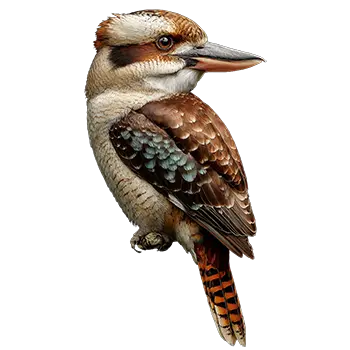

Kookaburras are large, powerful kingfishers that require significantly more space than comparably sized parrots. A Laughing Kookaburra measures fifteen to eighteen inches in length, with a robust body, a heavy head, and a large bill designed for striking prey against hard surfaces. Their flight style is direct and swift rather than acrobatic, and they need long, unobstructed flight paths to maintain cardiovascular fitness and muscle tone. Housing that restricts flight to short hops between closely spaced perches will produce a physically deteriorated bird over time, regardless of how well other aspects of care are managed.
The minimum recommended enclosure for a single Kookaburra is a flight aviary measuring at least twelve feet long, six feet wide, and seven feet tall. Pairs require proportionally more space, and breeding pairs need enough room to establish territorial boundaries and perform courtship flights without constant confinement stress. These dimensions represent minimums, not ideals — larger is always better for a species that ranges across considerable territory in the wild. Keepers who cannot provide an enclosure of this scale should seriously reconsider whether a Kookaburra is the right species for their circumstances.
Unlike parrots, which spend much of their time climbing and hanging from cage bars, Kookaburras are perch-and-pounce predators. They spend long periods sitting motionless on elevated perches, scanning for prey, and then launch into swift descents. This behavioral pattern means that vertical height with well-placed perches at various levels is more functionally important than sheer floor area, though both matter. The enclosure design should prioritize a few long, clear flight lines between perching stations rather than cluttering the space with obstacles that fragment the available volume.
Outdoor housing is strongly preferred over indoor housing for Kookaburras in climates where it is feasible. Exposure to natural sunlight provides essential ultraviolet radiation for vitamin D3 synthesis and calcium metabolism, natural temperature variation supports seasonal physiological cycling, and ambient sounds and visual stimulation from the outdoor environment contribute to psychological well-being. Indoor housing can work when supplemented with full-spectrum lighting and environmental enrichment, but it demands considerably more active management to approximate the benefits that outdoor exposure provides passively.