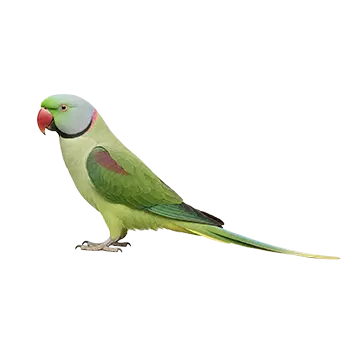

Enrichment Needs

Derbyan Parakeets are cognitively advanced birds whose wild behavior revolves around foraging, problem-solving, and social interaction across expansive montane forest territories. In captivity, where food is delivered in a dish and the environment rarely changes, the gap between the bird's intellectual capacity and the stimulation available to it can become enormous. Toys and enrichment devices exist to close that gap, and they are not optional accessories but essential components of responsible Derbyan Parakeet husbandry.

The consequences of inadequate enrichment are well documented in psittacine behavior literature. Boredom and frustration manifest as feather-destructive behavior, stereotypic movements such as repetitive pacing or head-swinging, excessive screaming, and aggression. Derbyan Parakeets are particularly susceptible to feather plucking when under-stimulated, and once the habit is established it can be extremely difficult to reverse even after enrichment is improved. Prevention through proactive environmental enrichment is far more effective than behavioral intervention after problems have developed.

Effective enrichment engages multiple sensory and cognitive pathways. A toy that requires the bird to manipulate, disassemble, or solve a problem to access a reward engages cognitive function. A toy that produces sound when shaken or struck provides auditory stimulation. Textural variety in materials, from smooth wood to rough bark to woven grass, stimulates tactile exploration. The best enrichment programs incorporate all of these elements through a diverse and regularly rotated collection of toys and activities.

It is worth noting that not every Derbyan Parakeet will engage with every type of toy immediately. This species can be cautious about novel objects, and new toys sometimes sit untouched for days or even weeks before the bird begins to investigate them. Placing a new toy near but not inside the cage initially, then moving it to the cage exterior, and finally positioning it inside allows a gradual introduction that respects the bird's comfort level. Forcing interaction by placing unfamiliar objects directly next to preferred perches can provoke anxiety rather than curiosity.

What to Look For

Safety is the non-negotiable first criterion when evaluating any toy for a Derbyan Parakeet. The bird's strong beak can reduce many toys to their component parts quickly, and every one of those components must be non-toxic and free of entanglement or ingestion hazards. Metal hardware should be stainless steel or nickel-plated steel, never zinc-coated or galvanized, as zinc toxicity from ingested metal fragments is a recognized hazard in aviculture. Any chains should use welded links rather than split rings, which can trap toes and beaks.

The materials that make up the toy's body determine both its safety and its engagement value. Natural, untreated wood is the foundation of most quality bird toys, and the wood species matters. Balsa, pine, yucca, and cactus wood are soft enough for satisfying destruction without posing a splintering hazard. Harder woods like manzanita and java wood are more durable and better suited for perch-style toys or structural elements that are not intended to be destroyed. Leather components should be vegetable-tanned rather than chrome-tanned, as chromium residues from the tanning process are toxic. Rope elements should be natural cotton, sisal, or hemp, and any fraying should be trimmed immediately to prevent toe entanglement.

Size appropriateness is frequently overlooked. Toys designed for budgies or cockatiels are too small and too fragile for a Derbyan Parakeet, offering neither adequate engagement nor safe play. Conversely, toys built for macaws may be too large for the bird to manipulate effectively, leading to frustration and disinterest. Toys marketed for medium parrots, conures, or small cockatoos generally provide the right scale for this species in terms of both physical dimensions and the force required to interact with them.

Durability should be evaluated relative to the toy's intended purpose. Destructible toys, those meant to be chewed apart and eventually replaced, should be inexpensive enough to replace regularly without straining the budget. Permanent enrichment devices like foraging wheels, puzzle boxes, and activity centers should be built to withstand sustained beak contact and daily use over months or years. A well-balanced toy collection includes both categories, providing the satisfaction of destruction alongside the enduring challenge of reusable puzzles.

Foraging Toys

Foraging toys replicate the most time-consuming activity in a wild Derbyan Parakeet's day: searching for and extracting food from its environment. In the wild, these birds may spend six to eight hours daily foraging, manipulating pine cones, peeling bark, and probing flowers and seed pods. A captive bird that eats its daily ration from an open dish in fifteen minutes is left with hours of unoccupied time that foraging toys can help fill.

The simplest foraging toys involve hiding food within or behind barriers that the bird must remove. Untreated paper cups filled with pellets or treats and placed inside the food dish force the bird to tear through the paper to access the food. Crumpled sheets of brown paper or small paper bags containing hidden food items work on the same principle. These disposable foraging opportunities cost virtually nothing to create and can be varied endlessly, making them an excellent daily enrichment strategy.

Commercial foraging toys range from simple to complex. Entry-level products include acrylic tubes with removable caps, bamboo cylinders packed with shredded paper and treats, and natural fiber pouches that must be untied or torn open. More advanced foraging devices feature sliding panels, rotating compartments, or threaded lids that require specific manipulation sequences to access the food inside. For a Derbyan Parakeet new to foraging toys, starting with simple designs and gradually increasing complexity prevents the frustration that can cause a bird to give up on foraging enrichment entirely.

Foraging walls and boards represent a more permanent foraging installation. These typically consist of a flat panel mounted to the cage wall, fitted with multiple cups, drawers, or covered compartments that can be loaded with different food items. They provide a centralized foraging station that engages the bird for extended periods and can be reconfigured by changing the contents of individual compartments. Some designs allow the addition of new modules as the bird masters existing ones, providing an escalating challenge that keeps pace with the bird's developing skills.

Chewing & Shredding Toys

The drive to chew is deeply embedded in psittacine behavior, serving functions that go beyond simple boredom relief. Chewing conditions the beak, keeping its edges sharp and its length properly maintained. It exercises the jaw musculature, provides tactile and proprioceptive stimulation, and satisfies an instinctive urge to manipulate and deconstruct objects. A Derbyan Parakeet denied appropriate chewing outlets will redirect this drive toward cage bars, perches, furniture, or its own feathers.

Soft wood toys offer the most satisfying chewing experience for this species. Balsa wood blocks, pine slats, and yucca chunks can be reduced to splinters within hours by an enthusiastic Derbyan Parakeet, which is exactly the point. These toys should be viewed as consumable items, budgeted for replacement on a regular basis. Many owners purchase bulk packs of wooden blocks, slats, and shapes, stringing them together with leather laces or stainless steel wire to create custom chewing toys at a fraction of the cost of pre-assembled commercial products.

Shredding toys made from palm leaf, corn husk, seagrass, and woven paper provide a different textural experience from solid wood. The act of pulling apart fibrous material engages the bird's feet and beak in coordinated manipulation that closely mimics the process of stripping bark and husking seeds in the wild. Commercially available shredding toys come in a wide range of designs, from simple bundles of palm strips to elaborate woven baskets and mats that offer hours of methodical dismantling.

Cardboard and paper-based toys occupy an important niche in the chewing and shredding category. Untreated cardboard boxes, paper towel rolls, and phone book pages can be offered directly as inexpensive shredding material. Some birds develop strong preferences for specific paper weights or textures, and experimenting with different materials helps identify what a particular Derbyan Parakeet finds most engaging. The key safety consideration is ensuring that all paper and cardboard is free of inks, adhesives, and coatings that could be toxic if ingested. Plain brown kraft paper and unprinted cardboard are the safest options.

Puzzle & Intelligence Toys

Puzzle toys challenge the Derbyan Parakeet's cognitive abilities in ways that other toy categories do not. These devices require the bird to observe, analyze, and execute specific actions, often in sequence, to achieve a reward. The cognitive engagement they provide is qualitatively different from the physical satisfaction of chewing or shredding, and it exercises mental faculties that are otherwise underutilized in captivity.

Entry-level puzzle toys include devices with simple sliding or rotating mechanisms that reveal hidden treats when operated correctly. Acrylic boxes with pull-out drawers, stacking rings that must be removed to access a treat cup beneath, and threaded bolts that the bird unscrews to open a compartment all fall into this category. Derbyan Parakeets that have never encountered puzzle toys should begin here, as immediate success builds confidence and motivation to tackle more complex challenges.

Intermediate and advanced puzzle toys introduce multi-step solutions, requiring the bird to complete two or more distinct actions in the correct order to access the reward. A device might require lifting a latch, sliding a cover, and then pulling a drawer, with no shortcut available. Some advanced toys incorporate color matching or shape sorting, though the degree to which birds solve these through genuine categorization versus trial and error is debated in the behavioral literature. Regardless of the cognitive mechanism involved, the sustained engagement these toys provide is beneficial.

DIY puzzle toys can be as effective as commercial products and offer the advantage of infinite customization. A muffin tin with treats placed in individual cups and covered with crumpled paper or small balls requires the bird to remove each cover to access the food, providing a simple but effective puzzle. Treats threaded onto knotted leather strips must be worked off sequentially. Small boxes nested inside larger boxes demand progressive unwrapping. The only limits on homemade puzzle design are safety and the owner's creativity, and many Derbyan Parakeet owners find that designing new puzzles becomes an enjoyable hobby in its own right.

Physical Activity Toys

Physical activity toys encourage movement, climbing, and aerial play that support the Derbyan Parakeet's cardiovascular fitness, muscle tone, and joint health. A bird that spends most of its time perched in a single spot, even if that spot is comfortable and well-positioned, is not getting the exercise it needs for long-term physical health. Activity toys create incentives for the bird to move through its environment in varied and engaging ways.

Swings are among the most universally enjoyed activity toys for Psittacula species. A well-constructed swing provides dynamic, unpredictable movement that challenges the bird's balance and grip, exercising core and leg muscles that remain largely inactive during stationary perching. Swings for Derbyan Parakeets should be built from sturdy materials with a perching surface appropriate for the bird's foot size, roughly three-quarters of an inch in diameter. Positioning the swing high in the cage encourages the bird to climb to reach it, adding an additional physical challenge.

Ladders and climbing structures extend the three-dimensional space available to the bird. Rope ladders, wooden runged ladders, and spiral climbing poles encourage vertical movement that exercises different muscle groups than horizontal perching and walking. Cargo nets made from natural fiber rope create a climbing surface that can be attached to the cage wall or suspended from the top, providing an expansive climbing area that doubles as a resting platform with an interesting texture.

Boing springs, which are large coiled rope or wire perches that bounce and sway when the bird moves, combine perching with unpredictable motion. They can be mounted vertically as climbing poles or horizontally as swaying perches, and many Derbyan Parakeets develop a strong attachment to their boings, using them as preferred resting spots as well as play equipment. Ring toys that encourage the bird to hang upside down or swing through an opening provide gymnastic challenges that are both physically demanding and visually entertaining for the owner.

Rotation & Safety

Toy rotation is a management strategy that prevents habituation and maintains the enrichment value of the toy collection over time. A toy that initially captivated a Derbyan Parakeet for hours will eventually become part of the background, ignored as thoroughly as the cage bars. By removing toys from the cage before they become completely uninteresting and reintroducing them after a period of absence, owners can maintain a sense of novelty without continuously purchasing new items.

A practical rotation schedule involves keeping three to five toys in the cage at any time and swapping individual toys every few days to a week. The removed toys should be cleaned, inspected for damage, and stored until their next rotation. Maintaining a reserve of eight to twelve toys allows for a rotation cycle of several weeks before any single toy reappears, which is generally sufficient to restore the bird's interest. Destructible toys that have been partially or fully consumed during their time in the cage should be replaced with fresh examples of the same type or entirely new designs.

Safety monitoring must be continuous and proactive. Every toy should be inspected each time it goes into or comes out of the cage. Specific hazards to check for include fraying rope that could entangle toes, cracked or splintered plastic components, loosened metal hardware, and worn leather strips that might break under the bird's weight. Toys with small parts that have been partially detached should be removed immediately, as the bird may swallow the freed piece. Bells are a common source of hazard when the clapper or mounting pin loosens with use, so these should receive particular attention during inspections.

Homemade and natural toys require the same safety scrutiny as commercial products. Branches collected from the outdoors must be confirmed as bird-safe species and should be scrubbed and baked to kill parasites and bacteria before use. Common safe species include apple, pear, willow, and eucalyptus, while cherry, cedar, and redwood contain compounds that are toxic to birds. Pine is generally considered safe when it is untreated and free of sap. Any natural material collected from roadsides or treated lawns may carry pesticide or herbicide residues and should be avoided regardless of the wood species.

Always consult a qualified professional before making any health-related decisions. This content is provided for informational reference only and should not replace professional guidance specific to your animal.