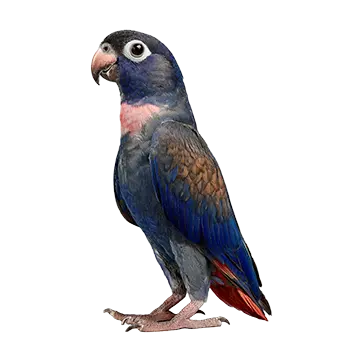

Enrichment Needs of the Bronze-Winged Pionus

The Bronze-Winged Pionus possesses a quiet intelligence that is easy to underestimate. Unlike the flashy problem-solving displays of cockatoos or the vocal exuberance of Amazons, the Pionus engages with its environment in a more methodical, contemplative manner. This temperament means that enrichment for this species should emphasize sustained engagement over high-intensity stimulation. Toys that reward patient manipulation — working a treat out of a crevice, unthreading a knot, or disassembling a layered structure — align well with the Pionus's natural approach to its surroundings.

In the wild, Bronze-Winged Pionus spend substantial portions of their day foraging through the canopy of Andean cloud forests, manipulating seed pods, stripping bark, and exploring crevices in branches. Captivity eliminates this foraging workload entirely, leaving the bird with hours of unoccupied time that, without appropriate enrichment, can lead to boredom, feather-destructive behavior, and apathy. The goal of a well-designed enrichment program is to replace the cognitive and physical demands of wild foraging with captive equivalents that keep the bird's mind active and its beak productively engaged.

Enrichment needs are not static. A toy that captivates a Bronze-Winged Pionus for a week may be completely ignored the following week, not because the toy has lost its quality but because the bird has exhausted its novelty. Successful enrichment programs rely on rotation, variety, and periodic reintroduction of previously retired items. Maintaining a library of toys and cycling groups of them in and out of the cage on a regular schedule keeps the environment feeling fresh without requiring a constant outlay for new purchases.

The individual personality of the bird also shapes enrichment preferences. Some Bronze-Winged Pionus are enthusiastic chewers who demolish wood toys with evident satisfaction, while others are more interested in manipulative puzzles or foot toys they can hold and turn. Observing which toy types the bird gravitates toward — and which it ignores — provides the most reliable guide for future purchases. A bird that has never shown interest in a particular toy category may simply need a different size, material, or presentation rather than a different category entirely.

Foraging Toys and Puzzle Feeders

Foraging toys are arguably the single most important enrichment category for any captive parrot, and the Bronze-Winged Pionus responds particularly well to foraging challenges that match its methodical temperament. The simplest foraging toys involve hiding food inside a container that the bird must open, unwrap, or disassemble to access its reward. Foraging cups with removable lids, paper-wrapped treat bundles, and vine balls stuffed with treats provide entry-level foraging challenges suitable for birds new to the concept.

As the bird develops foraging skills, graduated difficulty is essential for maintaining engagement. Intermediate foraging devices include acrylic puzzle boxes with sliding doors, foraging wheels that must be rotated to release food through small openings, and stacked foraging trays where the bird must remove successive layers to reach food hidden at the bottom. The Bronze-Winged Pionus often shows particular aptitude for multi-step puzzles that require more than one action to access the reward, provided the difficulty increase is gradual enough to avoid frustration.

Commercial foraging systems designed for medium-sized parrots offer a wide range of complexity levels. Products that allow the owner to adjust the difficulty — by changing the size of access openings, adding additional barriers, or altering the amount of food hidden inside — provide the longest useful life. Some manufacturers offer modular foraging systems where individual components can be combined in different configurations, creating essentially unlimited puzzle variations from a modest initial investment.

Do-it-yourself foraging opportunities are a cost-effective supplement to commercial foraging toys. Wrapping treats in plain, unbleached paper, tucking food inside clean cardboard tubes, or threading vegetables onto a stainless steel skewer all create foraging opportunities from readily available household materials. The key requirements are that all materials used are non-toxic, free of inks and adhesives that the bird might ingest, and sized appropriately so the bird cannot become entangled or accidentally swallow large pieces.

Chew Toys and Destructible Items

The urge to chew is deeply ingrained in parrot behavior, serving functions that range from beak conditioning and jaw exercise to stress relief and pure entertainment. Bronze-Winged Pionus, while not the most aggressive chewers among medium-sized parrots, still benefit substantially from regular access to appropriate chew targets. Without them, the bird may redirect its chewing instinct toward cage bars, perches, or furnishings during out-of-cage time, leading to beak damage and property destruction.

Softwood toys made from balsa, yucca, or pine offer satisfying resistance for the Bronze-Winged Pionus's beak without being so hard that the bird becomes discouraged. Balsa wood in particular is soft enough to yield visible results quickly, which can be especially motivating for birds that are new to chewing or have been kept in environments without chew toys. As the bird's chewing confidence and beak strength develop, incorporating harder woods like birch, maple, or manzanita provides increased challenge and longer-lasting engagement.

Leather strips, natural fiber rope, and palm leaf shredders add textural variety to the chew toy selection. Vegetable-tanned leather is the only safe leather option for parrot toys — chrome-tanned leather contains toxic heavy metals and must be avoided. Natural sisal, cotton, and jute ropes provide different tactile experiences and can be tied into knots of varying complexity for the bird to unravel. Palm leaf and corn husk toys are particularly popular with Pionus species, which seem to enjoy the process of stripping and shredding fibrous plant material.

Safety inspection of chew toys should be a regular practice. As toys are destroyed through normal use, they can develop sharp points, frayed rope ends that pose entanglement risks, or loosened hardware that could be swallowed. Removing and replacing chew toys before they reach a dangerous state of disrepair is far preferable to dealing with an injury. Quick-link attachments and pear-link clips simplify toy changes, but these hardware pieces should themselves be made of stainless steel or nickel-plated steel rather than zinc-plated hardware, which introduces a heavy metal toxicity risk.

Foot Toys and Manipulatives

Foot toys are small objects designed to be picked up, held, and manipulated by the bird using its feet and beak in coordination. They provide fine motor exercise and cognitive engagement in a format that differs significantly from hanging cage toys, and many Bronze-Winged Pionus develop strong preferences for particular foot toys that become favored play objects for extended periods. The appeal of foot toys lies in the bird's ability to control the object entirely — turning it, tossing it, examining it from every angle — which satisfies exploratory instincts in a way that fixed cage toys cannot.

Common foot toy materials include small wooden blocks, acrylic beads strung on wire or leather, vine balls, woven palm leaf rings, and small cardboard or paper constructions. The ideal size for a Bronze-Winged Pionus foot toy is large enough to grip comfortably but small enough to manipulate freely — roughly one to two inches in diameter for spherical toys, or two to three inches long for elongated shapes. Toys that are too large to grasp or too small to manipulate satisfyingly will be ignored.

Interactive foot toys that produce sounds or movement when manipulated often hold a Pionus's attention longer than static objects. Small bells encased in acrylic or wooden housings, rattles containing beads, and interlocking ring sets that click and shift during manipulation provide auditory feedback that reinforces play behavior. The Bronze-Winged Pionus is not generally a noisy player, but the subtle sounds produced by a well-designed foot toy clearly engage this species's attention and encourage continued interaction.

A collection of eight to twelve foot toys, rotated so that only three or four are available at any time, keeps the play area feeling novel without overwhelming the bird with choices. Scattering foot toys on a play stand or tabletop surface during supervised out-of-cage time encourages the bird to move from toy to toy, combining physical activity with mental engagement. Some owners designate a shallow tray or basket as the bird's foot toy station, which concentrates the toys in a defined area and makes cleanup straightforward.

Swings, Ladders, and Climbing Structures

Swings provide a form of physical stimulation that no other toy category replicates. The gentle rocking motion engages the bird's balance and proprioceptive systems, strengthening core muscles and coordination. Many Bronze-Winged Pionus develop a clear fondness for swings and will use them as preferred resting spots, gently swaying while preening or observing household activity. A swing sized for medium parrots, with a perch diameter between five-eighths and three-quarters of an inch, suits this species well.

Swing construction materials should follow the same safety guidelines as perches and other cage accessories. Natural wood perch bars on stainless steel chains or frames are the safest and most durable option. Rope swings made from natural cotton or sisal provide a different gripping texture and a softer motion, though rope components should be inspected regularly for fraying that could entangle toes. Platform swings, which replace the perch bar with a flat wooden or acrylic platform, offer a broader resting surface that some Pionus prefer, particularly for extended lounging.

Ladders made from natural wood rungs connected by stainless steel hardware or natural rope encourage climbing exercise and provide transitional pathways between perch levels within the cage or between the cage and a play area. The spacing between rungs should be comfortable for the bird's stride — approximately three to four inches for a Bronze-Winged Pionus. Ladders positioned at an angle rather than vertically are easier for this species to navigate and see more use than steep vertical ladders.

Freestanding play gyms and climbing structures designed for medium-sized parrots serve as out-of-cage activity centers where the bird can exercise, play with toys, and socialize with the household from an elevated vantage point. The best play gyms for Bronze-Winged Pionus feature multiple perch levels, attachment points for hanging toys, integrated food and water cups, and a tray base for catching debris. Java wood and manzanita play stands are durable and provide the irregular branching structure that parrots find most engaging, while modular PVC or hardwood gym systems offer configurability at a lower price point.

Sound and Interactive Toys

While the Bronze-Winged Pionus is among the quieter parrot species, it is far from uninterested in sound. Many individuals develop clear responses to music, rhythmic sounds, and their own vocalizations, and sound-producing toys can engage this auditory awareness in enriching ways. Small bells made from stainless steel, rattle toys containing sealed beads, and chimes that produce tones when struck by the bird's beak all provide auditory enrichment without generating the volume levels that might distress this noise-sensitive species.

Interactive electronic toys designed for parrots have expanded the enrichment market in recent years. Devices that play recorded sounds or music when the bird activates a trigger — by stepping on a pressure pad, pulling a lever, or tapping a button — introduce an element of cause-and-effect learning that resonates with the Pionus's thoughtful approach to problem-solving. The best of these devices are battery-powered, constructed from bird-safe materials, and designed to be operated by a medium-sized parrot's beak or foot without excessive force.

Mirrors are a contentious enrichment item in avian circles, and their appropriateness depends on the individual bird's response. Some Bronze-Winged Pionus enjoy brief mirror interactions as social stimulation, while others become obsessively fixated on their reflection, treating it as a rival or mate in ways that increase stress and disrupt normal social behavior. If a mirror is introduced, it should be offered during supervised play sessions initially, and the bird's behavioral response should be carefully monitored. Any signs of aggression, obsessive preening directed at the reflection, or regurgitation toward the mirror indicate that the item should be permanently removed.

Television and tablet screens attract the attention of many Pionus parrots, and some owners use nature videos or bird-specific programming as a form of passive enrichment. While screen time should never replace interactive enrichment, it can serve as a supplemental stimulus during periods when the bird is caged and the household is away. The content should feature natural scenes, bird calls, or gentle music rather than fast-paced action or loud sound effects, which can startle or stress a naturally cautious species.

Toy Safety and Rotation Strategy

Safety vigilance is an ongoing responsibility that accompanies every toy introduced into a Bronze-Winged Pionus's environment. Before offering any new toy, a thorough inspection should assess the materials, hardware, and construction for potential hazards. Zinc-plated hardware, lead-based dyes, chrome-tanned leather, loosely attached small parts, and toxic wood species are the most common safety concerns in commercially manufactured bird toys. Reputable avian toy manufacturers clearly list their materials and hardware specifications, and purchasing from established brands with transparent sourcing provides an important layer of assurance.

String, rope, and fiber components require particular attention because they present entanglement and ingestion risks. Loose threads from rope perches or frayed fabric strips on toys can wrap around toes, restricting blood flow and causing tissue necrosis within hours if not discovered. Ingested fibers can accumulate in the crop or intestines, creating blockages that require surgical intervention. Trimming frayed rope ends promptly, replacing rope toys when they begin to unravel, and choosing toys with tightly woven or braided fiber components over loosely strung ones all reduce these risks.

A structured rotation schedule maximizes the enrichment value of the toy inventory while preventing the staleness that comes from a static environment. A practical approach is to divide the total toy collection into three or four groups and rotate one group into the cage every five to seven days. Within each group, include at least one foraging toy, one chew toy, and one manipulative or foot toy to ensure variety across categories. Keeping a log of which groups are currently deployed and which toys within each group the bird engages with most helps refine the rotation over time.

Budgeting for ongoing toy replacement is a realistic part of Pionus ownership that new owners sometimes overlook. Destructible toys are designed to be consumed, and a bird that actively chews and forages will go through them steadily. Setting aside a modest monthly budget for toy replenishment ensures that the bird always has fresh enrichment available. Supplementing commercial purchases with homemade foraging and chewing opportunities made from safe household materials — paper, cardboard, untreated wood scraps — stretches the enrichment budget without compromising quality or safety.

Always consult a qualified professional before making any health-related decisions. This content is provided for informational reference only and should not replace professional guidance specific to your animal.