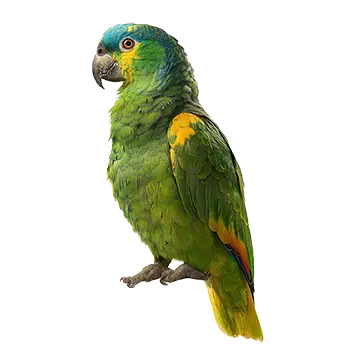

The Blue-Fronted Amazon is an active, physically robust parrot that requires generous living space to maintain physical and psychological health. Minimum recommended cage dimensions for this species are 36 inches wide by 24 inches deep by 48 inches tall, though larger is always preferable. A cage of these dimensions allows the bird to spread its wings fully, climb without restriction, and move between multiple perch levels without contorting its body. Width is more important than height for Amazons, as these birds tend to move horizontally rather than vertically in their daily activity patterns.
The practical reality of Amazon parrot ownership is that the cage serves as a home base rather than a full-time living space. Blue-Fronted Amazons that spend the majority of their waking hours inside their cage, even a spacious one, will develop behavioral problems ranging from feather destruction to aggression. The cage should be large enough to house the bird safely and comfortably during unsupervised hours and overnight, but daily out-of-cage time in a bird-safe room or on a play stand is not optional for this species. Owners who cannot provide several hours of supervised out-of-cage time each day should reconsider whether an Amazon parrot is the right choice.
Flight cages and indoor aviaries represent the upper end of the housing spectrum and are increasingly popular among dedicated Amazon owners. These enclosures, typically measuring six feet or more in at least one dimension, allow limited flight and far more natural movement patterns than a standard cage. Walk-in aviaries that permit the owner to enter the enclosure for interaction and maintenance offer the additional benefit of simplifying cleaning and social engagement. The investment in a flight cage or small aviary pays dividends in reduced behavioral problems and improved physical fitness over the bird's multi-decade lifespan.
Corner placement is a common cage positioning strategy that provides the bird with two walls of visual security while maintaining a clear sightline into the room. Placing the cage at chest height or slightly above allows the bird to observe household activity from a comfortable vantage point. Cages positioned on the floor or below eye level can make Amazons feel vulnerable and defensive, while cages placed well above head height can contribute to dominance behaviors. Avoiding direct proximity to windows, exterior doors, kitchen spaces, and heating or cooling vents protects the bird from temperature fluctuations, drafts, airborne cooking fumes, and the stress of perceived outdoor predators.