
Growth & Physical Development

The juvenile stage of the Eastern Milk Snake (Lampropeltis triangulum triangulum) spans roughly from six months of age through the onset of sexual maturity, which typically occurs between eighteen and thirty months depending on feeding regimen, thermal conditions, and individual genetics. During this period, the snake transitions from a delicate hatchling into a robust sub-adult, and the husbandry adjustments required to support this transformation are substantial. Understanding the pace and pattern of juvenile growth is essential for anticipating enclosure upgrades, dietary changes, and shifts in behavior.

A well-maintained juvenile Eastern Milk Snake will grow from approximately sixteen to twenty inches at six months to its near-adult length of twenty-four to thirty-two inches by eighteen to twenty-four months of age. Growth is not perfectly linear; it occurs in bursts that correlate with shedding cycles, as each shed event accommodates the expanding body. Juveniles typically shed every four to six weeks during periods of active growth, and each post-shed measurement should reveal a measurable increase in length. A juvenile that stops growing or begins losing weight between sheds may be underfed, harboring parasites, or experiencing chronic stress from inadequate environmental conditions.

Body proportions shift noticeably during the juvenile stage. Hatchlings have proportionally large heads relative to their bodies, giving them a somewhat gangly appearance. As the body fills out during adolescence, the head-to-body ratio normalizes and the snake develops the smooth, cylindrical body profile characteristic of adult Lampropeltis. Muscle mass increases visibly along the dorsal surface, and the ventral scales broaden and flatten as the snake gains girth. A healthy juvenile should feel firm and muscular when handled, with no visible spine ridging or concavity along the flanks that would indicate underweight condition.

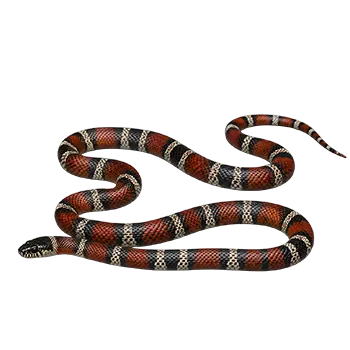
Color and pattern may undergo subtle changes during the juvenile stage. While the fundamental banding pattern of reddish-brown saddles bordered by black remains consistent, the intensity of the red pigment often deepens as the snake matures, and the lighter interband spaces may shift from cream or white toward a warmer buff or tan. These color changes are gradual and vary among individuals, influenced by genetics, diet quality, and ambient lighting conditions. Keepers should not be alarmed by slight color shifts between sheds, as this is a normal aspect of maturation in the species.

Feeding Progression & Dietary Management

Feeding management during the juvenile stage centers on the gradual transition from pinky mice to appropriately sized prey items that match the snake's increasing girth. The fundamental rule remains constant throughout the snake's life: each prey item should be no wider than one and a half times the diameter of the snake at its widest point, and should produce a modest but visible lump after consumption that is fully digested within forty-eight to seventy-two hours. For most juveniles, this means progressing from pinky mice through fuzzy mice and then to small hopper mice over the course of several months.

The transition between prey sizes should be gradual and responsive to the individual snake's growth rather than driven by a predetermined schedule. When a pinky mouse no longer produces any visible lump after feeding, it is time to move to the next size. Offering a prey item that is too large can result in regurgitation, which sets back the feeding schedule by at least ten days and can create a pattern of food refusal if it occurs repeatedly. When in doubt, err on the side of a slightly smaller prey item offered more frequently rather than pushing to a larger size prematurely.

Feeding frequency for juveniles can be reduced from the hatchling schedule of every five to six days to once every seven to ten days as the snake approaches the twelve-month mark. This reduction mirrors the metabolic reality that larger prey items provide proportionally more caloric and nutritional value per meal, and that the juvenile's growth rate naturally decelerates as it approaches adult size. Overfeeding juveniles in an attempt to accelerate growth — a practice sometimes called power feeding — leads to obesity, hepatic lipidosis (fatty liver disease), and a shortened lifespan. A slow, steady growth curve produces a healthier and longer-lived animal than rapid forced development.

Frozen-thawed rodents should remain the staple diet throughout the juvenile stage. Some keepers supplement with the occasional appropriately sized anole or house gecko to provide dietary variety, and while Eastern Milk Snakes do consume lizards and other small reptiles in the wild, this practice carries the risk of introducing parasites that are not present in commercially bred feeder rodents. If reptile prey is offered, it should be sourced from established captive colonies rather than wild-caught, and the frequency should not exceed one lizard meal per month at most. A well-nourished juvenile raised exclusively on rodent prey will suffer no nutritional deficiencies.

Enclosure Upgrades & Habitat Enrichment

The small shoebox-style enclosure appropriate for a hatchling becomes inadequate once the juvenile Eastern Milk Snake reaches approximately sixteen to eighteen inches in length, typically around the four-to-six-month mark. At this point, the snake should be transitioned to a larger enclosure measuring approximately 24 by 18 by 12 inches, which provides adequate space for thermoregulation, exploration, and exercise while remaining manageable enough for the snake to feel secure. Overly large enclosures can cause stress in shy juvenile colubrids, so the upgrade should be proportional to the snake's size rather than anticipating its eventual adult dimensions.

A second enclosure upgrade is generally warranted between twelve and eighteen months of age, when the snake has reached or is approaching its sub-adult length of twenty to twenty-eight inches. At this stage, an enclosure measuring 36 by 18 by 12 inches or the equivalent volume provides ample space for adult-level thermoregulation, multiple hide options, and naturalistic furnishing. This enclosure size is also suitable for adult Eastern Milk Snakes and may serve as the permanent home if dimensions are chosen with the animal's full adult size in mind.

Habitat enrichment becomes increasingly important during the juvenile stage as the snake's confidence and exploratory behavior develop. In addition to the essential warm-side and cool-side hides, juvenile enclosures benefit from the addition of cork bark tubes, grapevine branches, and artificial foliage that provide climbing opportunities and visual barriers. Eastern Milk Snakes are semi-fossorial and appreciate substrate deep enough to burrow in — two to three inches of aspen shavings or coconut coir allows the snake to engage in natural burrowing behavior, which reduces stress and promotes psychological well-being. Avoid substrates that produce dust or that the snake might ingest during feeding, including sand, calcium sand, and ground walnut shell.

The substrate transition from paper towel to a naturalistic bedding is best timed to coincide with the first enclosure upgrade. By six months of age, most juveniles are precise enough strikers that the risk of substrate ingestion during feeding is minimal, particularly when feeding is conducted with tongs in a consistent location within the enclosure. If a keeper remains concerned about substrate ingestion, feeding the snake inside a separate, bare-bottomed container eliminates the risk entirely, though this practice adds handling events around mealtimes and may not be necessary for animals that feed cleanly within their enclosures.

Behavioral Changes & Temperament Development

The juvenile stage is the period during which an Eastern Milk Snake's adult temperament is most actively shaped by its interactions with its keeper. While baseline temperament is influenced by genetics — some bloodlines produce consistently calmer individuals than others — the frequency, consistency, and quality of handling during the juvenile months plays a decisive role in determining whether the snake matures into a calm, easily managed adult or a persistently flighty and defensive animal. This is not to say that an adult snake cannot be socialized, but the effort required is substantially greater once defensive patterns have solidified.

Juvenile Eastern Milk Snakes that have been handled regularly since their hatchling stage typically show a marked reduction in defensive behaviors by the six-to-nine-month mark. Musking becomes infrequent, tail rattling decreases, and the frantic escape behavior of the neonate gives way to calm, purposeful exploration during handling sessions. Handling sessions can be gradually extended from the initial three to five minutes to ten to fifteen minutes as the snake matures, though sessions should never extend to the point where the snake becomes restless or begins actively seeking an exit. Learning to read the snake's body language — smooth, steady tongue-flicking indicates curiosity, while rapid jerky movements and a tightly coiled posture signal stress — is a skill that develops with experience.

Juvenile Eastern Milk Snakes are primarily crepuscular and nocturnal, and most activity within the enclosure occurs during the evening and early nighttime hours. Keepers who observe their animals during these active periods will notice regular circuit-patrolling of the enclosure perimeter, tongue-flicking investigation of scent trails, and exploratory climbing on cage furnishings. This activity level is a positive indicator of health and environmental comfort; a juvenile that remains buried or hidden around the clock, even during its natural active period, may be too cold, too stressed, or unwell.

One behavioral pattern that frequently alarms new keepers is the pre-shed period of inactivity and food refusal. For several days before each shed, the juvenile will become reclusive, refuse food, and may display increased defensive behavior if disturbed. The eyes will cloud over to a milky blue-gray as the old spectacle layer separates from the new one beneath it, temporarily impairing vision and making the snake feel vulnerable. This is an entirely normal physiological process, and the best response is to ensure humidity is elevated to 60 to 70 percent, provide a humidity hide if one is not already present, and leave the snake undisturbed until the shed is complete. Attempting to handle or feed a snake in pre-shed condition is counterproductive and can damage the trust built through weeks of consistent socialization.

Common Juvenile Health Issues

Internal parasites represent the most prevalent health concern for juvenile Eastern Milk Snakes, particularly those that were hatched from wild-caught parents or acquired from large-scale breeders where cross-contamination between animals is difficult to prevent entirely. The most commonly encountered internal parasites in captive Lampropeltis species are ascarid roundworms, which inhabit the gastrointestinal tract and can be identified through fecal flotation testing. Signs of a significant parasite burden include regurgitation, failure to gain weight despite adequate feeding, visibly distended midsection between meals, and the occasional passage of visible worms in the feces. Treatment is straightforward under veterinary guidance, typically involving one or two doses of an oral anthelmintic such as fenbendazole administered two weeks apart.

Scale rot, or ulcerative dermatitis, is a bacterial skin infection that develops when a snake is maintained on consistently damp or soiled substrate. The condition presents as discolored, softened, or blistered scales on the ventral surface, and if left untreated, it can progress to deep tissue infection and septicemia. Prevention is far more effective than treatment: spot-clean the enclosure promptly after every defecation, ensure substrate remains dry except within the humidity hide, and provide adequate ventilation to prevent stagnant, overly humid conditions. Mild cases respond to daily application of a dilute povidone-iodine solution and immediate correction of the underlying environmental issue, but moderate to severe cases require systemic antibiotic therapy prescribed by a veterinarian.

Respiratory infections remain a risk through the juvenile stage, though they are less common in well-maintained enclosures than during the more vulnerable hatchling period. The immune system of a juvenile Eastern Milk Snake is more robust than that of a neonate, but chronic environmental stressors — particularly temperatures that are consistently too low, humidity that is chronically too high, or poor ventilation — can overwhelm even a healthy immune response. Early symptoms include subtle changes in respiratory sounds, increased time spent resting with the head tilted upward, a slight excess of mucus at the nares, and reduced appetite. Because respiratory infections in snakes can progress from mild to life-threatening over a matter of days, prompt veterinary attention is essential at the first sign of respiratory compromise.

Routine veterinary care for juveniles should include an annual fecal examination and a physical assessment. While many healthy juvenile Eastern Milk Snakes never require veterinary intervention beyond parasite screening, establishing a relationship with a reptile-experienced veterinarian before an emergency arises is invaluable. Reptile medicine is a specialized field, and not all small-animal veterinarians are comfortable diagnosing and treating snakes. Locating a qualified practitioner proactively, through referrals from local herpetological societies or the Association of Reptilian and Amphibian Veterinarians, ensures that expert care is available when it is needed.

Preparing for the Transition to Adulthood

As a juvenile Eastern Milk Snake approaches eighteen to twenty-four months of age, its growth rate decelerates noticeably and the intervals between sheds lengthen from every four to six weeks to every six to eight weeks. This slowdown signals the approach of sexual maturity and the transition from the juvenile stage to adulthood. Males typically reach sexual maturity earlier than females, sometimes as early as eighteen months, while females may not be reproductively mature until twenty-four to thirty months. However, achieving sexual maturity does not mean the snake is ready to breed — responsible breeding requires that the animal has reached a minimum size and body condition threshold that varies by sex.

The feeding schedule should be adjusted as growth slows to prevent the onset of obesity. A sub-adult Eastern Milk Snake that is still being fed on a juvenile schedule of once every seven days may begin to accumulate excess body fat, which becomes visible as a rounded, overly plump body profile and a loss of the subtle muscle definition along the dorsal surface. Transitioning to a feeding interval of once every ten to fourteen days, with prey items sized to produce only a barely perceptible lump, is appropriate for most sub-adults that are approaching their final adult size. This feeding reduction is not a deprivation — it reflects the reality that a snake that has largely stopped growing requires significantly fewer calories than one in an active growth phase.

For keepers who intend to breed their Eastern Milk Snakes, the sub-adult period is the time to begin planning for the first brumation cycle, which will be necessary to stimulate reproductive behavior. However, no snake should be brumated until it is in excellent body condition with adequate fat reserves, is free of parasites, and has been feeding reliably for at least twelve consecutive months. A fecal examination and general health assessment by a reptile veterinarian three to four months before the planned brumation period provides a final confirmation that the animal is fit for the physiological demands of winter cooling.

For keepers who do not intend to breed, the transition to adulthood is less eventful but no less important from a husbandry perspective. The enclosure should be finalized at its adult dimensions if it has not already been upgraded, the feeding schedule should be stabilized at adult maintenance levels, and the keeper should be settled into a routine of regular handling, enclosure maintenance, and health monitoring that will continue for the next decade or more of the animal's life. The habits and routines established during the juvenile stage form the foundation for a long, healthy captive life.

Always consult a qualified professional before making any health-related decisions. This content is provided for informational reference only and should not replace professional guidance specific to your animal.