
Physical Maturity & Adult Characteristics

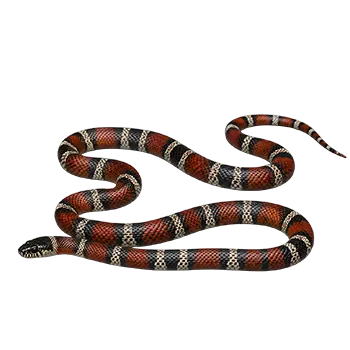
An Eastern Milk Snake (Lampropeltis triangulum triangulum) reaches physical maturity between two and three years of age, at which point growth rate slows dramatically and the animal takes on its definitive adult proportions. Mature adults range from twenty-four to thirty-six inches in total length, with exceptional individuals occasionally reaching forty inches. Males and females are similar in size, though females tend toward slightly heavier body mass relative to length, particularly when in reproductive condition. The fully mature body is smooth, cylindrical, and firmly muscled, with a well-defined head that is only slightly wider than the neck — a distinguishing feature of Lampropeltis species that differentiates them from the more head-distinct venomous pit vipers they are occasionally mistaken for.

The adult color pattern is the most refined and stable expression of the species' appearance. The dorsal saddles range from reddish-brown to deep chestnut, bordered by crisp black margins, with cream to grayish-tan interspaces. Ventral coloration is a distinctive black-and-white checkerboard pattern that serves as one of the most reliable field identification features for the species. While adult coloration is relatively fixed, subtle seasonal variations may occur — colors often appear most vivid immediately after shedding and may dull slightly in the weeks between sheds. Some captive individuals develop a gradual darkening or browning of the red pigment with age, a phenomenon that does not indicate any health concern.

Adult Eastern Milk Snakes shed their skin every six to ten weeks under normal conditions, though this interval can be influenced by feeding frequency, reproductive status, injury healing, and seasonal cycles. Each shed should come off in a single, unbroken piece from nose to tail tip, including the spectacle covers over the eyes. Consistent, complete sheds are one of the most reliable indicators of proper husbandry. The shed skin itself is a valuable diagnostic tool: measuring it provides an approximate length record, and inspecting it for embedded mites, retained scales, or unusual discolorations can reveal health issues that might not be immediately visible on the live animal.

Weight management becomes the primary growth-related concern during the adult years. An adult Eastern Milk Snake in ideal body condition has a smooth, rounded cross-section without visible spine ridging on the dorsal surface (which indicates underweight) or a pronounced triangular shape with bulging sides (which indicates obesity). Males typically weigh between 120 and 250 grams, while females range from 150 to 350 grams, though these figures vary with length and frame. A digital gram scale and monthly weigh-ins provide the objective data needed to adjust feeding frequency and prey size for optimal long-term condition.

Adult Feeding & Nutritional Maintenance

Feeding an adult Eastern Milk Snake is one of the simpler aspects of its husbandry, as the dietary requirements are straightforward and the species is generally an enthusiastic feeder. The staple diet consists of appropriately sized mice — typically adult mice or small sub-adult mice, depending on the individual snake's girth. Each prey item should be roughly equal to or slightly larger than the widest point of the snake's body and should produce a barely perceptible lump that is fully digested within seventy-two hours. Feeding frequency for a non-breeding adult in good body condition is once every ten to fourteen days, a significant reduction from the more frequent juvenile feeding schedule.

Frozen-thawed prey remains the safest and most practical food source for adult Eastern Milk Snakes. Commercially bred feeder mice that have been humanely euthanized and frozen are nutritionally complete, free of parasites, and pose zero risk of injury to the snake during feeding. Thawing should be accomplished by placing the frozen mouse in a sealed plastic bag submerged in warm (not hot) water for fifteen to twenty minutes until the core temperature reaches room temperature. Offering a prey item that is still partially frozen internally can cause digestive problems, while microwaving or overheating prey can create hot spots that scald the snake's oral and esophageal tissues.

Seasonal appetite fluctuations are normal in adult Eastern Milk Snakes and often correlate with the natural annual cycle of the species, even in animals that have never experienced seasonal temperature changes. Many adults will reduce their food intake or refuse meals entirely during the late autumn and winter months, particularly if they are exposed to any reduction in photoperiod or temperature. This voluntary fasting is a vestigial brumation response and is not cause for concern as long as the snake maintains its body weight within a healthy range. Attempting to force-feed a voluntarily fasting adult is counterproductive and stressful for both the animal and the keeper.

Supplementation is generally unnecessary for Eastern Milk Snakes fed an exclusive whole-prey rodent diet, as whole mice provide a balanced package of protein, fat, calcium, phosphorus, and essential vitamins. Some keepers dust prey items with a calcium or multivitamin powder once or twice per month as a precautionary measure, and while this practice is unlikely to cause harm, there is no strong evidence that it provides measurable benefit in snakes fed on nutritionally complete prey. Hydration management is more important than supplementation — a clean, appropriately sized water dish should be available at all times, and the water should be changed every two to three days or immediately if fouled.

Long-Term Enclosure Management

The adult enclosure for an Eastern Milk Snake should provide a minimum floor space of 36 by 18 inches, with a height of at least 12 inches. While Eastern Milk Snakes are not arboreal, they will make use of low climbing structures and elevated hides if provided, so additional vertical space is a welcome enrichment feature rather than a necessity. Front-opening enclosures are preferred over top-opening designs because they allow the keeper to approach the snake from the side rather than from above, reducing the predator-response behavior that overhead approaches can trigger even in well-socialized adults.

The thermal gradient within the adult enclosure should mirror the requirements established during the juvenile stage: a warm side of 82 to 86 degrees Fahrenheit, a cool side of 72 to 76 degrees, and a basking spot of up to 88 degrees controlled by a reliable thermostat. Thermostat quality is not a place to economize — a malfunctioning thermostat can allow heat sources to produce lethal temperatures within a sealed enclosure, and proportional thermostats that regulate output smoothly are far safer and more precise than simple on-off models. Temperature should be verified independently of the thermostat using a digital probe thermometer or an infrared temperature gun, with spot checks performed at least weekly.

Substrate choices for the adult enclosure include aspen shavings, coconut coir, cypress mulch, and bioactive soil mixes. Each substrate has advantages and trade-offs. Aspen is absorbent, easy to spot-clean, and widely available, but it molds quickly when wet and does not retain humidity well. Coconut coir holds moisture effectively and supports burrowing behavior but can become compacted over time. Cypress mulch resists mold and provides moderate humidity retention but is dustier than other options. Bioactive substrates — a layered system incorporating live plants, drainage layers, and a custodian crew of isopods and springtails that break down waste — represent the gold standard for naturalistic enclosures but require significantly more setup and maintenance knowledge.

Enclosure maintenance for adult Eastern Milk Snakes follows a predictable routine. Spot-clean feces and urates within twenty-four hours of deposition. Change the water dish every two to three days or immediately when soiled. Inspect the enclosure weekly for mold growth, substrate degradation, and any breaches in security such as loose-fitting lids or cracked hinge clips. Perform a complete substrate change and thorough enclosure disinfection with a reptile-safe disinfectant every four to eight weeks, depending on substrate type and bioburden. During the deep-clean, inspect all hides, climbing structures, and water dishes for cracks, sharp edges, or residue that could harbor bacteria.

Behavior, Enrichment & Handling

Adult Eastern Milk Snakes are among the most tractable colubrid species in captivity, and individuals that have been handled regularly since the hatchling stage are typically calm, inquisitive, and easy to manage during routine interactions. Handling sessions of fifteen to twenty minutes several times per week maintain the bond between keeper and animal and provide the snake with sensory stimulation beyond the enclosure environment. Adult handling technique remains the same as during the juvenile stage: approach from the side, support the body fully, and allow the snake to move freely through loosely cupped hands at its own pace.

Enrichment for adult Eastern Milk Snakes extends beyond the physical furniture in the enclosure to include sensory and cognitive stimulation. Rearranging enclosure furnishings every four to six weeks during substrate changes introduces novelty and encourages exploratory behavior. Placing small amounts of a novel, non-toxic scent — such as a pinch of dried leaf litter from a pesticide-free outdoor area — inside the enclosure stimulates investigative tongue-flicking and engages the snake's powerful vomeronasal (Jacobson's organ) system. Some keepers offer supervised out-of-enclosure exploration time in a snake-proofed room, which allows the animal to exercise on varied surfaces and textures unavailable within the confines of the enclosure.

Understanding the behavioral rhythms of the adult Eastern Milk Snake is key to successful long-term husbandry. The species remains primarily crepuscular and nocturnal throughout its life, with the peak activity window falling in the two to three hours after the enclosure lights turn off. During this period, the snake will emerge from its hide, patrol the enclosure perimeter, investigate the water dish, and actively explore climbing structures and substrate surfaces. During the daylight hours, the snake will typically remain concealed within its preferred hide, emerging only to thermoregulate on the warm side of the enclosure when internal body temperature drops below the optimal range. This cycle is entirely natural and healthy; a snake that is consistently active during daylight hours or consistently hidden around the clock may be experiencing thermal stress or illness.

Defensive behaviors in well-socialized adults are rare but can resurface in specific contexts. Gravid females often become more defensive and may refuse handling entirely during the weeks leading up to egg deposition. Both sexes may display increased defensiveness during the pre-shed opacity period when impaired vision makes them feel vulnerable. Seasonal shifts in temperament can also occur, particularly in animals that experience any degree of photoperiod or temperature cycling; males may become restless and mildly aggressive during the spring breeding season even when no females are present. Recognizing these contextual triggers allows the keeper to adjust handling frequency and approach accordingly rather than interpreting the behavior as a permanent temperament change.

Routine Health Monitoring & Preventive Care

Adult Eastern Milk Snakes are hardy animals that, under proper husbandry, rarely develop serious health problems. However, the relative rarity of disease in well-maintained specimens can breed complacency, and the stoic nature of snakes — which mask illness and pain as a survival strategy — means that health problems are often advanced by the time they produce externally visible symptoms. A proactive approach to health monitoring, centered on consistent observation and periodic veterinary checkups, is therefore essential for long-term animal welfare.

Annual veterinary examinations are recommended for adult Eastern Milk Snakes, even when no health concerns are apparent. The annual visit should include a full physical examination, a fecal flotation test for internal parasites, and a body condition assessment. Blood work is not routinely necessary for healthy adults but should be considered for animals over ten years of age or those with a history of health issues. The veterinary visit also provides an opportunity to discuss any changes in behavior, appetite, or shedding patterns that the keeper has documented, which may reveal subtle trends not apparent from individual observations.

Skin health requires ongoing attention throughout the adult years. Eastern Milk Snakes maintained on appropriate substrates with proper humidity levels should produce clean, complete sheds on a regular schedule. Chronic incomplete shedding — retained spectacles, tail tip retention, or patchy shed — indicates a systemic issue that may involve dehydration, subclinical infection, thyroid dysfunction, or chronic nutritional deficiency. A single incomplete shed can be addressed by soaking the snake in shallow, lukewarm water and gently assisting the remaining skin with a damp cloth, but recurrent problematic sheds warrant veterinary investigation to identify and address the underlying cause.

Oral health is an aspect of snake care that is frequently overlooked but critically important. Infectious stomatitis, commonly known as mouth rot, is a bacterial infection of the oral mucosa that can develop when a snake sustains a minor mouth injury — from a prey item, rough cage furniture, or persistent rubbing against the enclosure walls — that becomes secondarily infected. Early signs include reddening of the gum line, cheesy or cottage-cheese-like deposits on the oral mucosa, excessive salivation, and reluctance to feed. Caught early, stomatitis responds well to gentle daily cleaning with dilute povidone-iodine and a course of antibiotics. Left untreated, the infection can spread to the jawbone, causing osteomyelitis, permanent disfigurement, and potentially fatal septicemia.

Seasonal Considerations & Long-Term Planning

Even captive Eastern Milk Snakes that are not brumated for breeding purposes often display remnant seasonal behaviors that reflect the species' adaptation to the temperate climates of the northeastern and central United States. The most common manifestation is a voluntary reduction in appetite during the late fall and winter months, typically from November through February, even when enclosure temperatures and photoperiod remain unchanged. This cyclical appetite reduction is not pathological and should not prompt increases in temperature, force-feeding attempts, or veterinary visits unless it is accompanied by weight loss exceeding ten percent of the animal's baseline body mass.

For keepers who choose to provide a mild seasonal temperature cycle — a practice that many experienced colubrid keepers believe promotes long-term health and longevity — the approach is straightforward. During the winter months, the warm-side temperature can be reduced by five to eight degrees Fahrenheit and the cool side allowed to drop to ambient room temperature, typically in the mid to upper sixties. This mild cooling is not a full brumation and does not require the preparation protocols necessary for breeding-oriented brumation, but it does provide a metabolic respite that approximates the snake's natural annual rhythm. Feeding is reduced proportionally during the cooling period and should cease entirely if temperatures drop below 68 degrees for extended periods, as digestion becomes unreliable at low temperatures.

Long-term planning for an adult Eastern Milk Snake means committing to a decade or more of consistent care. With proper husbandry, these animals routinely live fifteen to twenty years in captivity, and some individuals have been documented exceeding twenty years. This longevity demands that keepers plan for life changes — housing moves, career shifts, family growth — that may affect their ability to maintain the animal's care. Identifying a backup caretaker who is educated in the snake's specific husbandry requirements, maintaining a written care protocol that a competent substitute could follow, and building a relationship with a local herpetological society that can rehome animals if necessary are all prudent measures that should be in place before they are urgently needed.

The financial commitment of long-term snake ownership, while modest compared to that of dogs or cats, is not negligible. Ongoing costs include substrate, frozen feeder rodents, electricity for heating equipment, occasional thermostat and bulb replacements, and annual veterinary visits. Emergency veterinary care for exotic species can be expensive, with a single visit often exceeding several hundred dollars before diagnostics and treatment. Keepers should maintain a modest emergency fund dedicated to veterinary expenses to ensure that financial constraints never delay necessary medical care for the animal.

Always consult a qualified professional before making any health-related decisions. This content is provided for informational reference only and should not replace professional guidance specific to your animal.