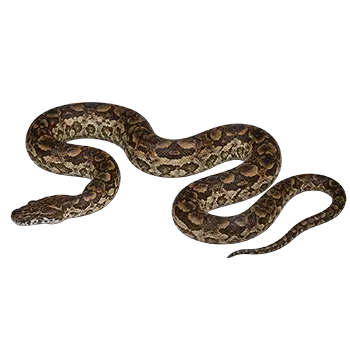

The juvenile stage in Dumeril's Boa runs roughly from six months of age to three years, a considerably longer adolescence than that of the small colubrids and ball pythons many keepers use as a mental reference. During this window the animal typically progresses from around two feet and several hundred grams to somewhere between three and a half and five feet and two to four kilograms, depending on sex, genetics, and feeding regime. Females grow larger and heavier than males and generally continue putting on length well past the point at which males have plateaued. This is a marathon, not a sprint, and expectations calibrated to faster-growing species will lead to overfeeding.
Sexual dimorphism becomes progressively easier to read during adolescence. Males possess proportionally larger and more prominent cloacal spurs, which they use during courtship, and tend toward a longer, more gradually tapering tail with a subtle post-cloacal thickening. Females are heavier-bodied with a shorter, more abruptly tapering tail. Neither cue is fully reliable in an individual animal, and definitive sexing is accomplished by probing or by popping in very young specimens, both of which should be performed by an experienced keeper or veterinarian, since improper technique can cause hemipenal or cloacal injury.
Coloration continues to change throughout this period. The high-contrast dark blotching of the neonate softens, the ground color often warms toward the salmon, buff, or grey-brown of the adult, and the overall pattern takes on the cryptic, leaf-litter appearance that makes this species so difficult to spot on the forest floor of its native range. Some individuals lighten noticeably, others darken; both are within normal variation. Regional locality differences within southern and southwestern Madagascar contribute to a wide spectrum of adult appearance in captive lines.
The practical significance of the juvenile stage is that nearly every long-term outcome, positive or negative, is set here. Body condition habits, feeding response reliability, handling tolerance, and the presence or absence of subclinical husbandry damage all trace back to how the animal is managed between six months and three years. A juvenile raised at a moderate growth rate on correctly sized prey, in a properly regulated thermal gradient, and handled consistently but briefly, becomes the calm, robust, decades-long companion this species is known for. The errors made in this window are much harder to undo later.