
Physical Maturity and Adult Conformation

A Dumeril's Boa is generally considered physically adult between three and five years of age, though length continues to increase slowly for several years beyond that, particularly in females. Mature males commonly reach four to five feet, while females typically range from five to six and a half feet, with exceptional individuals approaching seven. Adult weight ranges broadly from roughly two to four kilograms in males and three to seven kilograms in large, well-conditioned females. This places the species firmly in the medium-large boid category: substantial enough to demand proper enclosure and handling practice, but far more manageable in a household setting than a Burmese or reticulated python.

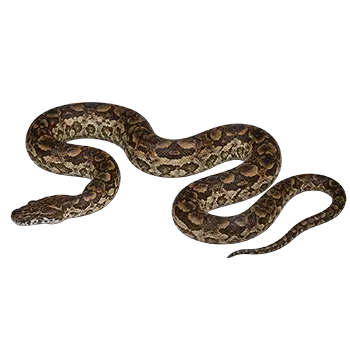
The adult body plan is heavily built and unmistakably terrestrial. The trunk is stout and slightly triangular in cross-section, the tail short and abruptly tapering, and the head broad, distinctly set off from the neck, and carrying the deep, angular labial pits characteristic of the genus. Adults have lost most of the high-contrast crispness of the neonate, settling into a muted mosaic of dark brown to charcoal blotches over a ground of grey, tan, buff, or salmon. Viewed on leaf litter, the pattern effectively dissolves, which is precisely its function on the floor of a Malagasy dry forest.

Mature sexual dimorphism is more readable than in adolescence. Males retain proportionally larger cloacal spurs and a longer tail with a subtle post-cloacal bulge; females are markedly heavier through the mid-body with a shorter tail. Neither feature is definitive on its own, and any decision that depends on sex should be confirmed by probing performed by an experienced handler or veterinarian. Ultrasound is increasingly available and provides a non-invasive alternative that also allows assessment of follicular development in females.

Growth in the adult years is slow enough that changes are best tracked by weight rather than length. A stable adult on a correct regimen will fluctuate within a modest band, gaining slightly through the warmer months and holding or dropping marginally through a winter period of reduced feeding. Sudden weight gain in an adult almost always means overfeeding rather than growth. Sustained weight loss in an adult that is eating normally is a genuine clinical finding and warrants a veterinary workup rather than an adjustment to the feeding schedule.

Adult Feeding Schedule and Weight Management

Adult Dumeril's Boas eat far less frequently than most keepers expect. A mature animal is well maintained on one appropriately sized prey item every fourteen to twenty-one days, and many large adults do best at the longer end of that interval or even at monthly feedings during cooler months. Appropriate prey for an adult is generally a medium to large rat, or occasionally a small rabbit or guinea pig for a very large female, sized so that its maximum girth approximates the widest point of the snake's body. Multiple smaller items are acceptable and sometimes preferable to a single oversized one, since oversized prey is a common cause of regurgitation in mature boas.

Obesity is the single most prevalent husbandry failure in captive adult Acrantophis dumerili and the most consequential. The species evolved in a seasonally arid environment with unpredictable prey availability and is metabolically equipped to thrive on far less food than a captive keeper's generosity typically provides. Obesity in boas manifests as fatty change in the liver, reduced immune competence, decreased fertility, impaired thermoregulation, and a measurably shortened lifespan. The visible signs are a body that appears round rather than gently triangular in cross-section, skin that separates between scales as the animal moves, palpable fat pads flanking the spine, and a jowl-like fullness behind the head.

Assessing body condition should be a deliberate monthly practice rather than an impression. Weigh the animal on a scale accurate to ten grams and record the number alongside the date and the last feed. Run a hand along the dorsal midline: the spine should be palpable but not sharply prominent, and the lateral body should curve gently rather than bulging. A healthy adult cross-section resembles a rounded loaf. If the animal has become overweight, the correction is a gradual extension of the feeding interval and a modest reduction in prey size over several months, never an abrupt fast, since rapid fat mobilization in reptiles carries hepatic risk.

Feeding mechanics for a large adult deserve care. Use tongs at least sixteen inches long, offer thawed frozen prey warmed at the surface, and feed in the evening when the animal's natural activity peak makes for a cleaner, more decisive strike. Adults readily develop a conditioned feeding response to the enclosure door, so a consistent non-feeding cue such as a hook tap before any routine access is worth maintaining throughout life. Provide constant access to a heavy, tip-resistant water bowl large enough for the animal to submerge in, changed at least twice weekly and immediately when soiled. Fasting periods of several weeks to a few months during the cooler season are physiologically normal in this species and require no intervention in an animal maintaining weight and normal behavior.

The Adult Enclosure and Long-Term Husbandry

The permanent enclosure for an adult Dumeril's Boa should offer a floor footprint of at least forty-eight by twenty-four inches, and for a large female a six-foot by two-foot enclosure is a far better standard. Height of eighteen to twenty-four inches is ample; this is a ground-dwelling ambush predator that will use a low branch or elevated shelf occasionally but spends the overwhelming majority of its life at substrate level. Floor area, not volume, is the meaningful metric. Front-opening PVC enclosures are the practical standard for adults, offering superior thermal retention, humidity control, and safe access compared with converted aquaria.

The thermal profile for adults reflects the species' semi-arid, seasonally variable origins. Maintain a warm-end surface or basking zone of 86 to 90 degrees Fahrenheit, an ambient cool end of 76 to 80 degrees, and allow a night-time drop into the low seventies. Radiant heat panels or thermostatically governed ceramic heat emitters mounted overhead are preferable to belly heat for a snake of this mass. Every heating element must be on a thermostat with the probe secured at the heated surface, and a backup thermostat or high-limit cutoff is prudent given the value and lifespan of the animal. Humidity should sit at 50 to 60 percent, rising toward 65 to 70 percent during shed cycles, with good ventilation at all times.

Furnishing an adult enclosure well means providing security rather than display value. Two hides large enough for the animal to coil in fully, one at each end of the thermal gradient, are the minimum. Cork rounds, hollow logs, half-buried hide boxes, and dense hardscape all serve. Four to six inches of coconut husk, cypress mulch, or a bioactive substrate over drainage supports the burrowing behavior this species displays and buffers humidity effectively. A large water container positioned at the cool end, heavy enough that a four-kilogram snake cannot overturn it, prevents both dehydration and the chronic flooding that leads to scale rot.

Maintenance for an adult is straightforward but must be consistent. Spot-clean feces and urates within a day of deposition. Replace substrate entirely and disinfect the enclosure every four to eight weeks with a reptile-safe disinfectant applied at the correct dilution and contact time, rinsed thoroughly, and dried before the animal returns. Inspect all locks, seams, and door tracks during each full clean, since an adult boa applies real force when testing an enclosure and a failed latch is an escape. Verify thermostat function and probe placement monthly with an independent digital thermometer or infrared gun rather than trusting the controller's display.

Adult Behavior, Activity Cycles, and Enrichment

Adult Dumeril's Boas are among the most placid of the medium-large boids. The typical adult is slow, deliberate, and secure in hand, gripping steadily rather than thrashing, and tolerating routine handling with equanimity. Handling sessions of fifteen to thirty minutes once or twice weekly are sufficient to maintain tractability. Once an animal exceeds roughly five feet, a second competent adult should be present as standard practice, less because of any real danger from this particular species than because supporting several kilograms of snake safely, and disengaging it from furniture or clothing, is genuinely a two-person task.

Activity in adults is firmly nocturnal and crepuscular, with animals typically emerging after dusk to patrol slowly, drink, soak, or take up an ambush position. Daytime observation will usually find the snake coiled and motionless in a hide, which is normal and healthy. Maintaining a seasonal photoperiod, shifting from around fourteen hours of light in summer to ten in winter, supports normal endocrine cycling and generally produces better long-term health and reproductive outcomes than an unvarying twelve-hour cycle. Room ambient lighting is adequate, though low-level UVB provision with proper shade access is increasingly regarded as beneficial for vitamin D3 metabolism and general wellbeing.

A distinct seasonal rhythm is normal in adults. Many individuals reduce or cease feeding for several weeks to a few months during the cooler part of the year, become less active, and spend more time buried or hidden. In females this may coincide with follicular development; in males it often coincides with increased roaming and rubbing behavior. As long as weight is stable and the animal remains alert and responsive, this seasonal anorexia requires no intervention. Attempting to force feeding through this period generally produces refusal or regurgitation.

Enrichment for a species like this is best understood as environmental complexity rather than activity provision. Rearranging hardscape periodically, introducing novel scents such as clean, unused substrate materials or shed skin from another enclosure, providing deep substrate for burrowing, offering a large soaking container, and varying prey species all engage natural behaviors. Occasional supervised time in a secure, warm, enclosed floor space allows extended exploration. What is not enrichment is cohabitation: Dumeril's Boas are solitary, derive no social benefit from a conspecific, and housing two together produces competition for thermal zones, feeding accidents, and elevated stress. House one animal per enclosure without exception outside of brief, supervised breeding introductions.

Routine Health Maintenance in the Prime Years

A wellness examination by a reptile-experienced veterinarian every twelve to twenty-four months is appropriate for an adult Dumeril's Boa even in the absence of visible problems. A useful adult wellness visit includes a weight and body condition assessment, an oral examination for early stomatitis or dental disease, palpation of the coelomic cavity, evaluation of skin and scale condition, and a fecal examination for endoparasites. Baseline bloodwork including a complete blood count and biochemistry panel, established while the animal is healthy, is one of the most valuable investments a long-term keeper can make, because reptile reference ranges are broad and an individual baseline is far more informative than a population average.

The conditions that most commonly affect adults are largely husbandry-derived and therefore largely preventable. Bacterial respiratory infection follows chronic over-humidity, poor ventilation, or an insufficient warm end, and presents with open-mouth breathing, audible respiration, discharge, and head-elevated posture. Infectious stomatitis, or mouth rot, presents as gingival inflammation, caseous plaques, and reluctance to feed, and is frequently secondary to trauma from striking enclosure surfaces or to immunosuppression. Scale rot and blister disease follow persistently damp substrate or a leaking water container. Thermal burns follow unregulated heat sources. In each case the medical treatment fails without the corresponding husbandry correction.

Several conditions of adult boids deserve specific vigilance. Inclusion body disease, associated with reptarenavirus, produces chronic regurgitation, progressive central nervous system signs including stargazing and loss of righting reflex, and opportunistic secondary infections; boas may carry it subclinically for long periods, which is why quarantine of new arrivals for a minimum of ninety days is standard practice. Cryptosporidium serpentis causes a distinctive mid-body swelling from gastric hypertrophy alongside chronic regurgitation and progressive wasting. Ophidiomycosis, snake fungal disease caused by Ophidiomyces ophidiicola, produces crusting, nodules, and facial disfigurement and is diagnosed by PCR or culture. Neoplasia, particularly of the kidney and liver, appears with increasing frequency in older adults.

Routine keeper-side monitoring is more valuable than any single veterinary visit. Weigh monthly and log the result. Photograph the animal in the same position quarterly, since gradual changes in body condition are far more visible in a photo sequence than in daily observation. Inspect each complete shed sheet for retained eye caps and tail tip. Examine the water bowl for mites and abnormal debris. Note every feed, every refusal, every shed, and every defecation. When a problem does arise, this record transforms a veterinary consultation from guesswork into diagnosis, and it will remain useful across the full two to three decades of the animal's life.

Long-Term Ownership Responsibilities

A healthy Dumeril's Boa acquired as a neonate will typically remain in a keeper's care for twenty to thirty years, and well-documented captive individuals have exceeded that. This is a commitment on the scale of a large parrot or a horse rather than a dog, and it will span changes of residence, employment, relationships, and household composition. Prospective and current keepers should think concretely about what happens if circumstances change: identify in advance a competent person or reputable regional herpetological society that could assume care, and document husbandry parameters, feeding history, veterinary contacts, and medical records in a form another keeper could actually use.

The legal position of this species is more complicated than that of most captive boids and must be verified rather than assumed. All Malagasy boas, including Acrantophis dumerili, have been the subject of significant CITES regulation; the species was historically listed on Appendix I and the Malagasy boas were the subject of a transfer to Appendix II adopted at the 2019 Conference of the Parties. The practical consequences concern international movement, documentation of captive-bred lineage, and in some jurisdictions record-keeping obligations. Because listings and national implementing rules change, keepers should confirm the current CITES appendix, applicable national wildlife law, and any state, provincial, or municipal restrictions before acquiring, selling, breeding, or transporting an animal.

Documentation should be maintained as a matter of routine, not assembled retroactively. Retain acquisition paperwork identifying the source and, where applicable, captive-bred status and any permit numbers. Keep a continuous husbandry log covering feeding, shedding, weights, and health events. Preserve veterinary records including any bloodwork, imaging, and diagnostic results. Photograph the animal periodically in a way that captures its distinctive pattern, which functions as effective individual identification. Microchipping is available for snakes of this size and is worth discussing with a veterinarian, particularly for animals of documented breeding lineage or where local regulation requires identification.

Finally, plan for the practical infrastructure of a long commitment. Reliable freezer capacity for frozen prey, a power failure contingency for heating during winter, an established relationship with a reptile veterinarian within reasonable travel distance, and a plan for care during extended absences all matter more over twenty years than they seem to matter in the first month. Never release a captive snake into the wild under any circumstances; released or escaped exotic reptiles rarely survive outside their native climate, may introduce pathogens to native wildlife, and in suitable climates can establish damaging populations. Rehoming through a rescue, a herpetological society, or a qualified private keeper is always the responsible path.

Always consult a qualified professional before making any health-related decisions. This content is provided for informational reference only and should not replace professional guidance specific to your animal.