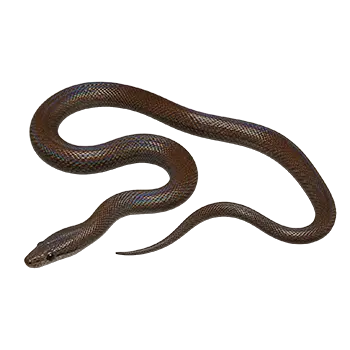

Adult Colombian Rainbow Boas (Epicrates maurus) typically reach their full length between three and four years of age, with most individuals measuring four to five and a half feet, though occasional specimens may reach six feet under optimal conditions. Males tend to be slightly smaller and more slender than females of the same age, and they develop proportionally larger pelvic spurs — vestigial hind limb remnants visible as small claw-like projections on either side of the vent. These spurs serve a functional role during courtship and mating and are more prominent in mature males than in females, though both sexes possess them.
Body composition in a healthy adult should be well-muscled and cylindrical, with a smooth, rounded cross-sectional profile. The spine and ribs should not be visible through the skin, nor should the body appear excessively round or doughy. When viewed from above, the body tapers gradually from midbody toward both the head and the tail without abrupt changes in width. An adult that appears triangular in cross-section — with a prominent dorsal ridge and concave flanks — is underweight and requires a reassessment of feeding frequency and prey size. An adult with visible fat rolls along the neck region or a soft, distended midsection even when not recently fed is overweight and at risk for metabolic disease.
The iridescent quality that gives rainbow boas their common name reaches its fullest expression in well-hydrated adult specimens maintained in proper humidity. The microscopic ridges on the surface of each scale act as diffraction gratings that scatter incoming light into its component wavelengths, producing a shimmering rainbow effect that is especially vivid under direct or angled light. This iridescence is most striking immediately after a shed, when the fresh scale surfaces are free of accumulated oils and micro-abrasions. Adults maintained in chronically low humidity environments may display muted iridescence due to dehydrated, roughened scale surfaces, even if they are otherwise healthy.
Adult Colombian Rainbow Boas exhibit subtle but consistent sexual dimorphism beyond the size difference noted above. Females tend to develop broader heads relative to their body length than males, and their body girth at midbody is proportionally greater, reflecting the internal space required for reproductive function. Tail length relative to total body length is greater in males, and males tend to have a more tapered, slender tail profile. These differences become increasingly apparent after sexual maturity and are useful for sex determination alongside probing or popping, which remain the most reliable methods for definitive sexing.