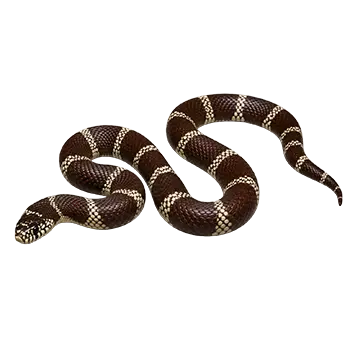

The juvenile period for a California Kingsnake (Lampropeltis californiae) broadly spans from approximately six months to two years of age, during which the animal transitions from a small, somewhat fragile hatchling into a sturdy, well-proportioned young adult. At the start of this phase, most individuals measure between sixteen and twenty inches, and by its conclusion, a healthy juvenile will have reached twenty-four to thirty-six inches, approaching or reaching its adult length. Growth during this period is steady but slower than the rapid gains seen in the first few months of life, reflecting the natural shift in metabolic allocation from rapid tissue building toward organ maturation and skeletal hardening.
Shed frequency serves as a reliable external indicator of growth rate during the juvenile stage. A healthy juvenile typically sheds every four to eight weeks, with more frequent sheds corresponding to faster growth periods. Each shed should be complete, coming off in a single, unbroken piece from nose to tail tip, including the eye caps. As the juvenile matures, the interval between sheds gradually lengthens, and by the time the animal approaches adult size, sheds may occur only every six to ten weeks. Tracking shed dates in a husbandry log allows keepers to identify any unusual changes in the growth trajectory.
Body proportions change noticeably during the juvenile phase. The head, which appears disproportionately large relative to the body in hatchlings, becomes more proportional as the body thickens and lengthens. Muscle definition along the dorsal surface becomes increasingly apparent, and the tail base fills out as the animal approaches sexual maturity. A juvenile in good condition should have smooth, rounded flanks with no visible spine ridge or rib outlines. Conversely, an overfed juvenile will appear sausage-shaped with skin stretched taut between scales, which is an equally undesirable condition that predisposes the animal to fatty liver disease and reproductive complications later in life.
Color and pattern may shift subtly during the juvenile period, depending on the morph. Wild-type banded individuals often develop richer, deeper chocolate or dark brown tones as they mature, while the lighter bands may take on a warmer cream or yellow hue. Some morphs, particularly those with aberrant or striped patterns, may show increased pattern definition or slight pattern changes as they grow. These shifts are cosmetic and entirely normal, but they are worth documenting for breeders who track lineage phenotypes across generations.