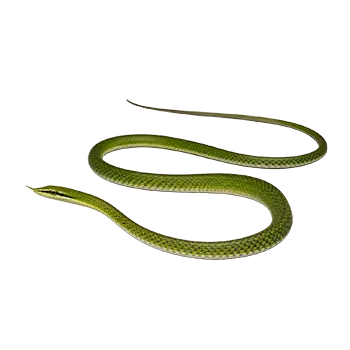

The juvenile stage of the Asian Vine Snake (Ahaetulla prasina) begins at approximately three to four months of age and extends until the animal approaches sexual maturity, typically around eighteen to twenty-four months. This transitional period is marked by accelerating growth, the completion of the characteristic green coloration, and the emergence of more complex hunting and exploratory behaviors. Keepers who have successfully navigated the demanding neonate period will find that juvenile Asian Vine Snakes become progressively easier to maintain as they grow, though the species' specialized dietary needs and environmental sensitivity remain constant considerations throughout this life stage.
The most visible sign that a neonate has entered the juvenile phase is the full expression of adult coloration. By three to four months of age, the brownish-olive tones of the newborn have been replaced by the vivid leaf-green dorsal coloration and the pale yellow-white ventral surface that define the species' appearance. Individual variation exists, with some specimens displaying blue-green, yellow-green, or even rare gray-phase coloration that becomes fixed during the juvenile period. The binocular eye stripe — a distinctive horizontal pupil set within a golden or yellow iris — becomes more prominent as the head grows and takes on the elongated, pointed profile characteristic of the genus.
Physically, juveniles at the beginning of this stage typically measure fourteen to twenty inches in total length and weigh between eight and fifteen grams. Their bodies remain extremely slender relative to length, maintaining the vine-like proportions that give the species its common name. The tail, which accounts for roughly one-third of total body length, becomes an increasingly effective prehensile tool during the juvenile period, allowing the snake to anchor itself securely while extending its body across gaps between branches in pursuit of prey or exploration.
The transition into the juvenile stage also brings changes in temperament and behavioral complexity. While neonates tend to remain stationary on their perches for extended periods, juveniles become noticeably more active, particularly during the late afternoon and evening hours that correspond to peak hunting activity in the wild. Keepers will observe more frequent tongue-flicking, more deliberate scanning movements of the head as the snake tracks movement in its environment, and a growing confidence in navigating the three-dimensional space of its enclosure. These behavioral shifts signal healthy neurological development and an expanding awareness of the environment that continues to mature throughout the juvenile period.