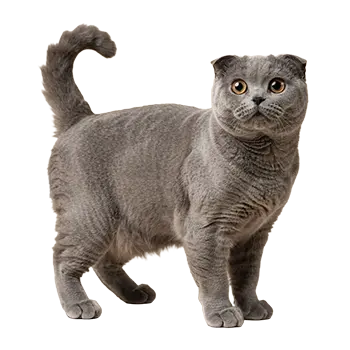

The Foldex juvenile period spans roughly three months to one year of age, a stretch of rapid physical transformation during which the kitten evolves from a compact, round-faced youngster into a muscular, well-proportioned young cat. Growth rates vary among individuals, but most Foldex kittens gain weight steadily, reaching approximately half their adult size by four to five months. Males tend to be slightly larger than females, ultimately reaching eight to twelve pounds at maturity, while females typically settle between six and nine pounds.
During this period, the Foldex's distinctive features become fully defined. Kittens that carry the fold gene will display their final ear set by approximately four months of age. The degree of fold varies from a loose single fold that tips forward slightly to a tight triple fold that lies close to the skull. Straight-eared Foldex kittens, often called Straights, are equally valid members of the breed and carry the same body type, coat, and temperament. The breed's characteristically round face, large expressive eyes, and sturdy bone structure become increasingly pronounced as the kitten matures.
Skeletal development continues well beyond the point at which the kitten appears outwardly grown. Long bone growth plates do not close until approximately ten to fourteen months, and premature high-impact activity or obesity during this window can damage developing joints. This consideration carries extra weight in the Foldex, whose fold gene affects cartilage development. Monitor your kitten's movement quality throughout adolescence, watching for any stiffness, reluctance to jump, or changes in gait that could indicate joint issues. Regular veterinary check-ups during this growth phase should include palpation of the limbs and tail to screen for early signs of osteochondrodysplasia.
The coat matures during the juvenile stage as well. Kitten fur gives way to the adult coat, which in the Foldex is dense, plush, and slightly resilient to the touch. Coat color and pattern may intensify or shift subtly as the adult hair replaces the softer kitten undercoat. Weekly brushing helps manage loose hair and trains the kitten to accept grooming as a normal part of its routine.