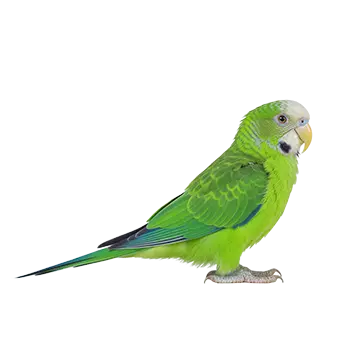

The juvenile stage of a Quaker Parrot begins around six to eight weeks of age, as the bird completes its weaning process and transitions into independence. By this point, the bird has a full complement of feathers, though the plumage may appear slightly duller or less defined than that of a mature adult. The characteristic bright green body, gray chest, and blue flight feathers are all present, and the bird has reached close to its adult length of 11 to 12 inches.
Weight stabilization is one of the hallmarks of this developmental period. After the rapid gains of the newborn phase, the juvenile Quaker Parrot settles into a healthy weight range, typically between 90 and 130 grams depending on the individual. Continued daily or weekly weighing helps ensure the bird maintains condition through the sometimes stressful weaning transition and early independence.
Beak and nail growth accelerate during this stage, and the bird begins to explore the world through vigorous chewing. Providing a variety of safe, destructible materials such as untreated wood, woven palm, and cardboard gives the juvenile an appropriate outlet for this natural behavior while strengthening the jaw muscles. The beak should appear smooth and symmetrical, and any flaking, discoloration, or overgrowth warrants a veterinary check.
Flight feathers reach their full length during the juvenile period, and the bird begins to develop coordination and stamina in flight. Whether or not the wings are clipped is a personal decision that should be discussed with an avian veterinarian, taking into account the bird's safety, the household environment, and the owner's ability to provide supervised flight time.