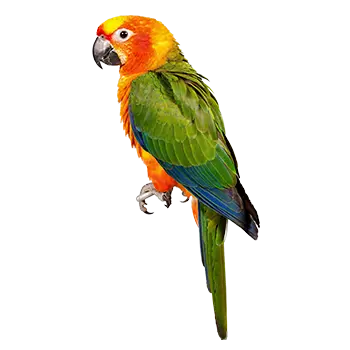

The Weaning Transition

Weaning is one of the most significant and sometimes stressful transitions in a young Jenday Conure's life, marking the shift from dependence on hand-feeding formula or parental crop feeding to independent consumption of solid foods. In Jenday Conures, the weaning process typically begins between six and eight weeks of age and may not be fully complete until the bird is ten to twelve weeks old. Rushing this process or forcing weaning on an arbitrary schedule is one of the most common mistakes made with young conures and can lead to lasting behavioral and health consequences.

The first signs that a Jenday chick is ready to begin weaning appear as increasing disinterest in formula feedings combined with growing curiosity about solid items in its environment. The chick will mouth, tongue, and toss objects, and will begin picking at soft foods if they are made available. Offer a variety of weaning foods in shallow dishes placed at a comfortable height, including warm softened pellets, finely chopped vegetables, small pieces of ripe fruit, and cooked grains. The emphasis should be on exploration and choice rather than volume of consumption during the early stages.

Maintain formula feedings alongside solid food offerings, gradually reducing the number and volume of formula meals as the chick demonstrates consistent consumption of solids. Most breeders begin by eliminating the midday formula feeding first, then the morning feeding, and finally the evening feeding last, as the evening meal provides overnight sustenance that the chick may not yet replace through daytime solid food intake. Daily weight monitoring is absolutely essential during weaning. A weight loss of up to ten percent from peak pre-weaning weight is considered normal, but losses beyond this threshold warrant a return to supplemental formula feedings and veterinary consultation.

Abundance weaning, the practice of surrounding the chick with a wide variety of appealing foods and allowing it to self-direct the weaning process, produces the best long-term outcomes for Jenday Conures. Birds weaned through abundance methods tend to be more adventurous eaters as adults, less prone to food-related behavioral issues, and more psychologically resilient. Forced weaning, where formula is abruptly withdrawn to compel solid food consumption, is stressful and can trigger a cascade of anxiety behaviors that persist well into adulthood.

Fledging & Flight Development

Fledging represents a Jenday Conure's first experience with powered flight, and it is a developmental milestone with profound implications for the bird's physical coordination, spatial awareness, and psychological confidence. Jenday Conures typically begin their first flight attempts between seven and nine weeks of age, though individual variation exists depending on the bird's physical condition, feather development, and rearing environment. The decision of whether to allow full fledging or to clip the wing feathers at this stage is one that carries long-term consequences and deserves careful consideration.

A Jenday chick preparing to fledge will spend increasing amounts of time perched at the highest available point, vigorously flapping its wings in exercises that progressively strengthen the pectoral muscles. These pre-flight workouts are essential and should be encouraged rather than restricted. The chick is building not only muscle mass but also the neural pathways for coordinated flight, balance, and three-dimensional navigation. Providing a safe, open space where the chick can practice without colliding with walls, windows, or ceiling fans is critical during this period.

The first flights are typically clumsy, short, and poorly controlled. The chick may launch from a perch and crash-land on the floor, overshoot its target, or lose altitude rapidly. This is entirely normal and part of the learning process. Caregivers should remain calm, avoid startling the bird during flight attempts, and ensure that the practice area is free of hazards including open water, hot surfaces, mirrors, and other pets. Each successive flight attempt builds skill and confidence, and most Jendays achieve reasonable flight competence within one to two weeks of their first launch.

Allowing a Jenday Conure to fledge fully before any wing trimming produces a bird with superior coordination, balance, and confidence compared to chicks whose wings are clipped before they have learned to fly. Birds that never experience flight during this developmental window often exhibit persistent clumsiness, fearfulness, and difficulty with spatial tasks throughout their lives. If wing trimming is ultimately desired for safety reasons in a particular household, the recommended approach is to allow the bird to fledge, achieve flight competence over several weeks, and only then perform a conservative clip that allows controlled descent rather than a hard drop.

Plumage & Physical Maturation

The juvenile Jenday Conure undergoes a remarkable physical transformation as it matures from a newly feathered chick into a bird approaching its adult appearance. Understanding the normal progression of plumage changes helps caregivers distinguish healthy development from signs of nutritional deficiency or illness that can manifest through feather abnormalities. The Jenday's vivid coloration does not appear fully until the bird has completed its juvenile molt, so patience is required during this transitional period.

A freshly weaned Jenday Conure typically displays a muted version of adult coloration. The head and breast feathers are predominantly olive-green with scattered yellow patches rather than the deep golden-orange of a mature bird. The green of the wings, back, and tail is present but may appear duller than it will at maturity. The flight feathers show blue tipping, and the tail carries the characteristic olive-green with blue outer feathers. The periorbital ring, the bare skin surrounding the eye, is present but paler than the bright white ring of an adult.

The juvenile molt, during which baby feathers are gradually replaced by adult plumage, typically begins between four and six months of age and continues over several months. During this period, the bird may appear patchy or unkempt as old feathers fall and new ones grow in. Pin feathers will be visible on the head, neck, and body as new feather shafts emerge. These pin feathers are encased in a keratin sheath that can cause itching and discomfort, and the bird will spend considerable time preening to remove the sheaths from accessible feathers. Gentle head scratches from a trusted caregiver can help with pin feathers on the head and neck that the bird cannot reach itself.

Nutrition during the juvenile molt period directly influences the quality of the incoming adult plumage. A diet rich in beta-carotene from sources such as sweet potato, carrots, red peppers, and dark leafy greens supports the development of the bright yellows and oranges that characterize the adult Jenday. Protein intake should be adequate to support the metabolic demands of feather production, as each new feather is composed primarily of keratin, a structural protein. Amino acid deficiencies during this period can result in stress bars, weak feather structure, and dull coloration that persists until the next molt cycle.

Behavioral Development & Training Foundations

The juvenile period is the optimal window for establishing the behavioral foundations that will define a Jenday Conure's temperament for the next two to three decades. Jendays are intelligent, energetic birds with strong social drives, and the behaviors they learn during adolescence, both desirable and undesirable, tend to become deeply ingrained. Investing time in positive reinforcement training during this receptive phase yields a companion that is a joy to live with, while neglecting behavioral guidance during this window often leads to problems that are far more difficult to address in an adult bird.

Begin with simple target training, teaching the bird to touch its beak to a designated object such as a chopstick or small ball on cue. Target training establishes the fundamental communication framework of positive reinforcement, in which the bird learns that performing a specific action results in a reward. Once the bird understands this contingency, it can be expanded to teach step-up commands, station training, recall, and a wide range of cooperative behaviors that make daily care and veterinary handling far less stressful for both bird and caregiver.

Jenday Conures are exuberant, vocal birds, and their volume is one of the most common complaints among unprepared owners. Addressing vocalization proactively during the juvenile period is far more effective than attempting to suppress an established screaming habit later. The key is to reinforce desirable vocalizations, such as talking attempts, whistling, and moderate contact calls, with attention and treats, while calmly ignoring excessive screaming. Reacting to screaming with scolding, yelling, or even entering the room teaches the bird that noise produces attention, guaranteeing that the behavior will escalate.

Biting is another behavior that requires thoughtful management during adolescence. Juvenile Jendays explore the world with their beaks and will test the boundaries of acceptable force during interactions. A chick that nips during play is not being aggressive but is learning about pressure and social feedback. Respond to hard bites by calmly withdrawing attention for a brief period rather than by flinching, yelling, or pushing the bird away, all of which can inadvertently reward or escalate the behavior. Consistent, patient responses during this learning phase produce an adult bird that understands appropriate beak pressure in social contexts.

Socialization during the juvenile period should expand well beyond the primary caregiver. Expose the young Jenday to a variety of people, environments, and experiences in a controlled, positive manner. Short car rides, visits to different rooms, meeting calm visitors, and encountering novel objects all build the bird's confidence and flexibility. A Jenday that experiences a wide range of positive social interactions during its juvenile months is far less likely to develop single-person bonding, fear-based aggression, or phobic responses to routine changes in its environment.

Diet & Nutritional Needs

A juvenile Jenday Conure's diet must support the dual demands of completing physical growth and fueling the high energy levels characteristic of this active species. The transition from weaning foods to a stable adult diet should be gradual and intentional, with the goal of establishing varied, nutritionally complete eating habits that will serve the bird well throughout its long life. Jendays that are offered only a narrow range of foods during the juvenile period often become stubbornly selective eaters as adults, making later dietary improvements extremely difficult.

A high-quality pelleted diet should form the nutritional foundation, comprising approximately 60 to 70 percent of total food intake. Pellets provide balanced nutrition and eliminate the selective eating that occurs with seed-based diets, where birds pick out high-fat favorites and ignore essential nutrients. Introduce pellets during the weaning phase and maintain them as the dietary staple going forward. If the bird was weaned primarily onto seeds, the transition to pellets requires patience and persistence, gradually mixing increasing proportions of pellets into the familiar seed mix while reducing the seed component.

Fresh vegetables and fruits should constitute the remaining 30 to 40 percent of the diet, with vegetables given greater emphasis than fruits due to their superior nutrient density and lower sugar content. Dark leafy greens such as kale, Swiss chard, and dandelion greens provide calcium and vitamins. Orange and red vegetables including sweet potato, carrots, and bell peppers supply beta-carotene, which is especially important during the juvenile molt for supporting vibrant adult plumage. Fruits such as berries, papaya, mango, and apple can be offered in smaller quantities as treats and enrichment.

Seeds and nuts should be used sparingly, reserved primarily as training treats or occasional enrichment rather than dietary staples. The high fat content of sunflower seeds, safflower seeds, and peanuts makes them irresistible to Jendays but nutritionally imbalanced as a primary food source. A juvenile bird allowed unrestricted access to a seed-heavy diet will often refuse all other foods and is at increased risk for fatty liver disease, obesity, and vitamin A deficiency as it matures. Establishing appropriate seed and nut boundaries during the juvenile period prevents these deeply entrenched preferences from forming.

Fresh, clean water must be available at all times, provided in a dish or bottle that is cleaned and refilled daily. Juvenile Jendays are playful and frequently dunk food into their water, contaminating it quickly. Check water sources multiple times throughout the day and replace fouled water immediately to prevent bacterial growth that can cause gastrointestinal illness.

Housing & Environmental Enrichment

As a juvenile Jenday Conure transitions from brooder to cage to a fully established living environment, the housing setup plays a central role in the bird's physical development, psychological health, and behavioral trajectory. Jendays are active, athletic conures that require sufficient space to climb, play, flap, and explore without restriction. A cage that is adequate for a sedentary species will leave a juvenile Jenday frustrated and prone to developing stereotypic behaviors such as bar chewing, excessive screaming, or feather picking.

The minimum cage dimensions for a single Jenday Conure should be 24 inches wide by 24 inches deep by 30 inches tall, though larger is always better. The bar spacing should be no wider than three-quarters of an inch to prevent the bird from wedging its head between the bars. Horizontal bars on at least two sides of the cage encourage climbing, which is a natural and important form of exercise. Position the cage in a room where the family spends time, as Jendays are flock-oriented birds that suffer psychologically when isolated from household activity, but avoid placement in the kitchen, where fumes from heated cookware with nonstick coatings can be rapidly fatal.

Enrichment is not optional for a juvenile Jenday Conure. These are intelligent birds that require mental stimulation to remain psychologically healthy. Provide a rotating selection of toys that address different behavioral needs. Foraging toys that require the bird to work for food mimic the natural behaviors of wild Aratinga conures, which spend a significant portion of their day searching for and processing food. Destructible toys made from untreated wood, leather strips, palm fronds, or woven grass satisfy the chewing drive that is especially strong during adolescence. Puzzle toys that challenge the bird to solve a problem for a reward engage cognitive abilities and prevent boredom.

Perch variety is another frequently overlooked aspect of juvenile housing. A cage outfitted with identical dowel perches forces the bird's feet to grip at the same diameter and angle at all times, which can lead to pressure sores and foot problems over time. Offer a variety of perch diameters and textures, including natural wood branches of varying thickness, rope perches, and flat platform perches. Natural branches from bird-safe trees such as apple, willow, or elm provide both perching and chewing opportunities, and their irregular surfaces promote healthy foot musculature.

Out-of-cage time is essential for a juvenile Jenday's development and should be provided daily in a supervised, bird-safe environment. This free time allows the bird to exercise flight muscles, explore its surroundings, and interact with family members in ways that cage confinement does not permit. Establish a designated play area with a play stand or tree, equipped with additional toys and foraging opportunities, where the bird can spend supervised time outside its cage each day.

Veterinary Care & Preventive Health

Maintaining a proactive veterinary care schedule during the juvenile period establishes health baselines that serve the Jenday Conure throughout its long life and catches developmental issues during the window when they are most readily corrected. The transition from neonatal to juvenile veterinary care shifts focus from the acute concerns of early life, such as crop infections and congenital abnormalities, toward preventive screening, vaccination where applicable, and establishing the bird's individual health norms.

A comprehensive veterinary examination should occur shortly after weaning is complete, typically around ten to twelve weeks of age. This visit allows the veterinarian to assess the bird's overall condition after the metabolically demanding weaning transition, confirm that weight has stabilized within the expected range, evaluate feather quality, and examine the musculoskeletal system for any developmental abnormalities such as beak malocclusion or angular limb deformities. Blood work at this age establishes baseline values for complete blood count and plasma biochemistry that will be referenced at every future health evaluation.

Disease screening remains important during the juvenile period. If not already completed during the neonatal phase, testing for Psittacine Beak and Feather Disease, Avian Polyomavirus, and Chlamydia psittaci should be performed before the bird is placed in a home with other birds. Some avian veterinarians recommend Polyomavirus vaccination for juvenile conures, particularly those that may be exposed to other birds at shows, boarding facilities, or multi-bird households. Discuss the appropriateness of vaccination with your veterinarian based on the bird's specific risk profile.

Between veterinary visits, the caregiver's ongoing monitoring remains the first line of defense against illness. Continue weighing the bird weekly on a gram-accurate scale, recording the results to track trends over time. A sudden weight change of more than five percent without an obvious cause warrants investigation. Monitor droppings daily, noting any persistent changes in color, consistency, or volume. Watch for behavioral changes such as decreased activity, reduced appetite, fluffed posture during waking hours, or changes in vocalization patterns, all of which can indicate early illness.

The juvenile period is also the ideal time to accustom the bird to cooperative care behaviors that make veterinary examinations less stressful. Practice gentle towel restraint at home, rewarding the bird with treats for calm acceptance. Handle the bird's feet, wings, and beak regularly so that these manipulations become routine rather than alarming. A juvenile Jenday that learns to tolerate these interactions develops into an adult that can be examined, groomed, and medicated with minimal stress for all involved.

Always consult a qualified professional before making any health-related decisions. This content is provided for informational reference only and should not replace professional guidance specific to your animal.