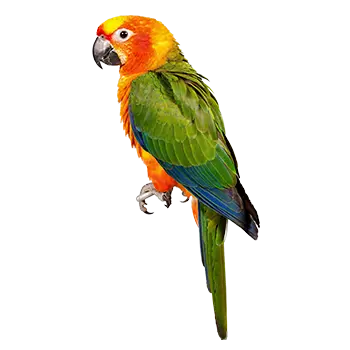

Nutrition for the Adult Jenday

An adult Jenday Conure's nutritional needs shift from the growth-focused demands of youth to a maintenance-oriented diet that supports sustained energy, immune function, feather quality, and long-term organ health. The dietary habits established during the juvenile period now pay dividends or exact costs, as adult Jendays with well-rounded palates are far easier to maintain on a balanced diet than those that were allowed to develop seed-fixated preferences. Regardless of the bird's current dietary habits, ongoing attention to nutrition remains one of the most impactful things a caregiver can do for long-term health.

A high-quality pelleted diet should remain the foundation of daily nutrition, constituting approximately 60 to 70 percent of total food intake. Pellets eliminate the nutritional gaps inherent in seed-based feeding by providing a consistent balance of proteins, carbohydrates, fats, vitamins, and minerals in every bite. Organic and naturally colored pellet formulations are preferred over those containing artificial dyes, which offer no nutritional benefit and introduce unnecessary chemical exposure. Evaluate the pellet brand periodically against current avian nutrition research, as formulations and recommendations evolve.

Fresh vegetables should make up the largest component of the non-pellet portion of the diet. Dark leafy greens including kale, collard greens, and dandelion greens provide calcium, vitamin K, and folate. Orange and yellow vegetables such as butternut squash, sweet potato, and carrots deliver beta-carotene, which the bird converts to vitamin A, a nutrient critical for epithelial tissue integrity, respiratory health, and immune function. Vitamin A deficiency is one of the most common nutritional disorders in captive parrots fed seed-heavy diets, and maintaining adequate dietary sources through fresh produce is the best prevention.

Fruits should be offered in moderation, comprising no more than ten to fifteen percent of the total diet. While fruits provide valuable antioxidants and are enthusiastically consumed by most Jendays, their high sugar content can contribute to weight gain and yeast overgrowth if overfed. Seeds and nuts remain appropriate as training rewards and occasional treats but should never return to a staple role. Adult Jendays have a tendency to become overweight if given free access to high-fat seeds, and obesity predisposes them to fatty liver disease, atherosclerosis, and reduced lifespan.

Fresh water must be available at all times, changed at minimum twice daily and more frequently if the bird contaminates it by dunking food or bathing in its drinking dish. Some caregivers provide a separate, larger dish specifically for bathing to keep the drinking water clean. Water quality matters; if your tap water contains high levels of chlorine, heavy metals, or other contaminants, filtered or bottled water is a worthwhile investment for a bird that may share your home for three decades.

Behavioral Enrichment & Mental Stimulation

An adult Jenday Conure in its prime years is an intelligent, curious, and energetically demanding companion that requires consistent mental stimulation to remain psychologically healthy. In the wild, Aratinga conures spend their days navigating complex social hierarchies within their flock, foraging across wide territories, and solving the constant environmental puzzles that survival demands. In captivity, the caregiver must recreate sufficient cognitive challenge and variety to prevent the boredom and frustration that manifest as screaming, feather destructive behavior, aggression, or stereotypic movements.

Foraging enrichment is the single most impactful form of mental stimulation for a captive Jenday. Wild conures spend a significant portion of their active hours searching for, accessing, and processing food. An adult Jenday that receives all its food in an open dish completes its foraging activity in minutes and then faces hours of unstimulated time. Foraging toys, puzzle feeders, and food-wrapped enrichment items extend feeding time and engage problem-solving abilities. Rotate foraging devices regularly, as Jendays are clever enough to master a particular toy quickly, at which point it no longer provides meaningful challenge.

Physical exercise is equally important and should not be conflated with enrichment. A bird perched on a toy is enriched, but it is not exercising. Flight is the most natural and effective form of exercise for any parrot, and adult Jendays that are permitted supervised flight time benefit from improved cardiovascular health, stronger musculature, and better weight management. If full flight is not feasible in your living situation, provide climbing structures, rope ladders, swings, and play gyms that encourage active physical movement throughout the day.

Social interaction constitutes a third pillar of enrichment that cannot be replaced by toys or physical infrastructure alone. Jenday Conures are flock animals that crave and require social engagement. Daily interactive time with household members, whether through training sessions, supervised exploration, or simple companionship during routine activities, fulfills a deep behavioral need. A Jenday that is left alone in its cage for extended periods without social contact will deteriorate psychologically, regardless of how many toys are available. If the household's schedule requires extended absences, consider whether the bird's social needs would be better met in a multi-bird environment.

Hormonal Behavior & Seasonal Changes

Adult Jenday Conures experience hormonal fluctuations that can produce dramatic temporary changes in behavior, typically occurring in spring and sometimes again in autumn. Understanding these hormonal cycles and managing their environmental triggers prevents the behavioral disruptions from becoming entrenched patterns and reduces the stress that hormonal surges create for both bird and caregiver. Hormonal behavior in conures is normal and expected, but its intensity can be modulated through thoughtful husbandry.

Common signs of hormonal activation in Jenday Conures include increased territoriality around the cage, regurgitation directed at a favored person or object, heightened aggression or biting toward perceived rivals, excessive shredding of paper or other materials, and in hens, posturing that indicates nesting readiness or actual egg laying. Some birds become unusually vocal or clingy during hormonal periods, while others become irritable and unpredictable. Recognizing these behaviors as hormonally driven rather than as deliberate misbehavior helps caregivers respond with appropriate management rather than punishment.

Several environmental factors stimulate hormonal behavior and can be adjusted to reduce its intensity. Extended daylight exposure is the primary trigger. Ensure the bird receives no more than ten to twelve hours of light per day by covering the cage or moving it to a dark, quiet room in the evening. Warm, enclosed spaces that mimic nesting cavities, such as fabric huts, boxes, or even the space under furniture, stimulate reproductive behavior and should be removed or blocked. Avoid petting the bird on its back, under its wings, or along its tail, as these forms of touch stimulate reproductive responses. Limit contact to head scratches and neck rubs, which are affiliative rather than sexual in avian social context.

Dietary adjustments can also help. Reduce or eliminate soft, warm, calorie-dense foods during hormonal periods, as these signal environmental abundance that the bird's physiology interprets as favorable breeding conditions. Maintain the standard pellet and vegetable diet but temporarily reduce fruit, cooked foods, and high-fat treats. If a hen begins laying eggs, do not remove them immediately, as this stimulates replacement clutching. Allow the hen to sit on the eggs until she loses interest naturally, typically after 21 to 28 days, while ensuring she maintains adequate calcium intake to prevent egg binding or metabolic depletion.

Annual Health Monitoring

An adult Jenday Conure in apparent good health still requires annual veterinary examinations to detect subclinical conditions before they progress to the point of visible illness. Parrots are prey animals whose survival strategy in the wild depends on concealing weakness, which means that by the time a Jenday shows obvious signs of being unwell, the underlying condition has often advanced significantly. Annual wellness checks circumvent this masking behavior by using diagnostic tools that reveal internal status regardless of the bird's outward presentation.

The annual examination should include a thorough physical assessment covering body weight and condition, feather quality, beak and nail condition, skin integrity, joint mobility, respiratory sounds, and abdominal palpation. Blood work consisting of a complete blood count and plasma biochemistry panel provides objective data on organ function, nutritional status, and inflammatory or infectious processes. Comparing each year's results against the bird's individual baseline values is far more informative than evaluating a single set of results in isolation, which is why establishing baseline blood work during the juvenile period is so valuable.

Fecal analysis for parasites, bacteria, and yeast should be part of every annual evaluation. Even birds housed indoors without contact with wild birds or soil can develop intestinal imbalances, particularly if dietary or environmental stressors have compromised normal gut flora. Choanal and cloacal cultures may be recommended based on the veterinarian's clinical findings or if the bird has a history of respiratory or gastrointestinal issues. For birds over five years of age, some avian practitioners also recommend periodic radiographs to screen for conditions such as atherosclerosis, hepatomegaly, or renal changes that are common in captive psittacines.

Between annual examinations, the caregiver's daily observations remain the most important monitoring tool. Maintain a weekly weight log, recording the bird's weight on the same day and time each week on a gram-accurate scale. Note any changes in appetite, activity level, vocalization patterns, droppings, or behavior and bring these observations to the veterinary appointment. A caregiver who can describe a gradual two-week decline in food interest provides the veterinarian with a clinical timeline that dramatically improves diagnostic accuracy and treatment outcomes.

Feather Care & Molting

Adult Jenday Conures undergo one to two major molt cycles per year, typically in spring and autumn, during which worn feathers are progressively replaced by new growth. The molt is a metabolically expensive process that places significant demands on the bird's nutritional reserves and energy budget. Understanding the normal molting pattern helps caregivers support the bird through this taxing period and distinguish healthy feather turnover from pathological feather loss that warrants veterinary investigation.

A normal molt progresses symmetrically, with feathers shed and replaced in matched pairs from the wings, tail, and body. The bird should never appear bald or show patches of bare skin during a healthy molt. Feather loss is gradual enough that the bird retains its ability to fly and regulate temperature throughout the process. New feathers emerge as pin feathers, encased in a keratin sheath that the bird removes through preening. Pin feathers on the head and neck, which the bird cannot reach with its own beak, may cause visible discomfort, and gentle assistance from a trusted caregiver in rolling these sheaths between moistened fingertips is welcomed by most tame Jendays.

Nutritional support during the molt should include increased protein availability and continued emphasis on beta-carotene-rich vegetables to fuel vibrant feather pigmentation. Some avian nutritionists recommend a modest increase in healthy fats during heavy molting periods, as feather production requires lipid components. A small daily portion of cooked egg, hemp seed, or flax seed can help meet this need without reintroducing a seed-heavy diet. Bathing opportunities should be offered more frequently during the molt, as moisture softens keratin sheaths and soothes itchy skin, making the process more comfortable.

Feather destructive behavior, in which the bird damages, chews, breaks, or plucks its own feathers, is not a normal part of molting and should never be dismissed as such. Feather destruction in Jenday Conures can stem from medical causes including hormonal imbalances, infections, allergies, liver disease, or heavy metal toxicity, as well as from psychological causes such as boredom, anxiety, sleep deprivation, or inadequate social interaction. Any bird that begins damaging its own feathers deserves a thorough veterinary workup to rule out medical causes before behavioral interventions are attempted. Early intervention produces the best outcomes, as feather destruction that persists for months can become a deeply habituated behavior that is extremely difficult to resolve.

Social Dynamics & Household Integration

A Jenday Conure's social needs do not diminish with maturity. If anything, the adult bird's capacity for complex social relationships deepens over time, and the quality of these relationships profoundly influences the bird's emotional wellbeing and behavioral stability. Jendays are pair-bonding species in the wild, and in captivity they typically form an intense primary bond with one household member while maintaining secondary social relationships with others. Managing these dynamics thoughtfully prevents the common problems of excessive single-person bonding, jealousy-driven aggression, and social anxiety.

Encourage all household members to participate in the bird's care and social life, even if one person serves as the primary caregiver. Each person should offer treats, engage in brief training sessions, and handle the bird regularly. This distributed socialization prevents the bird from becoming so exclusively attached to one individual that it reacts with aggression or panic when that person is absent or when others approach. In multi-person households, establish shared routines such as family mealtimes where the bird is present on a play stand, creating positive associations with the broader social group.

Introducing an adult Jenday to a new household member, whether a partner, roommate, child, or another pet, requires patience and careful management. Jendays can be suspicious of unfamiliar people and overtly hostile toward perceived competitors for their bonded person's attention. Introductions should proceed gradually, with the new individual offering high-value treats and engaging in calm, non-threatening activities near the bird. Forcing interactions or punishing the bird for defensive behavior toward a new person invariably worsens the situation. Most Jendays will warm to a new household member over weeks or months if the process is managed with consistency and respect for the bird's pace.

If the Jenday shares the home with other birds, inter-bird dynamics require ongoing supervision. Jendays are generally sociable with other conures of similar size but can be aggressive toward smaller species or toward birds they perceive as rivals for territory or caregiver attention. Even birds that coexist peacefully for months can experience sudden conflicts triggered by hormonal changes, resource competition, or environmental disruptions. Separate housing with supervised social time is often the safest arrangement for mixed-species households, allowing the birds to interact under controlled conditions without the risk of injury during unsupervised periods.

The long-term emotional wellbeing of an adult Jenday depends on the caregiver's willingness to adapt as circumstances change. Job changes, relocations, new family members, and shifting schedules all affect the bird's social world. A Jenday that was content with two hours of daily interaction may deteriorate if a career change suddenly reduces that to thirty minutes. Proactive planning for life transitions, including strategies for maintaining the bird's social engagement during periods of change, prevents the behavioral crises that often accompany disruptions to established routines.

Common Adult Health Concerns

While Jenday Conures are generally hardy birds when properly maintained, several health conditions occur with enough frequency in captive adults to warrant awareness and proactive management. Understanding the risk factors, early indicators, and preventive strategies for these conditions empowers caregivers to intervene before minor issues escalate into serious or irreversible health crises. Many of the most common problems in adult Jendays are directly related to husbandry practices, which means they are largely preventable.

Fatty liver disease, or hepatic lipidosis, is one of the most prevalent conditions in captive conures and is almost exclusively a consequence of high-fat, seed-based diets combined with insufficient exercise. The liver accumulates excess lipids, progressively impairing its ability to perform vital metabolic functions. Early signs include weight gain concentrated around the abdomen, overgrown or flaky beak, feather color changes, and lethargy. Blood chemistry reveals elevated bile acids and liver enzymes before clinical signs become pronounced, which is one of the strongest arguments for annual blood work. Treatment involves dietary correction to a low-fat, pellet-based diet, increased exercise opportunities, and in advanced cases, veterinary-administered liver support therapies.

Respiratory infections represent another common category of adult health problems in Jendays. Bacterial, fungal, and viral pathogens can all affect the respiratory tract, with Aspergillus fungus being a particular concern in environments with poor air quality, high humidity, or exposure to decaying organic matter. Respiratory symptoms include tail bobbing during breathing, nasal discharge, wheezing or clicking sounds, open-mouth breathing, and reduced vocalization. Any respiratory sign in a parrot should be treated as urgent, as the avian respiratory system's efficiency makes it highly vulnerable to rapid pathogen proliferation.

Psittacine Proventricular Dilatation Disease, caused by avian bornavirus, affects the nerves controlling the gastrointestinal tract and can also involve the central nervous system. Symptoms include chronic regurgitation, undigested food in droppings, weight loss despite normal appetite, and in neurological forms, seizures, incoordination, and head tremors. Diagnosis involves a combination of blood testing for bornavirus antibodies, crop biopsy, and radiographic imaging. While there is no cure, anti-inflammatory treatment can manage symptoms and improve quality of life in affected birds, particularly when the condition is identified before severe neurological involvement occurs.

Heavy metal toxicosis is an ever-present risk for curious, beak-oriented birds like Jenday Conures. Zinc and lead are the most common culprits, found in galvanized cage hardware, old paint, jewelry, stained glass, curtain weights, and various household objects that a free-roaming bird might investigate. Symptoms of heavy metal poisoning include lethargy, vomiting, bloody or dark droppings, weakness, seizures, and increased thirst. Blood testing can confirm elevated metal levels, and chelation therapy administered by a veterinarian can be life-saving if the condition is caught early. Prevention through careful evaluation of the bird's environment for potential metal sources is the most effective strategy.

Always consult a qualified professional before making any health-related decisions. This content is provided for informational reference only and should not replace professional guidance specific to your animal.