Lassie Dog

Collie

Quick Facts

πŸ• Breed Group
Herding Group
πŸ“ Size Category
Large
πŸ“ Height
Males: 24-26 inches (61-66 cm), Females: 22-24 inches (56-61 cm)
βš–οΈ Weight
Males: 60-75 lbs (27-34 kg), Females: 50-65 lbs (23-29 kg)
⏱️ Life Expectancy
12-14 years
🧣 Coat Type
Double coat (Rough variety: long, abundant; Smooth variety: short, dense)
🎨 Coat Colors
Sable and white, tricolor, blue merle, white
πŸ˜€ Temperament
Loyal, intelligent, graceful, gentle, responsive
πŸƒ Exercise Needs
Moderate to High
πŸŽ“ Training Difficulty
Low to Moderate
πŸ‘Ά Good with Children
Excellent
🐾 Good with Other Pets
Very Good

Other Names & Breed Recognition

Lassie Dog is the nickname that stuck to an entire breed because one fictional character became so thoroughly embedded in popular culture that she eclipsed the breed's actual name in everyday conversation. Ask someone to picture a Lassie Dog and they will immediately conjure the image of a sable-and-white Rough Collie with an aristocratic wedge-shaped head, flowing mane, and an expression that somehow manages to communicate both intelligence and kindness. The nickname is informal and does not appear in any kennel club registry, but its cultural reach is enormous. Generations of families have walked into shelters and breeders asking specifically for a "Lassie Dog," often without knowing that the breed's registered name is simply Collie.

The Collie itself comes in two coat varieties recognized by the AKC: the Rough Collie, with its long, abundant double coat, and the Smooth Collie, with its short, dense coat lying flat against the body. Both varieties share the same structure, temperament, and breed standard apart from coat. When people say "Lassie Dog," they are almost always picturing the Rough variety, since that was the coat type worn by every dog that played Lassie on screen. The Smooth Collie, while equally capable and lovely, has never achieved the same pop culture recognition.

The breed holds formal recognition across every major kennel club in the world. The American Kennel Club has registered Collies since 1885, placing them in the Herding Group. The United Kennel Club classifies the breed as a Herding Dog. The Canadian Kennel Club includes Collies in its Herding Dogs group. The FΓ©dΓ©ration Cynologique Internationale recognizes the breed within Group 1 (Sheepdogs and Cattledogs), Section 1 (Sheepdogs), maintaining separate standards for the Rough and Smooth varieties. The Kennel Club in the United Kingdom places the Collie in its Pastoral Group. The breed should not be confused with the Border Collie, which is a distinct breed with a different body type, working style, and temperament profile despite sharing a name and a common ancestral heritage in the Scottish and English borderlands.

Beyond "Lassie Dog," the Collie has been known historically by several other names. "Scotch Collie" was widely used in the 19th and early 20th centuries to identify the breed's Scottish highland origins, and this term still surfaces in discussions about the breed's history. The name "Collie" itself likely derives from the Scottish word for the black-faced sheep the dogs herded, though etymologists continue to debate the exact origin. Whatever name you encounter, the breed behind it remains the same: an elegant, intelligent herding dog whose reputation for loyalty and gentleness has made it one of the most recognized breeds on earth.

Lassie Dog Organizations & Standards

The Collie Club of America, founded in 1886, stands as one of the oldest breed-specific parent clubs in the United States and serves as the AKC's designated parent club for both Rough and Smooth Collies. This organization maintains the breed standard, promotes responsible breeding practices, and coordinates health research through its partnership with the Collie Health Foundation. The club's longevity reflects the breed's deep roots in American dog culture, and its ongoing work in health testing and genetic research has positioned it as a leader among breed clubs in proactive health management.

The AKC breed standard describes the Collie as a dog of beauty, dignity, and grace, with no part out of proportion to the whole. The standard calls for a lean, wedge-shaped head that is smooth and clean in outline, with a flat skull and a slight but perceptible stop. The expression, described as one of the breed's most important features, should convey intelligence, alertness, and readiness to serve. Males should stand 24 to 26 inches at the shoulder and weigh 60 to 75 pounds, while females should measure 22 to 24 inches and weigh 50 to 65 pounds. The standard recognizes four color patterns: sable and white, tricolor, blue merle, and white.

The Collie Health Foundation operates as the breed's primary health research organization, funding studies into genetic conditions that affect the breed and providing subsidized testing programs for owners and breeders. The foundation has partnered with UC Davis Veterinary Genetics Laboratory to offer a comprehensive health panel that includes testing for the conditions most relevant to Collie health. This partnership has made genetic testing more accessible and affordable for the breed community.

CHIC certification for Collies, as determined by the Collie Club of America, requires DNA testing for three conditions: Multi Drug Resistance 1 (MDR1), Progressive Retinal Atrophy rod-cone dysplasia type 2 (PRA-rcd2), and Dermatomyositis (DMS) across all three risk loci. These three tests represent the minimum health screening that responsible breeders should perform before breeding. The Collie Health Foundation subsidizes the OFA submission costs for these tests for its members, removing a financial barrier to responsible health screening. Beyond the CHIC requirements, the foundation also encourages hip and elbow evaluation and supports testing for Collie Eye Anomaly (CEA) and Cyclic Neutropenia.

In the United Kingdom, The Kennel Club monitors the Collie through its Breeding for Health framework and maintains breed-specific health data. The Rough Collie Breed Council and the Smooth Collie Club of Great Britain work alongside The Kennel Club to promote health testing and responsible breeding within their respective communities.

Kennel Club Recognition

  • American Kennel Club (AKC): Recognized in 1885, Herding Group
  • United Kennel Club (UKC): Recognized, Herding Dog
  • Canadian Kennel Club (CKC): Recognized, Herding Dogs
  • FCI: Recognized, Group 1: Sheepdogs and Cattledogs
  • The Kennel Club (UK): Recognized, Pastoral

Lassie Dog Physical Description

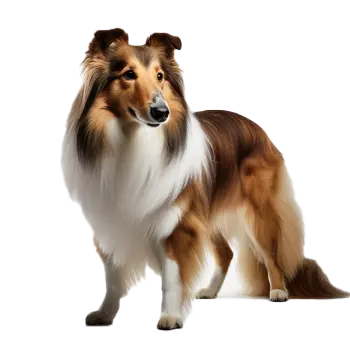
The Lassie Dog's appearance is so deeply embedded in popular consciousness that most people can describe it without ever having read a breed standard. That iconic image, a large, elegant dog with a flowing sable-and-white coat, refined wedge-shaped head, and an expression of serene intelligence, is the Rough Collie, and it remains one of the most visually distinctive breeds in existence. The Smooth Collie shares the same body structure and proportions but wears a short, dense coat that reveals the breed's athletic build more clearly.

Overall, the Collie is a dog of balance and proportion. Males stand 24 to 26 inches at the shoulder and weigh between 60 and 75 pounds, while females are slightly smaller at 22 to 24 inches and 50 to 65 pounds. The body is slightly longer than tall, with a strong, level back and a deep chest that provides ample lung capacity without appearing heavy. There is an unmistakable quality of lightness and athleticism about a well-built Collie, an impression of a dog that could run and turn with ease across uneven ground.

The head is the breed's signature feature and arguably its most carefully judged element in the show ring. Viewed from the front and side, the head presents a smooth, clean wedge shape that tapers gradually from ears to nose tip. The skull is flat on top with a slight but perceptible stop. The muzzle is well-rounded, never square or snipey, and blends smoothly into the cheeks. The eyes are medium-sized, almond-shaped, and set somewhat obliquely, conveying the breed's hallmark expression of gentle alertness. Eye color is dark in sable and tricolor dogs, but blue merles may have blue or merle eyes. The ears are three-quarters erect with the tips folding forward, giving the dog an attentive, questioning look.

The neck is long and arched, carried proudly and flowing into well-angulated shoulders. The forelegs are straight with strong bone, and the pasterns are slightly flexible. The hindquarters are muscular with well-bent stifles and clean hocks, providing the driving power for the breed's characteristic effortless, ground-covering trot. The feet are oval with well-arched toes and thick pads. The tail is long, reaching at least to the hock, and is carried low with a slight upward swirl at the tip when the dog is relaxed.

The Rough Collie's coat is the breed's crowning glory and the feature most responsible for the "Lassie" image. The outer coat is long, straight, and harsh-textured, standing off the body and providing weather protection. Beneath it lies a soft, dense undercoat so thick that it is difficult to see the skin when the hair is parted. The coat forms an impressive mane and frill around the neck and chest, with profuse feathering on the legs and a full, bushy tail. The Smooth Collie's coat is short, dense, and flat with a good undercoat, presenting a much sleeker profile while maintaining the same weather resistance.

Accepted colors include sable and white, ranging from light gold to deep mahogany; tricolor, which is predominantly black with tan markings and white accents; blue merle, a mottled gray-blue pattern with black markings and usually tan points; and white, in which the body is predominantly white with colored head markings. All color patterns feature the characteristic white markings on the chest, neck, legs, feet, and tail tip that give the breed its well-dressed appearance. In motion, the Collie moves with a smooth, effortless gait that covers ground efficiently, the front legs reaching well forward while the hind legs provide balanced driving power. There should be no wasted motion, no crossing or weaving, just fluid athleticism that speaks to the breed's working origins.

Affectionate With Family
The Lassie Dog bonds deeply with every member of its household, showing a warmth and devotion that made the breed an icon of canine loyalty. This is a dog that genuinely thrives on being part of family life.
Good With Young Children
Few breeds match the Collie's natural patience and gentleness with children. There is an almost intuitive awareness of small humans that makes this breed a trusted companion for families with kids of all ages.
Good With Other Dogs
Collies tend to be sociable and non-confrontational with other dogs, preferring diplomacy over conflict. Their herding background gives them good social awareness, though some individuals may attempt to herd canine housemates.
Shedding Level
The Rough Collie sheds heavily, particularly during seasonal coat changes when the undercoat releases in thick clumps. Even the Smooth variety sheds noticeably. Regular brushing is the primary defense against hair accumulation.
Coat Grooming Frequency
The Rough Collie's luxurious double coat requires thorough brushing two to three times weekly to prevent matting, with daily attention during heavy shedding periods. The Smooth variety needs less intensive care but still benefits from regular brushing.
Drooling Level
The Collie's refined, wedge-shaped head and tight lips produce virtually no drooling. This is one of the cleanest breeds in terms of mouth-related mess.
Coat Type
The Rough variety carries a long, straight, harsh-textured outer coat over a soft, dense undercoat, creating the breed's iconic flowing silhouette. The Smooth variety wears a short, dense, flat coat that lies close to the body.
Openness To Strangers
Collies are typically polite but initially reserved with unfamiliar people, warming up once they determine the newcomer poses no threat to their family. This measured friendliness reflects their watchful herding heritage.
Playfulness Level
The breed maintains a lively, playful spirit well into maturity, engaging enthusiastically in games and interactive activities with family members. Their play style tends toward graceful and athletic rather than rough.
Watchdog/Protective Nature
Collies are naturally alert and will bark to announce visitors or anything unusual in their environment. They are protective of their families in a watchful, vocal way rather than through physical aggression.
Adaptability Level
While Collies prefer homes with yard space for exercise, they can adapt to various living situations provided their physical and mental needs are met. They do not handle prolonged isolation well, needing regular human companionship.
Trainability Level
Intelligent and eager to cooperate, the Collie responds beautifully to positive training methods. They are sensitive to tone and mood, making gentle, consistent guidance far more effective than harsh correction.

Lassie Dog History & Development

The nickname "Lassie Dog" traces directly to a single short story that launched one of the most enduring franchises in entertainment history. In 1938, British-American author Eric Knight published "Lassie Come-Home" as a short story in The Saturday Evening Post, expanding it into a full novel in 1940. The story of a Rough Collie's epic journey across the Scottish Highlands to reunite with the boy she loved resonated so powerfully that MGM produced a film adaptation in 1943 starring a male Rough Collie named Pal. That film launched a television series, sequels, animated shows, reboots, and merchandise that kept the Lassie name in public consciousness for over eight decades.

What makes the "Lassie Dog" nickname culturally significant is the degree to which one fictional character shaped public perception of an entire breed. Before Lassie, the Collie was well known and well regarded, having been a favorite of Queen Victoria in the 1860s and a consistent presence in American and British show rings since the breed's formal standardization in the late 19th century. But Lassie transformed the breed from a respected show and working dog into a household icon synonymous with loyalty, courage, and intelligence. The nickname "Lassie Dog" became shorthand for these qualities, and for decades it drove enormous demand for Rough Collies.

The breed itself predates its most famous representative by centuries. Collies evolved in the Scottish Highlands and the Anglo-Scottish border regions as working sheepdogs, managing flocks across rough terrain in harsh weather. The name "Collie" most likely derives from the Scots word for the black-faced sheep the dogs herded, though some scholars connect it to the Gaelic word for "useful." For generations, these dogs were valued purely for their working ability, with appearance being secondary to function. They were medium-sized, hardy, intelligent dogs that could manage sheep independently across vast expanses of open hill country.

Queen Victoria's enthusiasm for the breed during her visits to Balmoral Castle in the 1860s sparked the transformation from working dog to fashionable companion. Show breeders began refining the Collie's appearance, emphasizing the elegant head, flowing coat, and graceful outline that define the modern breed. The Collie Club was founded in England in 1881, and the Collie Club of America followed in 1886. The AKC registered its first Collies in 1885. By the early 20th century, the breed had split into two distinct populations: working Collies that eventually became the Border Collie, and show Collies that became the Rough and Smooth Collie we know today.

The Lassie phenomenon's impact on the breed was a double-edged sword. It brought unprecedented popularity but also attracted casual buyers who were drawn to the image without understanding the breed's needs. Overproduction by commercial breeders during peak Lassie popularity introduced health and temperament problems that responsible breeders have spent decades working to correct. Today, the breed's popularity has settled to more sustainable levels, and the nickname "Lassie Dog" carries a warmth that reflects genuine public affection for a breed that earned its reputation through both fiction and reality.

Lassie Dog Temperament & Personality

The Lassie character was written as brave, loyal, and uncannily perceptive, and the remarkable thing about the Collie is that the fictional portrayal is not as far from reality as skeptics might assume. Collies genuinely possess an unusual sensitivity to human emotions and household dynamics that can border on the eerie. Experienced owners frequently report that their Collie knew something was wrong before anyone else in the house noticed, whether it was a child's distress, a shift in family tension, or an approaching storm. This attunement to human emotional states is one of the breed's most distinctive behavioral traits and likely stems from centuries of close working partnership with shepherds who needed dogs that could read subtle cues across distance.

Intelligence in the Collie manifests differently than in some other herding breeds. Where a Border Collie channels its brainpower into intense, obsessive focus on work, and a German Shepherd directs its intelligence toward task execution, the Collie's intelligence tends toward social awareness and emotional responsiveness. They read rooms. They notice when routines change. They respond to tone of voice with a precision that makes harsh training methods not just unnecessary but counterproductive. A sharply spoken correction can shut down a sensitive Collie for hours, while calm, positive reinforcement produces enthusiastic cooperation.

The breed's gentleness with children is not a marketing myth. Collies possess a natural patience with young humans that goes beyond mere tolerance. Many Collie owners describe their dogs actively supervising children at play, positioning themselves between kids and perceived dangers, and gently herding wandering toddlers back toward the group. This protective instinct operates through watchfulness and gentle physical intervention rather than aggression. It is herding behavior repurposed for family guardianship, and it is one of the reasons the breed earned its reputation as the ideal family dog.

Socially, Collies tend to be polite rather than pushy. They enjoy the company of other dogs and typically avoid confrontation, though they may attempt to herd other pets, particularly if those pets are moving quickly. Their interactions with strangers follow a predictable pattern: initial reserve, assessment, and then gradual warming once the Collie determines the person is welcome. This is not shyness in the fearful sense but rather the measured evaluation of a dog bred to be observant.

The breed does have a well-earned reputation for vocalization. Collies bark. They bark at visitors, they bark at unusual sounds, they bark when excited, and some individuals bark because they have decided the silence needs filling. This tendency is not random noise but communication, often quite specific in its intent. Learning to interpret a Collie's various barks helps owners respond appropriately, though managing excessive barking requires consistent training from an early age.

One behavioral trait that surprises some new owners is the Collie's sensitivity to household conflict. These dogs absorb the emotional atmosphere of their homes, and a Collie living in a tense or chaotic environment will show stress through behaviors ranging from withdrawal to digestive upset. They do best in stable, calm homes where their need for emotional equilibrium is understood and respected.

Lassie Dog Family Life & Living Requirements

The Lassie character lived on a farm with a devoted family, and while modern Collies do not require a farm, the domestic arrangement in those stories was not a bad model for how this breed thrives. Collies are family dogs in the truest sense, not just tolerating household life but actively participating in it. They want to be where their people are, involved in whatever is happening, and they wilt when left alone for extended periods. A Collie that spends most of its day in an empty house will develop anxiety-driven behaviors including excessive barking, destructive chewing, and attempts to escape.

Housing needs are moderate compared to some similarly sized breeds. Collies adapt well to suburban homes with fenced yards, and while they appreciate outdoor space, they are not dogs that need acres to roam. A securely fenced yard where they can play and patrol satisfies their physical needs, and the fence serves an important secondary purpose: preventing the breed's herding instinct from directing itself at passing joggers, cyclists, or neighborhood cats. For apartment dwellers, the breed can manage if given adequate daily exercise and outdoor time, though their tendency to bark may create friction with neighbors.

With children, the Collie approaches near-ideal territory. The breed's patience, gentleness, and watchful nature make it one of the most reliable family companions for households with kids. They tolerate the unpredictable behavior of young children remarkably well and often become the child's devoted shadow, following them through the house and settling at their feet. That said, no dog should be expected to endure sustained rough handling, and teaching children to respect the dog's boundaries remains important.

Collies integrate smoothly into multi-pet households in most cases. Their non-aggressive nature means they rarely pick fights with other dogs, and they can coexist peacefully with cats, particularly when raised together. The herding instinct may surface as gentle nudging or circling of other pets, which is usually harmless but can annoy cats and smaller dogs if left unchecked.

One practical consideration that surprises first-time Collie owners is the coat maintenance required by the Rough variety. The abundant double coat sheds heavily, particularly during seasonal changes, and loose hair will find its way onto every surface in the home. Prospective owners who are not prepared for regular brushing and seasonal shedding cleanup should consider whether this commitment fits their lifestyle. The Smooth Collie offers an alternative with significantly less coat maintenance while preserving the same temperament and structure.

Lassie Dog Training & Exercise Needs

The Collie's trainability was part of what made Lassie possible on screen, since the dogs playing the character needed to learn and reliably perform complex sequences of behavior under the distracting conditions of a film set. In everyday life, this same willingness to learn and cooperate makes the Collie one of the more pleasant herding breeds to train. They respond beautifully to positive reinforcement methods, picking up new commands quickly and retaining them reliably. Their desire to please, combined with their sensitivity to human approval, means that a well-timed word of praise can be as motivating as a treat.

The critical caveat to Collie training is the breed's emotional sensitivity. These are dogs that wither under harsh correction. Raising your voice, using physical punishment, or expressing visible frustration during training sessions creates a Collie that either shuts down completely or becomes anxious and unable to focus. The most successful Collie trainers work with a calm, patient demeanor and frame training as a collaborative game rather than a series of demands. Short, varied sessions prevent boredom, and ending each session on a positive note ensures the dog looks forward to the next one.

Socialization requires attention despite the breed's generally friendly disposition. Some Collies, particularly those from show lines, can be reserved to the point of shyness if not exposed to a wide range of people, environments, and experiences during the critical socialization window. Puppy kindergarten, controlled outings to various settings, and regular positive interactions with strangers all help build the confident, well-adjusted temperament the breed is known for.

Exercise requirements are moderate by herding breed standards. The Collie needs daily activity but does not demand the intense physical output required by breeds like the Border Collie or Australian Shepherd. A good hour of exercise daily, split between walks and play sessions, keeps most Collies content. They enjoy activities that engage their minds as well as their bodies, including obedience work, rally, agility at a moderate pace, and herding instinct exercises. Many Collies also take naturally to therapy dog work, where their calm demeanor and sensitivity to human emotions make them exceptionally effective.

Off-leash exercise works well with Collies once basic recall is established, since the breed generally stays within reasonable range of its handler and lacks the single-minded prey drive that sends some breeds sprinting toward the horizon. However, the herding instinct may cause a Collie to attempt to round up joggers, children, or other dogs in open spaces, which requires management through training and appropriate venue selection.

Lassie Dog Health Concerns

The Collie's health profile includes several breed-specific genetic conditions that prospective owners should understand before committing to the breed. The good news is that DNA testing now exists for the most significant conditions, making it possible for responsible breeders to make informed decisions that reduce the incidence of these problems in future generations.

Gastric dilatation-volvulus poses a risk given the breed's deep chest conformation. Feeding smaller, more frequent meals and avoiding vigorous exercise immediately after eating help reduce this risk.

Common Health Issues

  • Multi Drug Resistance 1 - MDR1, is a genetic mutation affecting approximately 70 percent of Collies that impairs the blood-brain barrier's ability to pump out certain drugs, causing potentially fatal neurological reactions to medications including ivermectin, loperamide, and several chemotherapy agents.
  • Collie Eye Anomaly - CEA, is a congenital condition affecting choroid development beneath the retina, ranging from mild choroidal hypoplasia with no vision impact to severe colobomas or retinal detachment causing significant visual impairment.
  • Progressive Retinal Atrophy rod-cone dysplasia type 2 - PRA-rcd2, causes progressive photoreceptor degeneration in the retina, typically showing symptoms by six weeks of age and leading to complete blindness within the first year of life.
  • Dermatomyositis - DMS, is an autoimmune condition causing skin lesions, hair loss, and crusting primarily on the face, ears, and extremities, with severity ranging from mild self-resolving cases to chronic conditions requiring ongoing medical management.
  • Cyclic Neutropenia - Grey Collie Syndrome, is a fatal inherited condition in which the bone marrow fails to produce neutrophils on a normal cycle, identifiable by diluted gray coat color in affected puppies who rarely survive past two years.
  • Gastric dilatation-volvulus is a life-threatening emergency where the stomach distends with gas and may twist on its axis - Representing an elevated risk in deep-chested breeds like the Collie.

Preventive Care & Health Monitoring

  • MDR1 DNA testing through Washington State University or UC Davis VGL should be performed on every Collie - And results should be recorded in the dog's veterinary file so that problem drugs including ivermectin, loperamide, acepromazine, and butorphanol can be avoided or dose-adjusted.
  • PRA-rcd2 DNA testing identifies carriers and affected dogs - Allowing breeders to avoid producing affected offspring and ensuring owners of at-risk dogs can monitor for early vision changes.
  • DMS DNA testing across all three risk loci - A, B, and C, provides a risk profile that informs breeding decisions and helps owners and veterinarians recognize early symptoms for prompt treatment.
  • Ophthalmologic examination by a board-certified veterinary ophthalmologist at five to six weeks of age screens for Collie Eye Anomaly - And the NHEJ1 DNA test identifies carriers of the CEA mutation.
  • Hip and elbow radiographic evaluation through OFA or PennHIP screening is encouraged by the Collie Health Foundation for all breeding stock to reduce the incidence of orthopedic conditions in future generations. - Hip and elbow radiographic evaluation through OFA or PennHIP screening is encouraged by the Collie Health Foundation for all breeding stock to reduce the incidence of orthopedic conditions in future generations.

Lassie Dog Grooming & Maintenance

The Rough Collie's coat is the breed's most labor-intensive feature, and maintaining it properly requires a commitment that should not be underestimated. That flowing mane, the profuse leg feathering, and the full, bushy tail that define the "Lassie" silhouette do not maintain themselves. Without regular care, the coat mats, the skin underneath becomes irritated, and the dog's comfort and health suffer.

Brushing should happen at least two to three times per week using a pin brush and a long-toothed metal comb. Work through the coat systematically, section by section, paying special attention to the areas behind the ears, under the armpits, along the chest frill, and around the hindquarters where mats form most readily. Many experienced Collie owners use a technique called line brushing, where the coat is parted in lines and each layer is brushed from skin to tip, ensuring the undercoat receives attention along with the outer coat. During shedding season, which typically occurs twice a year, daily brushing becomes necessary as the undercoat releases in thick sheets.

Bathing should be done as needed, generally every four to six weeks or when the dog gets genuinely dirty. The coat should be thoroughly brushed before bathing, as water tightens existing mats and makes them nearly impossible to remove. Use a quality dog shampoo and conditioner, and ensure the coat is rinsed completely to prevent skin irritation from soap residue. Drying a Rough Collie takes time. A high-velocity dryer speeds the process considerably and helps remove loose undercoat, but the process still requires patience.

The Smooth Collie's grooming needs are dramatically simpler. Weekly brushing with a bristle brush or rubber grooming mitt keeps the coat clean and removes loose hair. Smooth Collies still shed and still benefit from regular brushing, but the time investment is a fraction of what the Rough variety requires.

Both varieties need regular ear checks, as the semi-erect ears can trap moisture and debris. Clean the ears weekly with a veterinarian-approved solution. Nail trimming every two to three weeks prevents overgrowth and the associated discomfort and gait changes. Dental care through regular brushing or dental chews supports long-term oral health. Some Collie owners also trim the hair on the feet and hocks for a tidier appearance, though this is aesthetic rather than essential.