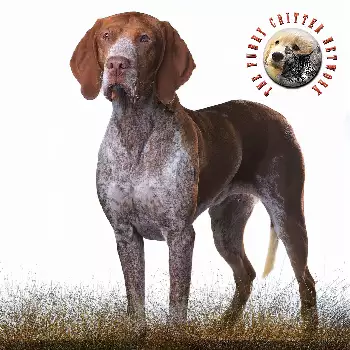
Stand next to an Italian Pointing Dog and the first thing that registers is how much dog there is. This is a large breed, with males reaching 23 to 27 inches at the shoulder and weighing anywhere from 55 to 90 pounds. Females are proportionally smaller but still substantial. The build suggests a dog that was designed for all-day endurance rather than sprinting speed, with heavy bone, well-developed muscle, and enough substance in the chest and hindquarters to power through brush and rough terrain without tiring. Despite that heft, there is nothing clumsy about this breed when it moves.
The head immediately distinguishes the Italian Pointing Dog from other pointing breeds. It is large and angular, with a broad skull, a prominent occiput, and a deep, squared-off muzzle that gives the face a noble, almost Roman profile. The nasal bridge can be straight or slightly convex, which is called a ram-nosed profile and is characteristic of the breed. The lips are full and pendulous enough to overlap the lower jaw, contributing to the breed's tendency to drool and giving the face its distinctive soft expression. The nose is large and matches the coat color, with wide-open nostrils that serve the dog well when working scent in the field.
The ears are perhaps the breed's most recognizable single feature. They are long, broad, and set at roughly eye level, hanging flat against the cheeks with a slight inward twist at the lower edge. Pulled forward, they should reach approximately to the tip of the nose. The ears frame the face in a way that gives the Italian Pointing Dog a dignified, slightly melancholy expression that people either find endearing or slightly comical, depending on their sensibility. The eyes are large and oval, set neither too deep nor too prominent, with colors ranging from amber to dark ochre that harmonize with the coat.
The neck is strong, moderately arched, and well-muscled, blending into shoulders that are laid back enough to allow generous front reach during movement. The body is slightly longer than tall, with a deep chest that reaches to the elbows, well-sprung ribs, and a broad back that flows into a muscular loin and moderately sloping croup. The legs are straight, well-boned, and end in rounded, compact feet with hard pads. The tail, when undocked, is long and carried at or slightly below the horizontal during work. In countries still permitting docking, it is typically shortened to six to ten inches.
Coat colors run through white, white and orange, white and chestnut, and roan. The hair itself is short, dense, and carries a noticeable gloss when the dog is in good condition. It lies flat against the body and provides enough protection for fieldwork without the maintenance demands of a longer coat. Some dogs carry slightly thicker hair on the ears and along the back of the legs, but there should be no feathering.
The gait is what serious breed enthusiasts talk about most, and for good reason. The Italian Pointing Dog moves at a powerful extended trot that covers enormous ground with each stride. The head stays high to catch airborne scent, the topline remains steady, and there is a rolling cadence to the movement that looks effortless even though it requires significant muscular coordination. It is a gait built for hours of work across open country, and watching a well-built Italian Pointing Dog move across a field is one of those things that reminds you why people devoted centuries to breeding this animal.
Affectionate With Family
★★★★★
This breed bonds deeply with everyone in the household and seeks physical proximity as a near-constant part of daily life.
Good With Young Children
★★★★☆
A naturally gentle sporting breed that tends to be careful and tolerant around children, though supervision is wise given its size.
Good With Other Dogs
★★★★☆
Sociable by nature and lacking the dominance drive found in many breeds, the Italian Pointing Dog integrates well into multi-dog households.
Shedding Level
★★★☆☆
Sheds moderately throughout the year with predictable seasonal increases that are easily managed with regular brushing.
Coat Grooming Frequency
★★☆☆☆
Minimal coat maintenance is needed beyond a quick weekly session with a bristle brush or grooming glove.
Drooling Level
★★★☆☆
Produces noticeable drool due to its pendulous lip structure, especially around water and mealtimes, but less than heavier-lipped breeds.
Coat Type
★★☆☆☆
A smooth, close-lying coat with a slight sheen that repels light debris in the field and dries quickly after rain.
Openness To Strangers
★★★★☆
Naturally friendly and curious about new people, approaching visitors with interest rather than suspicion.
Playfulness Level
★★★★☆
Maintains a playful, almost clownish streak well beyond puppyhood, particularly during interactive games with family members.
Watchdog/Protective Nature
★★☆☆☆
May bark at unfamiliar sounds but lacks any real guarding instinct and is far too friendly to serve as a deterrent.
Adaptability Level
★★★☆☆
Adjusts to new settings reasonably well as long as exercise and human companionship remain consistent, but struggles in confined spaces.
Trainability Level
★★★★☆
Highly willing to work with its handler when approached through encouragement and reward, but will withdraw under forceful methods.