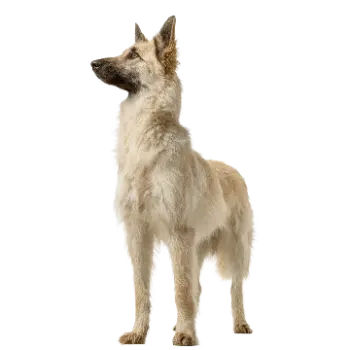
Stand the Laekenois next to the other Belgian Shepherd varieties and the coat is the first thing you see, and the thing that makes this variety unforgettable. The rough, wiry, slightly tousled double coat is unlike the coats of the Groenendael, Tervuren, or Malinois - it looks purposefully unsettled, like the dog has just come in from a good long run through tall grass and does not plan to be brushed anytime soon. The topcoat is dry and hard to the touch, with a slightly frizzy or curled quality that is distinct from both the long flowing coats of the other long-haired varieties and the sleek close coat of the Malinois. Underneath is a soft, dense undercoat that provides the insulation a working farm dog in the Belgian countryside would need.
Color in the Laekenois runs from fawn through reddish brown, often with black tipping or shading at the muzzle and tail. The coat gives the dog a slightly dusty or weathered look even when clean, which is part of its character. Unlike some rough-coated breeds, the Laekenois should not be clipped - the correct texture is maintained by stripping or hand-rolling, and clipping softens the coat into something that no longer matches the standard.
The body beneath that distinctive coat is a study in balanced function. The Laekenois is a medium-sized dog, squarely proportioned with males standing 24 to 26 inches at the shoulder and females between 22 and 24 inches. Weight ranges from around 55 to 65 pounds for males and slightly less for females. The build is muscular and lean rather than heavy, reflecting the breed's origins as a dog that moved with a flock across open ground for hours at a time. The chest is deep, the back is straight and strong, and the hindquarters carry the muscular drive that makes the breed's movement efficient and tireless.
The head is long and clean, proportioned to the body without appearing either coarse or refined. The skull and muzzle are approximately equal in length. The stop is moderate. The ears are triangular, stiff, erect, and set high on the skull - always carried upright and forward when the dog is alert. The eyes are medium-sized, almond-shaped, and brown, with a direct, attentive expression that conveys both intelligence and readiness. The lips are tight, the jaw strong, and the bite should meet in a scissors or level position.
Movement reflects the working character of the breed. The Laekenois trots with ground-covering efficiency rather than the show-ring animation of a purely conformation breed. It is fast, light on its feet, and capable of changing direction quickly. The breed historically moved in wide circles and curved paths rather than straight lines - the natural movement pattern of a dog managing a flock by circling and containing rather than by driving from behind in a straight line.
The tail is strong, reaching to the hock, and is carried with a slight upward curve at the tip but never curled or held above the topline in a ring. In the correct working specimen, every physical feature of the Laekenois serves a function that can be traced back to the Belgian fields where the breed developed its character.
Affectionate With Family
★★★★☆
The Laekenois bonds deeply with its household, showing warmth and devotion to the people it considers its own. This affection is genuine but expressed with the reserve of a working dog rather than the effusiveness of a lap breed.
Good With Young Children
★★★☆☆
The Laekenois raised alongside children and properly socialized is a patient and watchful family companion, but its herding instincts and high energy require supervision and clear boundaries with very young children.
Good With Other Dogs
★★★☆☆
With socialization from an early age the Laekenois manages well with other dogs, though it may show dominance tendencies and should be supervised with unfamiliar animals. Same-sex pairs can sometimes be challenging.
Shedding Level
★★★☆☆
The Laekenois sheds moderately year-round, with heavier periods coinciding with seasonal coat changes. The rough, wiry topcoat does not shed in the same way as smooth or long-coated breeds, but grooming is still needed regularly.
Coat Grooming Frequency
★★★☆☆
The rough double coat benefits from weekly brushing to remove debris and prevent the undercoat from compacting. The coat should never be clipped, as stripping or hand-rolling maintains its correct harsh texture far better than scissors.
Drooling Level
★☆☆☆☆
The Laekenois is a dry-mouthed breed with a lean, well-formed muzzle that produces no meaningful drool under normal circumstances. This is not a concern for owners of this variety.
Coat Type
★★★★☆
The Laekenois is uniquely identified by its rough, wiry, slightly tousled double coat - the only variety of the four Belgian Shepherd types with this texture. The coat appears purposefully disheveled rather than groomed to perfection.
Openness To Strangers
★★☆☆☆
The Laekenois is watchful and reserved with people it does not know, sizing them up carefully before deciding how to respond. This natural protectiveness is a trait of the working Belgian Shepherd and not something socialization fully removes.
Playfulness Level
★★★★☆
The Laekenois has real play drive and enjoys games with its people - especially those that engage its body and mind simultaneously. It is not a couch dog and its playfulness reflects the energy of a breed built to work.
Watchdog/Protective Nature
★★★★★
Protection of its family and property is core to the Laekenois character. It watches, assesses, and responds, and it has the confidence and conviction of a dog that was bred to guard as well as herd.
Adaptability Level
★★★☆☆
The Laekenois adapts to varied living environments when its exercise and mental engagement needs are fully met, but it is not suited to sedentary households or those unable to provide meaningful daily activity.
Trainability Level
★★★★☆
The Laekenois is intelligent and responds well to consistent, positive training. It learns quickly, retains what it has been taught, and performs reliably with handlers who establish clear communication. Harsh methods are counterproductive.