Belgian Laekenois

Belgian Laekenois

Quick Facts

🐕 Breed Group
Herding Group
📏 Size Category
Medium
📏 Height
Males: 24-26 inches, Females: 22-24 inches
⚖️ Weight
Males: 55-65 pounds, Females: 55-65 pounds
⏱️ Life Expectancy
12-14 years
🧣 Coat Type
Rough, wiry double coat with slight wave
🎨 Coat Colors
Fawn to mahogany with black overlay, black mask
😀 Temperament
Alert, Loyal, Intelligent, Protective, Active, Devoted
🏃 Exercise Needs
High
🎓 Training Difficulty
Moderate
👶 Good with Children
Good with older children in the household
🐾 Good with Other Pets
Requires careful introduction; herding instinct strong

Other Names & Breed Recognition

The Belgian Laekenois is pronounced "lak-in-wah" - a point that most first-time encounters with the breed involve learning, since the spelling gives no obvious pronunciation hint to English speakers. The name honors the town of Laeken, a municipality near Brussels where the breed originated, and where Belgian Queen Marie Henriette kept a kennel of Laekenois in the late 19th century, providing the breed with a brief period of royal association that added to its historical profile.

In most countries outside North America, the Laekenois is not recognized as a separate breed. The FCI, which governs dog registration in the vast majority of countries worldwide, classifies the four Belgian shepherd varieties - the Groenendael (black, long coat), the Tervuren (fawn or mahogany, long coat), the Malinois (fawn or mahogany, short coat), and the Laekenois (fawn or mahogany, rough wire coat) - as a single breed with four coat and color varieties, formally known as the Chien de Berger Belge (Belgian Shepherd Dog). Under this classification, the official name "Laekenois" distinguishes the wire-coated variety from the others. In the UK, The Kennel Club similarly treats all four as varieties of one breed in its Pastoral Group.

In North America, the situation is different. The AKC has historically separated the Belgian breeds. The Malinois has been AKC-recognized since 1959 and the Tervuren since 1960. The Laekenois, however, had a much longer road to full recognition. It entered the AKC's Miscellaneous Class in 2011, remained there for nearly a decade, and received full AKC recognition in the Herding Group on July 1, 2020 - making it one of the most recent AKC breed additions. The delay partly reflects the Laekenois's extreme rarity; with only an estimated few hundred dogs in North America and perhaps a thousand worldwide, the AKC's registration volume requirements took years to satisfy.

The parent club in the United States is the American Belgian Laekenois Association (ABLA), which advocated for full AKC recognition and which maintains the breed standard and health programs. The UKC in the United States recognizes all four Belgian shepherd varieties as one breed called the Belgian Shepherd. The Canadian Kennel Club recognizes the Laekenois in the Herding Group. For those who encounter the breed in international contexts, "Chien de Berger Belge" or "Belgian Shepherd Laekenois variety" may be the operative terms.

Belgian Laekenois Organizations & Standards

The American Belgian Laekenois Association (ABLA) is the AKC parent club for the breed in the United States, and its membership drove the decade-long campaign to achieve full AKC recognition that culminated in 2020. The ABLA maintains the breed standard, coordinates the CHIC health program, and works to promote responsible breeding and ownership of this rare breed. Given the Laekenois's very small population in North America, the ABLA's role in maintaining genetic diversity, educating buyers, and connecting the small breeder community is particularly important. The club organizes herding trials, conformation events, and working events, emphasizing the breed's dual identity as both a capable working dog and a companion.

The FCI breed standard, maintained by the Societe Royale Saint-Hubert (the Belgian national kennel club), is the foundational document for the breed worldwide. The FCI standard describes all four Belgian shepherd varieties under one set of structural requirements, with the distinguishing factor for the Laekenois being the rough, wiry coat of approximately 2.5 inches in length that gives the dog its characteristic tousled appearance. The standard emphasizes a square, well-balanced body - the height at the shoulder should approximately equal the length from the point of the shoulder to the point of the hip. The build should convey harmonious proportion and the capacity for sustained work.

The AKC breed standard for the Laekenois, derived from the FCI standard, calls for males to stand 24 to 26 inches at the shoulder and females 22 to 24 inches. Weight for both sexes falls in the range of 55 to 65 pounds, giving the breed a medium build that is athletic and capable without the bulk of larger herding dogs. The head is described as long and lean, with a flat skull that equals the muzzle in length. Eyes are almond-shaped, dark brown, with an intelligent, alert expression. Ears are triangular, stiff, and erect, set high on the skull - the upright, forward-facing ears contribute to the breed's characteristic look of constant attentiveness.

The coat standard for the Laekenois is specific and distinct from the other Belgian varieties. The outer coat is rough and harsh to the touch, approximately 2.5 inches long, with a characteristic slight wave or tousle but never curled. The coat should appear somewhat disheveled but must not be soft or woolly. The Laekenois should never be scissor-trimmed or clipped, as this destroys the rough texture. The correct maintenance method is hand-stripping once or twice a year to remove dead outer coat and encourage proper regrowth.

The CHIC program for the Belgian Laekenois requires OFA hip evaluation, OFA elbow evaluation, and an ACVO eye examination for certification. These three screenings reflect the breed's documented health vulnerabilities and provide buyers with the documented evidence of responsible health management that the small, dedicated breeding community in North America prioritizes.

Kennel Club Recognition

  • American Kennel Club (AKC): Recognized in 2020, Herding Group
  • United Kennel Club (UKC): Recognized, Herding Dog Group
  • Canadian Kennel Club (CKC): Recognized, Herding Group
  • FCI: Recognized, Group 1
  • The Kennel Club (UK): Recognized, Pastoral Group

Belgian Laekenois Physical Description

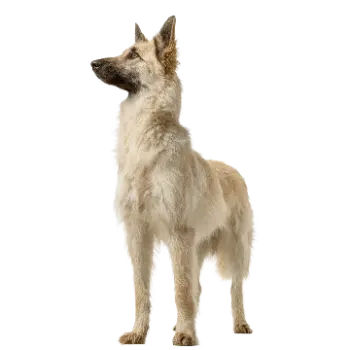
The Belgian Laekenois is an immediately recognizable dog once you know what you are looking at - a medium-sized herding breed with a rough, tousled wire coat, erect ears, an attentive expression, and a square, well-proportioned body that conveys both athleticism and substance. People who encounter a Laekenois and immediately think of a Malinois with the wrong coat are on the right track - the four Belgian shepherd varieties share the same structural blueprint, differentiated primarily by coat type and color.

The head is long and lean with a flat skull and a muzzle that is approximately equal to the skull in length. There is a moderate stop. The nose is black. Lips are tight, with no looseness or flews. The jaw is strong, and the bite should be scissors. The head carries a characteristic expression of intelligent alertness - the Laekenois is always watching, always processing, and the head and eye work together to communicate that quality at a glance.

The eyes are medium-sized, almond-shaped, and dark brown. Light or round eyes are considered faults and change the character of the expression. The expression in a well-bred Laekenois reads as frank and alert - not hard or suspicious, but engaged and watchful. Ears are triangular, moderately large, carried rigidly upright with the ear canal opening forward. Ear set is high on the skull. The erect ears are one of the Laekenois's most expressive features and contribute significantly to the impression of constant readiness.

The neck is strong, moderately long, and slightly arched, carrying the head proudly. The topline is level and firm. The chest is deep, reaching to the elbow, and moderately broad. The ribcage is well-sprung without being barrel-shaped. The loin is short and muscular. The croup slopes gently, and the tail is thick at the base, reaching at least to the hock, and carried in a slight upward curve at rest - never over the back in a curl, which would indicate crossing with another breed type.

Forelegs are straight, parallel, and well-boned. Pasterns are strong with very slight slope. Feet are round and catlike with well-arched, close-set toes. The hindquarters are powerful and well-angulated, with well-developed second thighs that provide the driving force for the breed's characteristic smooth, ground-covering trot. The Laekenois should move with a confident, free-flowing gait that can be maintained for extended distances - a quality that reflects the breed's historical role as a dog that worked all day across Belgian farmlands and linen fields. Viewed from behind, the hind legs should track closely behind the forefeet, moving with drive and purpose.

The Laekenois stands square - the standard specifies that height at the shoulder and body length from shoulder point to hip should be approximately equal. This squareness of proportion is a key standard requirement that distinguishes the Belgian shepherd type from some other herding breeds that are built on longer, lower lines. Males stand 24 to 26 inches at the shoulder; females 22 to 24 inches. Weight for both sexes falls between 55 and 65 pounds. The build reads as athletic and capable rather than heavy - this is a dog built for endurance and agility, not for brute strength.

The coat is what most immediately distinguishes the Laekenois from the other Belgian shepherd varieties. It is rough and harsh to the touch - a wiry outer coat approximately 2.5 inches in length with a characteristic tousled, slightly disheveled appearance. There is a shorter, denser undercoat. The texture should be harsh and dry, never soft or silky, and the coat should have a slight wave or irregularity that gives the tousled look - but it should not form tight curls. This coat provides weather resistance and protection during outdoor work. The muzzle and brow have a slight but characteristic fringe or beard that reinforces the tousled impression from the front.

Color is fawn to mahogany with varying degrees of black overlay, black tipping on the outer hairs, and a black mask. The amount of black varies between individuals and is acceptable across a range. Traces of white are permitted on the chest and the tips of the toes but should not be extensive. The coat's color and texture give the Laekenois a wild, working-dog appearance that is quite different from the clean, polished look of the short-coated Malinois, despite the two breeds sharing the same structural foundation.

Sexual dimorphism is present but moderate. Males should be clearly masculine in head type and overall substance; females should be feminine without appearing fragile. Both should convey the breed's characteristic quality of harmonious proportion and quiet power.

Affectionate With Family
The Laekenois forms deep bonds with its family and is known for choosing one or two people as its primary anchors while remaining devoted and warm with the whole household. It does not like to be separated from its people.
Good With Young Children
Best suited to households with older children who understand how to interact respectfully. The herding instinct can cause circling, nipping at heels, and management behavior directed at young, running children.
Good With Other Dogs
Can be dominant with other dogs, particularly of the same sex, and may display herding behavior toward smaller housemates. Thorough early socialization produces the best outcomes.
Shedding Level
The Laekenois sheds less than most double-coated herding breeds. The rough coat tends to hold dead hair rather than releasing it in volume, though seasonal coat changes do occur.
Coat Grooming Frequency
Needs brushing two to three times weekly and hand-stripping once or twice a year to maintain proper coat texture. This is not a wash-and-go coat, but it is less demanding than many long-coated breeds.
Drooling Level
Clean-mouthed and tidy. Drooling is not a characteristic of this breed.
Coat Type
The rough, wiry outer coat with its characteristic slight wave and tousled appearance is unique among the Belgian shepherd varieties. It must be hand-stripped rather than clipped to preserve the correct harsh texture.
Openness To Strangers
Reserved and watchful with strangers - this is a dog that makes its own assessments and doesn't warm up to unfamiliar people on a stranger's schedule. Proper socialization is essential to prevent excessive suspicion.
Playfulness Level
An enthusiastic and willing play partner with its own family, combining working-dog focus with genuine enjoyment of games, fetch, and training-based activities.
Watchdog/Protective Nature
A reliable alert dog with natural protective instincts that don't require training to activate. Will escalate to active protection if it judges a genuine threat to be present.
Adaptability Level
Adaptable enough for city or country life provided its substantial exercise and mental engagement needs are met daily. Boredom in this breed produces destructive behavior reliably.
Trainability Level
Highly intelligent and capable of advanced work - this breed has competed at the top level in agility, herding, obedience, and protection sports. Requires experienced handling that is consistent and respectful.

Belgian Laekenois History & Development

The Belgian Laekenois is believed to be the oldest of the four Belgian shepherd varieties, with roots in the herding and guarding traditions of the Laeken region near Brussels. The breed's earliest documented role was guarding the linen fields around Antwerp, where Belgian-produced cloth was laid out in open fields to bleach in the sun, and where the Laekenois served as a watchdog protecting this valuable inventory from theft or damage. This is a distinctive and unusual original job for a herding breed, and it shaped the Laekenois into a dog with strong territorial instincts and reliable guardian character that extend beyond simple livestock management.

Formal classification of the Belgian shepherd varieties began in 1891, when a group of Belgian dog fanciers formed the Belgian Shepherd Dog Club and set out to identify and document the herding dogs native to Belgium. The group found a consistent structural type across the different regions, with variation primarily in coat type and length. The Laekenois, representing the rough wire coat from the Laeken area, was catalogued alongside the smooth Malinois, the long-coated Groenendael, and the long-coated Tervuren. All were found to share the same basic build, proportions, and working temperament. The first breed standard for all four varieties was established that year.

Belgian Queen Marie Henriette kept a kennel of Laekenois at her Royal Estate in Laeken in the late 19th century, providing the breed with brief royal patronage and heightened visibility in Belgian society. This connection contributed to early interest in the variety and to efforts to preserve and promote it within the emerging formal dog fancy. However, the Laekenois's rough coat was never as fashionable as the elegant long coat of the Tervuren or the striking solid black of the Groenendael, and the variety remained the least numerous of the four from early on.

Both World War I and World War II had devastating effects on Belgian dog populations, and the Laekenois suffered particularly severely. Both wars saw these dogs pressed into military service as messenger dogs - a role all four Belgian varieties played - and wartime destruction and food shortages decimated breeding kennels across Belgium. The breed's small initial numbers made recovery more difficult than for the more populous varieties, and dedicated breeders in Belgium and the Netherlands worked to rebuild the population from limited stock. This wartime bottleneck contributed to the breed's continuing rarity and to the relatively small gene pool that modern breeders work to manage carefully.

The first Laekenois arrived in North America in the 1990s, brought by enthusiasts aware of the breed from European sources. Population growth was slow, constrained by the difficulty of finding breeding stock and the small number of dedicated breeders. The AKC Miscellaneous Class admission in 2011 was a significant milestone that allowed Laekenois to compete in performance events and build the registration numbers needed for full recognition. The July 1, 2020 AKC recognition placed the Laekenois in the Herding Group, where it can now compete in all-breed conformation alongside the other Belgian varieties.

At the time of AKC recognition, estimates suggested fewer than 1,000 Laekenois existed worldwide, with only a few hundred in North America - a number that prompted comparisons to endangered wildlife species. The American Belgian Laekenois Association and breed clubs in Europe continue to work on expanding the breed's population while maintaining the type, health, and working ability that define it.

Belgian Laekenois Temperament & Personality

The Laekenois has been described as a "primitive breed" and a "heritage breed" by those who know it best, and both terms point at something real about how this dog operates. Unlike breeds that have been heavily selected for predictable softness or unconditional social compliance, the Laekenois retains its own independent judgment about people and situations. It is not aggressive by default, but it is not automatically deferential either. It decides. That quality is part of what makes this breed so capable in working roles and simultaneously part of what makes it a poor choice for inexperienced dog owners.

With its own family, the Laekenois is devoted and demonstrably affectionate. It tends to select one or two people as primary anchors - the individuals whose cues it trusts most and whose presence it seeks preferentially - while remaining warm and loyal to the entire household. These dogs do not like to be left out of family activities and will follow their people from room to room, maintaining close proximity. Left alone for extended periods without adequate exercise beforehand, they develop restless, destructive behavior that reflects genuine stress rather than mischief.

With strangers, the Laekenois is reserved and watchful. This is not shyness - a well-bred, properly socialized Laekenois is confident, not fearful - but a deliberate assessment that precedes acceptance. Socialization during puppyhood is critical to shaping how this default reserve expresses itself in adulthood. A Laekenois that has met many different kinds of people, environments, and situations from an early age will be discriminating but functional in the world. One that has been isolated or undersocialized will be difficult to manage in any context that involves strangers or new environments. The difference between a challenging, reactive adult and a confident, capable one is almost entirely determined by what happened in the first six months.

The herding instinct is active in this breed and will be directed at whatever is available if it is not managed. Running children, bicycles, other animals, and even guests can become targets for circling, stalking, and nipping behavior if the dog's working drive is not understood and channeled appropriately. This is not a behavior failure - it is the breed doing exactly what it was developed to do - but it requires consistent correction and appropriate outlets. Owners who channel this instinct into herding trials or treibball find it becomes a strength rather than a management problem.

Energy and drive in the Laekenois are substantial. This is a breed that needs a job. It excels in agility, herding trials, tracking, protection sports, and obedience competition. Without meaningful physical and mental challenge, a Laekenois that is bored will make its own decisions about how to spend its energy, and those decisions will involve chewing, digging, fence-testing, and vocal complaints. Owners who approach this breed as a companion-sport partnership - investing genuinely in training, exercise, and shared activity - tend to find the Laekenois deeply rewarding. Those expecting a low-maintenance household dog will be disappointed.

Protective instincts are present and reliable without requiring formal training to activate. The Laekenois will alert to perceived threats, position itself between its family and the source of concern, and escalate if it judges the situation to warrant escalation. This is a dog capable of physical protection and should be treated accordingly - meaning that socialization and clear behavioral expectations are not optional extras but essential elements of responsible ownership.

Belgian Laekenois Family Life & Living Requirements

The Laekenois can adapt to city or suburban living, but adaptation requires daily commitment to genuine exercise and mental engagement that does not bend when life gets busy. This is not a dog that recalibrates its needs downward because the week was hard. It needs two hours of meaningful activity daily - not two casual walks, but structured exercise, training sessions, play, or sport work that genuinely taxes both its body and its mind. On the days when that doesn't happen, the dog will tell you clearly and in ways that will cost you something.

Space requirements for this breed are moderate. A secure fenced yard is a significant quality-of-life asset, but the breed can function without one if off-leash time in a safe area is provided regularly. Fencing should be solid - this is an athletic, observant dog that will find and exploit a weak fence if properly motivated. Underground electronic fencing is not appropriate for a breed with this level of guardian instinct and drive.

This is a breed that does best as a working partner rather than a background pet. Owners who train seriously, compete in dog sports, work on herding or protection, or provide rich daily interaction with their dogs find the Laekenois remarkably capable and satisfying. Owners who want a dog that is content with minimal engagement should look elsewhere. The Laekenois is simply too intelligent and too driven to be comfortable as a passive companion.

With children, the Laekenois can be an excellent family member in the right household. School-age children who understand how to interact respectfully with a working breed, and who are part of the dog's socialization from puppyhood, will find a loyal and playful companion in this breed. Very young children present a different calculation - the breed's herding instinct, size, and energy make supervision essential, and the tendency to circle and nip at moving targets can be directed at toddlers without the dog having any aggressive intent. The behavior needs consistent correction regardless.

The Laekenois is a rare breed, and finding a well-bred puppy from health-tested parents requires patience. Waiting lists of six months to a year from reputable breeders are common. The rarity of the breed means that casual, poorly-researched purchase of a Laekenois from a puppy broker or commercial source carries real risks of getting a dog with poor health testing, unknown temperament background, or health problems that responsible breeders screen against. The investment in finding the right breeder pays dividends for the 12 to 14 years you will share with the dog.

Belgian Laekenois Training & Exercise Needs

The Laekenois is an exceptionally capable working dog when handled by someone who understands what that means in practice. The AKC's top Laekenois in agility competition has held that title for multiple years, which gives you some sense of what this breed can do when working with a skilled, committed handler. But that same capacity and intelligence that produces elite sport performance also means the dog is always thinking, always processing, and always forming opinions about how things should go - which creates training challenges for handlers who are not prepared.

Socialization must begin the day the puppy comes home and must be treated as a serious, ongoing project through the first two years of life. The Laekenois's default setting with the unfamiliar tends toward caution and assessment, and without broad positive experience across many different people, places, and situations in puppyhood, that caution can harden into suspicion or reactivity that is genuinely difficult to modify in an adult dog. Puppy classes, park visits, exposure to crowds and traffic and children and other animals - all of it matters, and all of it should happen consistently during the critical developmental windows.

Basic obedience is where the foundation of the working partnership gets built, and this breed has the intelligence to absorb it quickly. The Laekenois learns commands fast and remembers them reliably. What requires ongoing attention is the maintenance of respect for rules and consistency of expectations - this is a breed that will test the boundaries when it senses a handler losing focus or commitment. Positive reinforcement combined with clear, consistent structure is the approach that works best. Confrontational or punitive training methods tend to produce shutdown or backlash with a breed this sensitive and intelligent.

For exercise, an adult Laekenois needs genuine physical work that goes beyond routine walking. Long runs, off-leash work in a safe space, herding sessions, agility training, or competitive sport are what this breed is built for. The two-hour daily minimum is real, and it needs to include both cardiovascular work and cognitive engagement. Scent work, tracking, and obedience exercises address the mental side; running, hiking, and sport training address the physical side. Both are necessary.

The Laekenois thrives in dog sports that demand versatility - agility, herding, protection work, obedience, and rally are all activities where this breed has proven itself. Prospective owners who are drawn to the Laekenois are well advised to plan from the start to participate in at least one organized activity with the dog. The structure, the weekly commitment, and the skill-building that come with sport participation provide exactly the kind of purposeful engagement this breed needs to be its best self.

Belgian Laekenois Health Concerns

The Belgian Laekenois is a generally healthy breed with a documented lifespan of 12 to 14 years - a good outcome for a medium-large working dog. Because the breed's North American population remained small and isolated for decades, and because dedicated breeders worked deliberately to maintain health standards in a limited gene pool, the Laekenois does not carry the accumulated genetic disease burden that sometimes develops in breeds that experienced explosive popularity before health testing was standard practice.

Eye conditions are screened through the required ACVO certification. The Laekenois does not have a breed-specific eye disease unique to the variety, but the Belgian shepherd group more broadly has documented progressive retinal atrophy in various lines, and annual eye certification provides ongoing monitoring. The CHIC program for the Laekenois requires OFA hip evaluation, OFA elbow evaluation, and ACVO eye examination for certification. Because this is a rare breed with a small gene pool, responsible breeders are particularly attentive to genetic diversity and work actively to avoid line-breeding that narrows the breed's health foundation.

Common Health Issues

  • Hip dysplasia: Abnormal hip joint development causing laxity and progressive osteoarthritis. Required OFA screening for all CHIC-certified breeding Laekenois - Severity ranges from subclinical to significantly limiting mobility.
  • Elbow dysplasia: Abnormal elbow joint development encompassing several related conditions leading to joint pain - Front limb lameness, and arthritis. Required OFA elbow evaluation for CHIC certification.
  • Hypothyroidism: Reduced thyroid hormone production, typically from immune-mediated thyroid tissue destruction. Causes weight gain, lethargy, and coat quality changes - Managed with daily oral thyroid hormone replacement.
  • Progressive retinal atrophy - PRA, : Hereditary degeneration of retinal photoreceptor cells causing progressive vision loss. Documented in related Belgian shepherd lines; annual ACVO eye certification provides ongoing monitoring for Laekenois breeding stock.

Preventive Care & Health Monitoring

  • OFA hip evaluation - Or PennHIP, required for CHIC certification; performed at or after 24 months for OFA certification.
  • OFA elbow evaluation required for CHIC certification - Performed at or after 24 months.
  • Annual ACVO eye examination by a veterinary ophthalmologist required for CHIC certification and recommended annually for breeding dogs. - Annual ACVO eye examination by a veterinary ophthalmologist required for CHIC certification and recommended annually for breeding dogs.
  • Annual wellness bloodwork including thyroid panel to monitor for hypothyroidism in adults over four years of age. - Annual wellness bloodwork including thyroid panel to monitor for hypothyroidism in adults over four years of age.
  • Given the breed's small global gene pool - Buyers should request documentation that both parents have CHIC certification numbers and that the breeder is actively working to maintain genetic diversity.

Belgian Laekenois Grooming & Maintenance

The Laekenois coat requires more knowledge than time, and the single most important thing to understand about grooming this breed correctly is that the coat should never be clipped with electric clippers. Clipping softens the harsh outer coat texture permanently and progressively, resulting in a coat that looks increasingly wrong and loses the weather-resistant properties built into the breed's working heritage. The correct grooming method is hand-stripping - manually pulling the dead outer coat to remove it and encourage proper harsh regrowth.

Hand-stripping is done once or twice a year depending on the individual coat's growth rate and the owner's goals. For show dogs, it is performed on a schedule that keeps the coat in correct show condition. For companion dogs, it can be done as needed when the coat looks blown or overly abundant. Hand-stripping is a skill that takes practice to do well and is best learned from an experienced Laekenois breeder or a groomer familiar with wire-coated breeds. Many owners learn to do it themselves; others engage a specialist groomer twice a year.

Between stripping sessions, the coat needs brushing two to three times weekly using a coarse-toothed comb that reaches through the outer coat to the undercoat. The muzzle fringe and any areas with longer furnishings are most prone to tangling and need particular attention. The Laekenois coat tends to hold dirt somewhat rather than releasing it the way a smooth coat does, so post-hike or post-field cleanup involves more combing than bathing. Bathing should be done sparingly - over-bathing strips the coat's natural oils and can soften the texture even without clipping. A bath every two to three months, or when the dog is genuinely dirty, is typically sufficient.

Ear care for the Laekenois involves a weekly check of the ear canal for redness, odor, or excess moisture. The upright, open ears allow better airflow than pendulous-eared breeds and are generally less prone to chronic ear infections, but they are not maintenance-free. Nail trimming every three to four weeks is standard. Dental care following routine guidelines - brushing regularly, using dental chews, and scheduling professional cleanings - rounds out the maintenance program for this breed.