Bedlington Terrier

Bedlington Terrier

Quick Facts

🐕 Breed Group
Terrier Group
📏 Size Category
Medium
📏 Height
Males: 16-17.5 inches, Females: 15-16.5 inches
⚖️ Weight
Males: 17-23 pounds, Females: 17-23 pounds
⏱️ Life Expectancy
11-16 years
🧣 Coat Type
Linty, non-shedding double coat with distinctive curl
🎨 Coat Colors
Blue, sandy, liver, blue and tan, sandy and tan, liver and tan
😀 Temperament
Affectionate, Playful, Alert, Tenacious, Loyal, Adaptable
🏃 Exercise Needs
Moderate
🎓 Training Difficulty
Moderate
👶 Good with Children
Very good with children when well-socialized
🐾 Good with Other Pets
Good with dogs; strong prey drive toward small animals

Other Names & Breed Recognition

The Bedlington Terrier takes its name from the coal-mining town of Bedlington in Northumberland, England, where the breed was established and where it became a working-class fixture in the early 19th century. The name has remained consistent since the breed was formally named at a dog show in 1825 - one of the earlier breeds to receive a formal designation before the AKC or The Kennel Club formally organized modern dog registration. Before that naming event, the dogs were often called Rothbury Terriers, after another Northumberland town, or Rodbury Terriers, both informal regional names for the working terrier type that preceded the formalized breed.

In older texts the breed is occasionally referenced as the "Gypsy Dog" or "Gypsy's Dog," reflecting the historical connection between Romany travelers in northern England and the working terrier types they kept for poaching, hunting rabbits and other small game, and general vermin control. This connection also gave rise to the breed's reputation as an animal that appeared deceptively mild - docile enough to slip past the notice of gamekeepers - but was capable of tenacious, even ferocious work in the field. The saying that the Bedlington looked like a lamb but fought like a lion was not hyperbole; it described what these dogs actually did.

The breed is recognized by every major kennel registry. The AKC admitted the Bedlington Terrier in 1886, making it one of the earliest terrier breeds admitted to the stud book. It competes in the Terrier Group in AKC conformation and is eligible for all AKC performance events including earthdog trials, which test a terrier's instinct to work underground - an ability the Bedlington possesses despite its ornamental appearance. The UKC recognizes the breed in its Terrier Group. The FCI classifies it in Group 3 (Terriers), Section 1 (Large and Medium Terriers), and The Kennel Club in the UK places it in the Terrier Group, which is its home country registry.

The parent club in the United States is the Bedlington Terrier Club of America (BTCA), founded in 1932, which is the AKC parent club responsible for maintaining the breed standard, overseeing the CHIC health program, and promoting the breed through conformation, performance events, and breeder education. In the UK, the Bedlington Terrier Association is the primary breed club. Both clubs are actively involved in promoting genetic testing for copper toxicosis, which is the one health matter that defines responsible Bedlington breeding and that prospective owners most need to understand before they make a commitment to this breed.

Bedlington Terrier Organizations & Standards

The Bedlington Terrier Club of America (BTCA) has served as the AKC parent club for the breed since 1932. The BTCA maintains the official AKC breed standard, manages the CHIC health program for the breed, and provides educational resources for owners and prospective buyers. Its Code of Ethics requires members to DNA test all breeding dogs for copper toxicosis before breeding, a requirement that reflects how central this single health issue is to responsible stewardship of the breed. The BTCA also promotes Bedlingtons in earthdog trials, conformation, and companion events, working to maintain awareness of the breed's dual nature as both a show dog and a functional terrier.

The AKC breed standard describes the Bedlington as a graceful, lithe breed combining the qualities of speed, endurance, and intelligence. The standard calls for a dog of medium size with a distinctive pear-shaped head, a topknot of lighter-colored hair, and a body with a characteristic arched back and tucked flank that gives the silhouette a resemblance to a greyhound or whippet in motion - which is not coincidental, since whippet crosses were introduced into the breed's development during the 19th century. Males and females are both described as 16 to 17.5 inches at the shoulder and 17 to 23 pounds, making this one of the more uniformly sized terrier breeds.

The standard's description of the head is highly specific and unlike any other breed. The skull is narrow and rounded, with no stop. The silhouette of the head from the front should be pear-shaped. The topknot, which is a distinctive feature required in the standard, should be lighter in color than the body coat. Almond-shaped eyes are described as small, bright, and well-sunken, with a characteristic expression that shifts depending on mood - mild and gentle at rest, but showing a spark of energy and alertness when aroused. This expressiveness in the eye is a hallmark of a well-bred Bedlington and something experienced judges look for specifically.

The FCI standard, which governs the breed in Europe and most countries outside North America, is substantially similar to the AKC standard but emphasizes the breed's working heritage slightly differently. The FCI description notes the breed's mingling of raciness and strength, and the capacity for surprising turn of speed and gameness in the field. The Bedlington Association in the UK, the breed's home country club, also maintains breed records and conformation championship events that continue to define the standard against which show Bedlingtons worldwide are measured.

The CHIC program for the Bedlington Terrier requires DNA testing for copper toxicosis (COMMD1 gene), OFA patellar luxation evaluation, and an ACVO eye examination. The copper toxicosis DNA test is the non-negotiable foundation of any responsible Bedlington breeding program. Breeders are required to make all CHIC test results public, and prospective buyers should verify the copper toxicosis status of both parents before committing to a puppy.

Kennel Club Recognition

  • American Kennel Club (AKC): Recognized in 1886, Terrier Group
  • United Kennel Club (UKC): Recognized, Terrier Group
  • Canadian Kennel Club (CKC): Recognized, Terrier Group
  • FCI: Recognized, Group 3
  • The Kennel Club (UK): Recognized, Terrier Group

Bedlington Terrier Physical Description

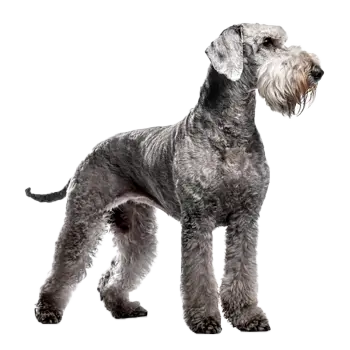
The first thing people say when they see a properly presented Bedlington Terrier is that it looks like a lamb. This is not an exaggeration - standing in profile, a Bedlington in full show trim could briefly be mistaken for a small decorative sheep, and the resemblance is intentional. The breed's unique combination of arched back, tucked flank, rounded head, and white-to-cream topknot creates a silhouette unlike any other dog breed in existence. That distinctive appearance is not just cosmetic; it reflects a genuine physical structure that gives this dog real athletic ability underneath the ornamental presentation.

The most immediately striking feature is the head. The skull is narrow, long, and rounded from the front, creating the characteristic pear shape that the breed standard specifically requires. There is virtually no stop - the transition from skull to muzzle is smooth, maintaining the rounded, gentle contour. The muzzle tapers to a point without being snippy. The nose is large relative to the muzzle and is black in blue dogs and brown in livers and sandys. The jaw is strong enough to hold working quarry and the bite should be scissors or level.

The topknot is a breed hallmark. Required by the standard, it is a fall of hair on the top of the skull that should be lighter in color than the body coat. In blues this topknot often shades from a creamy white to silver; in livers and sandys it shades lighter than the body. The topknot is scissored and shaped by groomers to create the characteristic fall that completes the lamb-like impression of the head. Without the topknot properly maintained, the breed's distinctive expression is lost.

The eyes are small, triangular in outline, and deep-set - almond-shaped rather than round. The eye color varies with coat color: blues and blue-and-tans have blue eyes with a dark reddish tinge around the corner; sandys and livers have hazel to light brown eyes. The expression changes with the dog's mood in a way that experienced owners recognize - there is a mild, gentle look at rest and something sharper, brighter, and more intent when the dog's attention is caught. Ears are moderate in size, triangular with a rounded tip, set low on the skull, and covered with fine, silky hair with a small silky tassel at the tip. Ear set and shape contribute significantly to the breed's expression.

The body is the second great surprise in the Bedlington. Under the lamb's-wool coat is a dog built on whippet-influenced lines - a slight but definite arch to the back at the loin, a pronounced tuck-up of flank, and hindquarters that are slightly higher than the withers when the dog is standing naturally. This roach-backed, arched profile is a defining structural feature of the breed, not a fault. It creates a dog capable of a double-suspension gallop similar to a hound's, and Bedlingtons moved out on open ground with real, surprising speed for a terrier of their size. The neck is long and tapering, carried proudly and giving the dog an elegant reach on the move. Feet are long, hare-footed rather than cat-footed, with thick and well-closed pads. The tail is moderately long, set low, thick at the root, and tapering to a point - it should not be carried over the back. Movement should be free and easy, with the gait showing the dog's characteristic springy, light quality at a trot that reflects the whippet heritage in the hindquarter drive.

The coat is the breed's defining characteristic among terriers. It is described as linty in texture - a mixture of hard and soft hairs that forms a crisp, close curl rather than the hard, wiry coat of most working terriers. This texture gives the dog its woolly, lamb-like look. The coat is not wire and should never be stripped like a wire terrier's coat. It must be scissored and shaped to maintain the breed's silhouette. The coat is considered low-shedding because the dead hair is caught within the living coat structure rather than releasing freely, which is why the Bedlington is sometimes considered suitable for households with mild dog hair sensitivities.

Colors are blue, liver, and sandy, each with or without tan points, giving six accepted color combinations. Blue is the most common and is perhaps the most striking in its contrast with the light topknot. All colors fade and lighten with age, and puppies are born much darker than adults - blue puppies are nearly black at birth. Size is consistent across the breed: 16 to 17.5 inches, 17 to 23 pounds, with no meaningful difference between dogs and bitches in weight or structure.

Affectionate With Family
The Bedlington is a genuinely people-loving dog that bonds deeply with its family and thrives on close human companionship. Guests to the household are typically greeted with enthusiasm once trust is established.
Good With Young Children
Bedlingtons are playful and gentle enough for older children and can do well with younger ones in a supervised, respectful household. Their moderate size and good humor make them workable family dogs.
Good With Other Dogs
Generally tolerant and sociable with dogs when properly socialized, though terrier spirit can emerge in play - they do not always back down from a challenge. Same-sex pairs sometimes have tension.
Shedding Level
The Bedlington's distinctive linty coat sheds minimally and is sometimes considered a lower-allergen option compared to heavy-shedding breeds. Dead coat is caught within the curls rather than distributed around the house.
Coat Grooming Frequency
The Bedlington's coat requires professional scissor trimming every six to eight weeks to maintain the characteristic lamb-like silhouette. Regular brushing between trims prevents matting, and the topknot and leg furnishings need particular attention.
Drooling Level
Clean-mouthed and tidy. Drooling is essentially nonexistent in this breed under normal circumstances.
Coat Type
The breed's unique linty, curling coat - a mix of hard and soft hairs that forms a characteristic crisp texture - is unlike any other terrier. It must be scissor-trimmed and shaped; clipping distorts the texture over time.
Openness To Strangers
Bedlingtons are not typically shy but can be reserved with strangers until they have made their own assessment. Once a person is accepted, they are generally warmly received.
Playfulness Level
Playful, lively, and genuinely fun to live with - the Bedlington keeps its youthful energy well into adulthood and enjoys games, fetch, and interaction with its family.
Watchdog/Protective Nature
Good alert barker who will reliably notify the household of changes in the environment. Physical protective capacity is limited by size, but the Bedlington is no pushover and has genuine terrier nerve.
Adaptability Level
One of the more adaptable terriers - can live comfortably in a city apartment provided daily exercise needs are met, or in a house with a yard. Handles moderate temperature ranges well.
Trainability Level
Intelligent and willing, but retains a terrier's independent streak. Bedlingtons respond very well to positive reinforcement and game-based training; they lose interest quickly in repetitive, drill-based approaches.

Bedlington Terrier History & Development

The Bedlington's working roots trace to the coal-mining and farming communities of Northumberland in northeast England, where a type of hard-driving working terrier had been developed by the early 19th century. These dogs were used to hunt and kill rats, rabbits, badgers, and other quarry by miners and small-scale farmers who needed a tough, economical working dog that could keep vermin populations in check. The Rothbury or Rodbury Terrier, as these dogs were first informally called, was already well established by 1800 among the working-class communities of the region.

The formal naming of the breed happened in 1825, when Joseph Aynsley of Bedlington is generally credited with helping to name and codify the type at a local dog show. The name "Bedlington Terrier" stuck from that point. The breed's development in the decades following involved crosses to introduce the whippet's speed and elegance of line - a contribution that is clearly visible in the modern breed's arched back, tucked flank, and genuine turn of speed at a gallop. Some accounts also suggest Dandie Dinmont and otterhound influence in the breed's early development, which would help explain the distinctive head shape and the unusual coat texture.

The Bedlington was associated historically with Romany (Gypsy) travelers across northern England and Scotland, who prized the dog for its ability to course rabbits and small game at speed and its relatively inconspicuous appearance, which made it useful for poaching on estate lands. The breed's deceptively mild, lamb-like look while concealing genuine ferocity in the field was something that owners found strategically useful, and the reputation became part of the breed's identity. The "looks like a lamb, fights like a lion" saying has followed the Bedlington for nearly two centuries.

The Bedlington Terrier Club was founded in England in 1877, and The Kennel Club officially recognized the breed around that time, providing the breed with formal registration and a codified standard. The AKC accepted the breed in 1886, making it one of the earlier terrier breeds in the American registry. Through the late 19th and early 20th centuries, the breed transitioned from its working origins to primarily a show and companion dog, and the grooming presentation became increasingly elaborate and specialized. The characteristic scissored silhouette that defines the modern show Bedlington requires considerable skill to produce and maintains a strong tradition of craftsmanship among breed groomers.

The Bedlington Terrier Club of America was established in 1932 and took on the role of the AKC parent club, providing the organized structure for conformation, health promotion, and breeder education in North America. By the mid-20th century, the breed occupied a comfortable place as both a show dog and a companion, known within terrier circles for its distinctive appearance, athletic ability, and affectionate character.

The most significant event in the breed's modern history was the identification of copper toxicosis in the 1970s - a genetic liver disease that proved to be widespread in the breed and which ultimately affected as many as 30 to 60 percent of Bedlingtons before DNA testing became available. The development of the COMMD1 gene test transformed the breed's health picture and provided breeders with the tool needed to eliminate the disease from their lines through selective, informed breeding decisions. The story of how the Bedlington Terrier community rallied around this challenge and used genetic testing to reduce the disease's prevalence is one of the more positive examples of a breed club addressing a serious health problem head-on.

Bedlington Terrier Temperament & Personality

The Bedlington is one of those dogs that is genuinely fun to live with, and that quality - a kind of cheerful, engaged personality combined with real affection for its people - is what keeps the breed's dedicated followers so devoted. This is not a stuffy, formal dog. It has a sense of humor. It will clown around to get attention, bounce up to a returning family member with genuine enthusiasm, and engage in play with a lively spirit that it maintains well into middle age.

At the same time, this is still a terrier underneath the lamb's-wool exterior. The Bedlington was bred for generations to hunt and kill quarry - rats, rabbits, badgers, and other animals that required genuine drive and tenacity to pursue and dispatch. That working heritage doesn't disappear just because the dog now lives in a house. It shows up in the Bedlington's strong prey drive toward small, fast-moving animals; in a stubborn refusal to back down from challenges with other dogs when pushed; and in the terrier's characteristic independent thinking that can frustrate owners expecting a dog that defers automatically.

With its own family, the Bedlington is warm and demonstrably affectionate. These dogs bond closely and tend to be good with everyone in the household, including children. They are not one-person dogs in the way that some herding and working breeds can be - they spread their affection broadly across the household, though they may choose a favorite. They are generally sociable and not prone to the separation anxiety that affects some velcro breeds, though they do prefer company to solitude and should not be left isolated for long periods.

The breed's relationship with other dogs is generally positive but comes with the standard terrier caveat: they do not always know when to stop. A Bedlington that has been challenged by another dog will not necessarily retreat gracefully, and same-sex pairs sometimes develop friction over time. With proper socialization - genuine, ongoing exposure to other dogs throughout puppyhood and adolescence - most Bedlingtons become reliable, playful companions with other dogs. The problem arises when socialization is minimal and the dog's instinct to be persistent and bold is allowed to operate without appropriate social education.

Small animals - cats, rabbits, small rodents - are a real management consideration. The prey drive in a Bedlington is specific to small, fast-moving creatures, and even a Bedlington raised alongside cats from puppyhood may always carry a level of chase instinct that requires management. Introductions should be careful and supervised, and small pocket pets should be considered incompatible with this breed in most households. This is not a training failure; it is the honest reality of what this dog was developed to do.

Reserve with strangers varies by individual. Some Bedlingtons are openly warm with new people from the start; others take a "I'll decide" approach and warm up on their own schedule. Neither is wrong. The breed is not known for stranger-directed aggression or excessive suspicion, but it is also not the automatically-friendly-to-everyone type. Early, ongoing socialization shapes the adult's default response significantly.

Bedlington Terrier Family Life & Living Requirements

The Bedlington is one of the more adaptable terriers when it comes to living environment, which makes it a better fit for a wider range of households than some of its more intense working cousins. It can live comfortably in an apartment if its exercise needs are genuinely met - and that is the critical qualifier. A dog this size does not need a farm or an acre of yard, but it does need daily outdoor time, opportunities to move at speed, and mental engagement to stay settled and well-behaved indoors.

A typical day with a well-exercised Bedlington means one or two solid walks, some off-leash time in a safely fenced area, and some interactive play or training. An hour of genuine activity daily is a reasonable estimate for an adult. Without that outlet, the terrier energy has to go somewhere, and it tends to go into digging, chewing, barking, and general creative mischief. A Bedlington that is getting what it needs is a calm, pleasant housemate. A bored Bedlington makes its own entertainment, and you will not always approve of the choices.

The "safely fenced" qualifier for off-leash time is not optional. The Bedlington's prey drive will launch it after a rabbit, squirrel, or other small animal with a speed that surprises people who judge the dog by its gentle appearance. An unleashed Bedlington near traffic or in an unfenced area is a genuine safety risk. Fencing should be solid enough to contain a determined, athletic dog.

This breed is excellent for people who want a medium-sized dog that does not shed heavily. The linty coat deposits minimal hair in the house, which is a real quality-of-life difference for people who care about that. The tradeoff is professional grooming every six to eight weeks, which adds a recurring cost and time commitment that prospective owners need to factor in.

The Bedlington is a good family dog in a household where children are respectful and supervised. Smaller children who cannot yet control their physical interaction may accidentally provoke terrier irritability - a pinch or rough handling will get a response from this breed. School-age children who understand how to interact with dogs appropriately will find the Bedlington a willing playmate with genuine energy and humor. Overall this is a breed that fits well into active family life without requiring the intensive management that some working breeds demand, making it a genuine candidate for the "family dog" category that its subtitle suggests.

Bedlington Terrier Training & Exercise Needs

The Bedlington is smarter than it sometimes acts, and experienced owners will tell you that the dog always understands what you want - it just reserves the right to decide whether to comply based on how worthwhile the proposition seems. This is terrier logic, not stupidity, and approaching training with that understanding is the difference between a frustrating battle of wills and a genuinely enjoyable partnership.

Socialization in puppyhood is important for all dogs but especially for terriers, which carry instincts that can default toward boldness, independence, and reactivity when not shaped by early positive experience. A Bedlington puppy needs to meet a wide range of people, encounter other dogs in positive, off-leash settings, and experience different environments and sounds during the critical window of 8 to 16 weeks. This early investment pays dividends in an adult dog that is confident, adaptable, and socially reliable rather than reactive or suspicious.

Positive reinforcement training - treats, play, and praise - is the approach that works best with this breed. Bedlingtons lose interest rapidly in repetitive, drill-based training that offers no variety or reward. They engage enthusiastically when training feels like a game with good payoffs and when the handler is genuinely engaged rather than mechanically going through the motions. Short, frequent sessions of 10 to 15 minutes that end while the dog is still interested outperform long, exhausting sessions that push past the dog's engagement threshold.

The Bedlington can compete credibly in a range of dog sports. Earthdog trials are a natural fit given the breed's working heritage; the ability to navigate underground tunnels in pursuit of caged quarry is deeply instinctive in this breed. Agility is another good outlet for the Bedlington's athleticism and speed - people who have watched a Bedlington run an agility course are often surprised by how capable and quick this breed is. Obedience competition is also achievable with a handler who is creative enough to keep the dog engaged. Rally, scent work, and trick training are all enjoyable activities that engage the Bedlington's intelligence.

Exercise needs are moderate compared to working herding breeds or sporting dogs but should not be underestimated. An hour of daily activity - varied between walking, off-leash running, and interactive play - keeps this dog physically and mentally satisfied. One of the more useful things about the Bedlington for people in urban environments is that its exercise needs can largely be met through walks, dog park visits, and indoor play without requiring large acreage or intensive running regimens.

Bedlington Terrier Health Concerns

The Bedlington Terrier is a generally long-lived breed with a documented median lifespan of approximately 13.5 years, and some individuals have lived well into their mid-teens. UK breed health surveys indicate that the leading causes of death in the breed include old age, urological conditions, and hepatic disorders - the last category reflecting the breed's well-known issue with liver disease from copper toxicosis. That one condition, copper toxicosis, is the single most important health matter for anyone buying or breeding Bedlingtons, and it requires careful explanation.

The testing protocol for responsible Bedlington breeders is specific: DNA testing for copper toxicosis (COMMD1 gene, available through VetGen and other approved laboratories), OFA patellar luxation evaluation, and ACVO annual eye examinations. Buyers should request documentation of copper toxicosis test results for both parents before committing to a puppy. A puppy from two clear parents cannot inherit the disease from those parents.

Common Health Issues

  • Copper toxicosis - COMMD1 gene mutation, : An autosomal recessive metabolic disorder causing progressive copper accumulation in liver cells, leading to chronic hepatitis, cirrhosis, and liver failure. Affected dogs may also experience acute hemolytic crises unique to this breed. DNA testing allows breeders to identify affected dogs, carriers, and clear dogs before breeding.
  • Distichiasis: Abnormally positioned eyelashes arising from the eyelid glands and contacting the corneal surface - Causing chronic irritation, excessive tearing, and potential corneal ulceration. Treated with cryotherapy or surgical correction.
  • Retinal dysplasia: Abnormal development of the retina, typically an inherited condition in Bedlingtons. Mild forms may not significantly affect vision - More severe forms cause visual impairment. Detected through ACVO eye examination.
  • Patellar luxation: Dislocation of the kneecap from the femoral groove - Ranging from occasional slipping with brief lameness to persistent dislocation requiring surgical correction. An OFA-required screening for breeding Bedlingtons.
  • Renal cortical hypoplasia: Abnormal kidney development resulting in chronically reduced kidney function. Affected dogs may show increased thirst and urination - Weight loss, and progressive kidney disease.

Preventive Care & Health Monitoring

  • Copper toxicosis DNA test - COMMD1 deletion, available through VetGen and other approved laboratories, required for all breeding dogs; both parents must be tested and results verified before a litter is produced. Buyers should request documentation.
  • OFA patellar luxation evaluation required for CHIC certification - Performed by a licensed veterinarian at minimum one year of age.
  • Annual ACVO eye examination by a veterinary ophthalmologist required for CHIC certification - Ongoing annual exams recommended for breeding dogs.
  • For copper-toxicosis-affected or carrier dogs under management, periodic liver enzyme panel - ALT, ALP, allows monitoring of hepatic copper accumulation before clinical signs develop.
  • Diet management for copper-toxicosis-positive dogs: feed a controlled-copper dog food - Avoid supplements or treats high in organ meats, shellfish, or other copper-rich foods.

Bedlington Terrier Grooming & Maintenance

The Bedlington's distinctive appearance is entirely the product of skilled grooming, and maintaining it requires a commitment that prospective owners need to understand fully before acquiring this breed. This is not a brush-and-go dog. The characteristic lamb-like silhouette - the rounded head, the light topknot, the sculptured body lines, the tasseled ears - requires professional scissor trimming every six to eight weeks by a groomer who understands the breed. This is a recurring cost and scheduling commitment that continues for the dog's entire life.

The coat's unique linty texture - a crisp mixture of hard and soft hairs forming characteristic curls - must be scissored, not clipped. Repeated clipping with electric clippers gradually alters the coat texture, making it softer and less characteristic over time. Experienced Bedlington groomers scissor by hand to maintain the proper texture and silhouette. Many owners learn to do basic maintenance trimming themselves between professional appointments, but the full styling trim typically requires professional skill to execute correctly.

Between professional appointments, the coat needs brushing two to three times weekly to prevent matting, particularly in the longer furnishings on the legs, face, and ears. A pin brush or slicker brush works well for the body; a fine-toothed comb is needed for the leg furnishings and topknot where tangles are most likely to develop. The ear fringes and tassels mat easily and need particular attention. Matting that progresses past a certain point is difficult to remove without cutting, and severe matting requires veterinary or professional groomer intervention under sedation.

The Bedlington's ears - low-set, triangular, and covered with fine hair and a silk tassel at the tip - create conditions that benefit from regular checking and cleaning. The ear canal should be checked weekly for redness, odor, or excess moisture that might indicate a developing infection. A veterinarian-approved ear cleaner and cotton balls handle routine maintenance. The ears are not as heavily prone to infection as pendulous-eared breeds, but they are not self-cleaning either.

Dental care follows standard guidelines: daily brushing with dog-safe toothpaste is ideal, supplemented by dental chews and professional cleanings as needed. Nail trimming every three to four weeks maintains proper foot structure and prevents the overgrown nails that force an uncomfortable walking posture. For Bedlingtons that are copper-toxicosis positive or being managed for liver disease, grooming sessions also serve as an opportunity to monitor body condition and check for signs of weight change or coat quality shifts that might indicate disease progression.