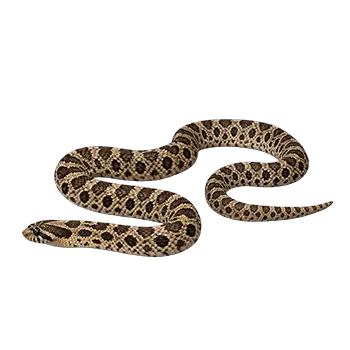

The Mexican Hognose Snake (Heterodon kennerlyi) is a small, stout-bodied rear-fanged colubrid native to the arid and semi-arid landscapes of northern and central Mexico and the southwestern United States. Its range extends from the Chihuahuan Desert and the Mexican Plateau northward into portions of southeastern Arizona, southwestern New Mexico, and the Trans-Pecos region of western Texas. Throughout this range, the species inhabits sandy and gravelly soils in desert scrub, grassland, mesquite flats, and the dry washes and arroyos that thread through the region's basin-and-range topography. The Mexican Hognose Snake's preference for loose, friable substrates reflects its fossorial tendencies and its reliance on burrowing to thermoregulate, shelter from predators, and locate its primary prey.
The species was first formally described by the American herpetologist Robert Kennicott in 1860, based on specimens collected during the United States and Mexican Boundary Survey of the 1850s. That landmark survey, which followed the conclusion of the Mexican-American War and the subsequent Gadsden Purchase, employed teams of naturalists tasked with cataloging the flora and fauna of the newly established international boundary region. Kennicott's description placed the snake within the genus Heterodon, recognizing its kinship with the other North American hognose snakes already known to science, particularly the Eastern Hognose Snake (Heterodon platirhinos) and the Western Hognose Snake (Heterodon nasicus).
The specific epithet kennerlyi honors Caleb Burwell Rowan Kennerly, a physician and naturalist who served as a surgeon-naturalist on several of the great western survey expeditions of the mid-nineteenth century. Kennerly collected extensively along the border region, amassing specimens of reptiles, birds, and mammals that would prove invaluable to the taxonomic work being carried out at the Smithsonian Institution and other centers of American natural history research. The naming of the Mexican Hognose Snake in his honor reflects the pivotal role that government-sponsored expeditions played in documenting the biodiversity of the North American West during a period of rapid territorial expansion.
For much of the twentieth century, the Mexican Hognose Snake was not universally recognized as a distinct species. Many herpetologists treated it as a subspecies of the Western Hognose Snake, classifying it as Heterodon nasicus kennerlyi. This subordination reflected the morphological similarities between the two forms, including the characteristic upturned rostral scale that gives all hognose snakes their common name. However, accumulating evidence from morphological analyses, geographic distribution studies, and molecular phylogenetics gradually strengthened the case for recognizing Heterodon kennerlyi as a full species, a position that has gained broad acceptance among contemporary herpetologists.