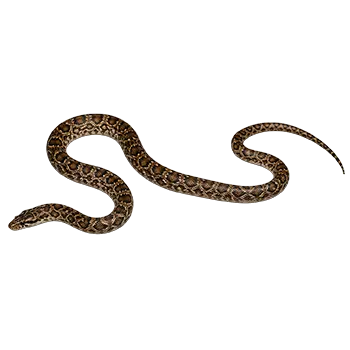

The Eastern Small-Blotched Python (Antaresia maculosa) is a non-venomous constrictor native to the tropical and subtropical regions of northeastern Australia, predominantly across the Cape York Peninsula and the coastal ranges of Queensland. It inhabits a range of environments including rocky outcrops, monsoon vine thickets, open eucalyptus woodland, and the edges of dry rainforest, demonstrating a notable adaptability for a python that rarely exceeds one meter in total length. Its relatively compact size and cryptic coloration of brown, tan, and reddish blotches against a lighter ground color allow it to occupy ecological niches that larger Australian pythons cannot easily exploit, particularly in rock crevices and the narrow hollows of termite mounds.
The species was formally described by the German zoologist Wilhelm Peters in 1873, based on specimens collected from the Queensland coast. Peters placed the species within the genus Liasis, reflecting the taxonomic understanding of the era, which grouped many Australian pythons together under broader generic categories. The specific epithet maculosa, derived from the Latin word for spotted or blotched, referred to the distinctive irregular pattern of markings that distinguishes this species from its close relatives. Peters' description was part of a broader wave of taxonomic activity during the mid-to-late nineteenth century, as European naturalists worked to catalog the considerable reptile diversity of the Australian continent.
The genus Antaresia, to which the Eastern Small-Blotched Python is now assigned, was erected by the Australian herpetologist Laurie Wells and Ross Wellington in 1985 as part of a major revision of Australian python taxonomy. The genus name draws from the star Antares in the constellation Scorpius, a naming convention that Wells and Wellington applied to several Australian reptile genera. The reclassification recognized that the small Australian pythons formerly placed in Liasis represented a distinct evolutionary lineage, more closely related to each other than to the larger water pythons and olive pythons that retained the Liasis designation. Molecular phylogenetic studies conducted in subsequent decades have broadly supported this generic arrangement, confirming Antaresia as a monophyletic group.
Prior to its formal scientific description, the Eastern Small-Blotched Python had been well known to the Aboriginal peoples of northeastern Queensland for thousands of years. European settlers in the region also encountered the species regularly, noting its presence around homesteads where it was sometimes tolerated or even welcomed for its habit of preying on rodents and small geckos. However, early colonial natural history literature often failed to distinguish the Eastern Small-Blotched Python from the closely related Spotted Python (Antaresia maculosa's sister species Antaresia maculosa was sometimes confused with Antaresia childreni), and many early records must be interpreted with caution due to inconsistent identification practices that prevailed before modern taxonomic revisions clarified species boundaries within the genus.