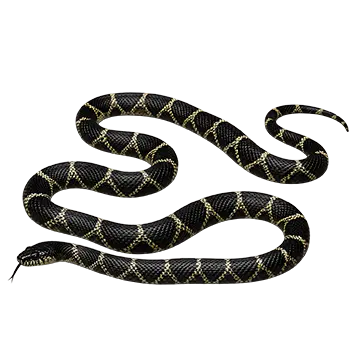

The Eastern Kingsnake's presence in published literature stretches back to the earliest European accounts of North American natural history. Colonial-era naturalists writing for audiences in London, Paris, and Stockholm included descriptions of the species in their catalogs of New World wildlife, drawn by its striking chain-link pattern and its remarkable habit of overpowering venomous snakes. Mark Catesby's The Natural History of Carolina, Florida and the Bahama Islands, published between 1729 and 1747, included some of the first illustrated references to kingsnakes in the southeastern colonies, establishing a tradition of visual documentation that would continue through centuries of increasingly sophisticated natural history publishing.
The nineteenth century saw the Eastern Kingsnake featured prominently in the foundational texts of American herpetology. John Edwards Holbrook's North American Herpetology, published in multiple editions during the 1830s and 1840s, included detailed descriptions and hand-colored plates of the species that set a standard for scientific illustration of North American reptiles. Spencer Fullerton Baird and Charles Girard's catalogs of reptiles collected during government-sponsored surveys of the American West and South further documented the species' distribution and variation, embedding the Eastern Kingsnake firmly within the canon of American zoological literature.
The twentieth century brought a proliferation of popular natural history writing that introduced the Eastern Kingsnake to audiences well beyond the academic herpetological community. Field guides published by Peterson, Audubon, and other series made species identification accessible to amateur naturalists and outdoor enthusiasts, and the Eastern Kingsnake's bold pattern and widespread distribution ensured it a prominent place in these widely circulated reference works. Authors such as Raymond Ditmars, whose books on reptiles reached enormous popular audiences during the early and mid-twentieth century, devoted substantial attention to kingsnakes and played a significant role in shaping public perception of the species as beneficial and worthy of protection.
Contemporary herpetological literature continues to feature the Eastern Kingsnake in both technical and popular formats. Monographs on colubrid systematics, regional herpetofaunal inventories, and species-focused natural history accounts maintain the scholarly tradition established by earlier generations of researchers, while accessible trade books and magazine articles bring updated information about the species' ecology, conservation status, and captive husbandry to a broad readership. The cumulative body of published literature on the Eastern Kingsnake represents one of the most extensive documentary records for any North American snake species.