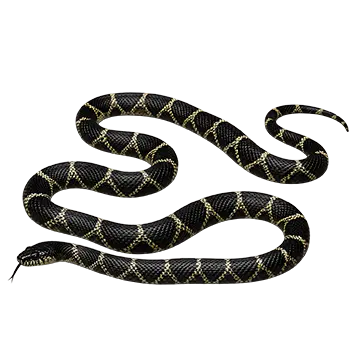

The Eastern Kingsnake (Lampropeltis getula) is a robust, glossy-scaled colubrid native to the eastern half of the United States. Its range extends from southern New Jersey and the Delmarva Peninsula south through the Atlantic coastal plain and piedmont regions to northern Florida, then west along the Gulf states into Alabama and parts of eastern Mississippi. Throughout this broad territory, the species occupies a variety of habitats including pine flatwoods, hardwood hammocks, riparian corridors, agricultural margins, and the sandy edges of coastal marshes, reflecting a degree of ecological flexibility that has allowed it to persist across a patchwork of landscapes shaped heavily by human activity.
The species was first formally described by the Swedish naturalist Carl Linnaeus in the landmark tenth edition of his Systema Naturae, published in 1758. Linnaeus placed the animal within the genus Coluber under the binomial Coluber getulus, working from specimens and descriptions that had reached European collections through the networks of colonial-era natural history correspondence. The specific epithet getulus is believed to derive from a Latin term associated with the Getulians, an ancient North African people, though the precise reasoning behind Linnaeus's choice of this name for an American snake remains a subject of scholarly conjecture.
Subsequent taxonomic work transferred the species into the genus Lampropeltis, a name coined by the American herpetologist Leopold Fitzinger in 1843. The genus name, derived from Greek roots meaning shining shields, aptly describes the smooth, polished dorsal scales that give kingsnakes their characteristic lustrous appearance. Over the following two centuries the taxonomy of the kingsnake complex underwent numerous revisions, with various regional populations being elevated to subspecific or full species status, then reclassified again as new morphological and molecular data became available. The Eastern Kingsnake has at different times been treated as a full species, a subspecies of a broadly defined Lampropeltis getula, and more recently restored to species rank by researchers using phylogenetic methods.
The common name kingsnake itself carries significant historical weight. English-speaking settlers in colonial America bestowed the name in recognition of the snake's well-documented habit of preying upon other serpents, including venomous species such as copperheads, cottonmouths, and timber rattlesnakes. This ophiophagous behavior, made possible by the kingsnake's partial immunity to pit viper venom, elevated the animal to a position of special regard among rural communities who viewed it as a natural check on the dangerous snakes that shared their farms and woodlands.