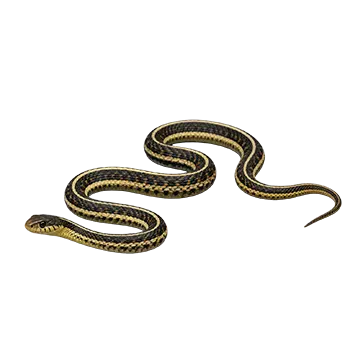

Early Appearances in Print & Literature

The Eastern Garter Snake's presence in North American print culture stretches back to the earliest European accounts of New World natural history. Colonial-era naturalists and travelers writing for European audiences frequently mentioned garter snakes in their catalogs of American fauna, and while these early descriptions often lacked the precision of modern herpetological writing, they established the garter snake as a recognized element of the North American landscape in the literary imagination of the English-speaking world. Mark Catesby's landmark work The Natural History of Carolina, Florida and the Bahama Islands, published between 1729 and 1747, included illustrations and descriptions of garter snakes that reached a wide educated readership on both sides of the Atlantic.

As American literature developed its own distinct voice during the nineteenth century, the garter snake appeared with increasing regularity as a background element in fiction and poetry set in rural and small-town environments. The snake's role in these literary works was rarely central, but its recurrent presence as a detail of landscape description reflected its status as one of the most immediately recognizable creatures of the American countryside. Writers seeking to evoke the sensory texture of a meadow, a stream bank, or a garden path could invoke the garter snake with confidence that their readers would recognize the reference from personal experience.

The natural history essay tradition that flourished in the late nineteenth and early twentieth centuries gave the Eastern Garter Snake somewhat more prominent literary treatment. Writers in the tradition of John Burroughs and John Muir, who sought to cultivate public appreciation for the natural world through careful observational prose, found the garter snake a rewarding subject precisely because of its accessibility. An animal that could be observed in detail without venturing into wilderness, that displayed interesting behaviors including communal hibernation and live birth, and that challenged the reader to look past cultural prejudice against snakes provided fertile material for the kind of close-focus nature writing that characterized the genre.

Children's literature has proven to be one of the most enduring and influential arenas for the Eastern Garter Snake's literary presence. Countless picture books, early readers, and juvenile nonfiction titles have featured the garter snake as a subject, taking advantage of its harmlessness and its familiarity to introduce young readers to basic concepts in ecology, life cycles, and animal behavior. These books have played a meaningful role in shaping the attitudes of successive generations toward snakes, often explicitly countering the fear-based narratives that children absorb from broader cultural messaging about serpents.

Television & Documentary Presence

The Eastern Garter Snake has been a staple of North American nature television since the medium's earliest days, appearing in programming that ranges from flagship natural history series to local educational broadcasts and cable wildlife shows. Its suitability for television production stems from several practical advantages that distinguish it from more spectacular but less cooperative reptile subjects. Garter snakes are easy to locate and film in the field, they tolerate the proximity of camera equipment without extreme stress responses, and their active daytime behavior provides filmmakers with opportunities to capture engaging footage without the specialized nocturnal filming setups that many other snake species require.

The species' communal emergence from winter hibernation dens has proven to be one of the most frequently filmed and widely broadcast natural history sequences involving any North American reptile. Footage of thousands of garter snakes writhing in mating aggregations at sites such as the Narcisse Snake Dens in Manitoba, while technically featuring the Red-sided Garter Snake subspecies, has become iconic in nature documentary programming and has introduced audiences worldwide to the genus Thamnophis. These sequences are among the most visually dramatic wildlife spectacles on the continent, and their repeated broadcast across multiple documentary series and nature programs has made garter snake emergence footage almost as recognizable to international audiences as footage of salmon runs or monarch butterfly migrations.

National and regional educational television programs have long relied on the Eastern Garter Snake as a live animal demonstration subject. The snake's manageable size, its generally calm demeanor when handled, and the absence of any significant bite risk make it an ideal animal for on-camera presentation by hosts and educators working in studio environments. Programs aimed at children and family audiences have been particularly consistent in featuring garter snakes, using them to teach concepts such as ectothermy, predator-prey relationships, and the ecological roles of reptiles in a format that combines entertainment with genuine scientific content.

In the contemporary streaming and digital video landscape, the Eastern Garter Snake continues to appear in nature content produced for platforms ranging from established broadcast networks to independent creators on video-sharing sites. The democratization of high-quality video production equipment has enabled amateur naturalists and herpetology enthusiasts to produce detailed observational footage of garter snake behavior that in some cases rivals the quality and informational value of professionally produced documentaries. This expanding body of user-generated content has broadened the species' media presence beyond the confines of traditional television and introduced it to audiences that may not regularly watch conventional nature programming.

Digital Media & Online Culture

The rise of social media and digital content platforms has generated an entirely new dimension of the Eastern Garter Snake's cultural presence, one characterized by informal, often humorous engagement with the species that contrasts sharply with the earnest educational tone of traditional nature media. Garter snakes appear with remarkable frequency in the casual wildlife content that circulates across platforms, typically in the form of backyard encounter videos, garden discovery photographs, and informal identification requests posted by homeowners who have found a snake on their property and want to know whether it poses any danger.

The genre of snake identification posts on community forums and social media groups represents one of the most significant ways in which the Eastern Garter Snake enters digital discourse. Across platforms, herpetology enthusiast groups and regional wildlife identification communities field a steady stream of photographs from concerned or curious members of the public who have encountered snakes in their yards, basements, or garden beds. The Eastern Garter Snake is by far the most frequently submitted species in these forums across much of its range, and the routine identification of these snakes as harmless serves a genuine public education function by providing accurate information at the moment when people are most receptive to learning about the wildlife around them.

Meme culture and humorous online content have also embraced the garter snake, often leveraging the contrast between the exaggerated fear that some people express upon encountering any snake and the conspicuously unthreatening reality of a small, stripe-patterned colubrid. Images and videos of garter snakes captioned with ironic references to danger, ferocity, or menace have become a recognizable subgenre of wildlife humor online, and their widespread circulation contributes to a gradual normalization of positive or at least neutral attitudes toward snakes among digital audiences. This informal, peer-to-peer reframing of snake perception may ultimately prove more effective at shifting cultural attitudes than formal educational campaigns, simply because of the scale and reach of social media distribution.

Citizen science platforms have added a more structured dimension to the Eastern Garter Snake's digital presence. Projects hosted on platforms that invite users to photograph and geolocate wildlife observations have accumulated tens of thousands of verified garter snake records contributed by members of the public. These records generate scientifically valuable distributional and phenological data while simultaneously engaging participants in a form of digital naturalism that deepens their connection to the species and to the broader practice of wildlife observation.

Educational Media & Outreach

The Eastern Garter Snake occupies a uniquely important position in educational media and outreach programming as the species most frequently used to introduce North American audiences to the biology and ecology of snakes. Its prevalence in educational contexts is not accidental but reflects a deliberate strategic choice by educators, herpetological societies, and nature centers who recognize that an animal capable of being safely handled by children, easily maintained for demonstration purposes, and encountered by participants in their own neighborhoods possesses pedagogical advantages that rarer or more temperamental species cannot match.

Nature centers, zoos, and natural history museums across the Eastern Garter Snake's range maintain live specimens specifically for use in educational programming. These ambassador animals are presented to school groups, summer camp participants, scout troops, and general visitors in programs designed to build basic herpetological literacy and challenge the reflexive fear of snakes that many people carry from early childhood. The format of these encounters typically involves a brief presentation on snake biology, followed by an opportunity for participants to observe and, if willing, touch or hold the animal under supervised conditions. Research on the effectiveness of these programs suggests that direct positive contact with a live snake is one of the most potent interventions for reducing snake phobia and building conservation-oriented attitudes.

Printed and digital educational materials targeting primary and secondary school audiences have featured the Eastern Garter Snake extensively. Textbooks, classroom posters, educational websites, and curriculum supplements use the species to illustrate concepts ranging from vertebrate classification and reptile adaptations to food web dynamics and seasonal behavioral cycles. The garter snake's live-bearing reproductive strategy, unusual among North American snakes but shared with other natricine species, provides a particularly engaging teaching point that challenges students' assumptions about reptile reproduction and introduces concepts of reproductive diversity within vertebrate lineages.

The species' role in formal and informal science education extends to its use as a subject in undergraduate and graduate-level biology courses. University herpetology classes frequently use preserved garter snake specimens for anatomical study and live individuals for behavioral observation exercises. The extensive body of published research on garter snake ecology, physiology, and behavior provides a rich literature base for student research projects and literature review assignments, making the species a pedagogical resource at every level of the educational system from preschool through postgraduate study.

Photography & Visual Arts

The Eastern Garter Snake has been a subject of photographic and artistic attention since the earliest days of wildlife photography in North America, and its visual representation across these media reflects evolving attitudes toward snakes and changing aesthetic conventions in the depiction of the natural world. Early natural history illustrations of garter snakes, produced for scientific publications and popular natural history books during the nineteenth century, tended toward stylized, somewhat rigid depictions that prioritized the display of diagnostic features such as scale counts, stripe patterns, and head shape over any attempt to convey the animal's behavior or personality.

The development of wildlife photography as a distinct artistic practice during the twentieth century brought new visual approaches to the Eastern Garter Snake. Photographers working in the nature photography tradition discovered that garter snakes, despite their modest size and subdued coloration compared to many tropical snake species, offered rewarding photographic subjects when approached with patience and technical skill. Close-up and macro photography techniques revealed details of scale texture, tongue morphology, and eye structure that were invisible to casual observation, presenting the animal in a light that could inspire aesthetic appreciation in viewers who might otherwise feel indifferent or hostile toward snakes.

The proliferation of high-quality digital cameras and macro lenses among amateur naturalists and hobbyist photographers has generated an enormous body of Eastern Garter Snake imagery in the twenty-first century. Online photography communities and nature photography contests regularly feature striking garter snake images, and the species has become a popular subject for photographers seeking to develop their skills in reptile and amphibian photography. The accessibility of the subject, which can be found and photographed in suburban backyards as readily as in wilderness areas, makes it an ideal practice species for photographers building portfolios in wildlife and macro photography.

Beyond photography, the Eastern Garter Snake appears in various traditions of visual art across North America. Indigenous artistic traditions have incorporated serpent motifs for millennia, and while these representations are often stylized or symbolic rather than species-specific, the garter snake's prevalence in the lived environment of eastern North American peoples means that it has inevitably informed the visual vocabulary of serpent imagery in these traditions. Contemporary wildlife artists working in painting, sculpture, and mixed media continue to find the garter snake a worthy subject, and juried wildlife art exhibitions regularly include works featuring the species alongside depictions of more conventionally charismatic fauna.

The Eastern Garter Snake has also found its way into decorative and commercial design contexts. Its distinctive striped pattern has inspired textile designs, ceramic decorations, and graphic design elements, and its image appears on merchandise ranging from educational posters to naturalist-themed clothing and accessories. While none of these applications constitute high art, they collectively reinforce the species' status as a recognized and culturally embedded element of the North American visual landscape.

The Species in Popular Imagination

The Eastern Garter Snake occupies a singular position in the popular imagination of North America as a creature that is simultaneously a snake and, in many people's perception, not quite a snake in the way that the word typically connotes. When people speak casually about snakes, they often invoke images of danger, venom, and predatory menace that draw heavily on cultural representations of cobras, vipers, and large constrictors. The garter snake, by contrast, tends to be mentally categorized alongside frogs, turtles, and other small, familiar backyard animals rather than grouped with its more formidable serpent relatives. This perceptual separation is linguistically reinforced by the widespread use of the diminutive term garden snake, which domesticates the animal by association with a cultivated, human-controlled space.

This ambiguous status has made the Eastern Garter Snake a recurring reference point in popular discussions about the nature of fear and the distinction between rational and irrational responses to perceived threats. The question of why so many people feel intense anxiety upon encountering a small, completely harmless garter snake has been explored in popular psychology writing, self-help literature, and casual conversation for decades. The garter snake's role in these discussions serves a broader cultural function by providing a concrete, relatable example through which people can examine the mechanisms of phobia, the influence of cultural conditioning on emotional responses, and the gap between objective risk assessment and subjective experience.

In the realm of casual language and everyday metaphor, the garter snake serves as a benchmark of harmlessness against which other threats, both real and figurative, are measured. The reassurance that something is no more dangerous than a garter snake functions as a recognizable rhetorical device across the English-speaking portions of the species' range, testimony to the depth of the animal's integration into common cultural knowledge. This idiomatic usage, while informal, reflects a genuine and widely shared understanding of the species' biology that has been transmitted through generations of direct personal experience.

The species' place in popular imagination is not static but continues to evolve in response to shifting cultural attitudes toward wildlife, environmentalism, and the natural world. Growing public interest in biodiversity, native species gardening, and backyard ecology has elevated the garter snake's cultural status from mere familiar background animal to a species that is actively welcomed and even encouraged by homeowners who understand its role in controlling pest populations and indicating ecosystem health. This attitudinal shift, while far from universal, represents a meaningful change in the cultural position of a species that has always been known but has not always been appreciated.

Always consult a qualified professional before making any health-related decisions. This content is provided for informational reference only and should not replace professional guidance specific to your animal.