
Representation in Nature Documentaries

The Diamond-Backed Water Snake has appeared in a variety of nature documentaries focused on the freshwater ecosystems of the American South and the broader biodiversity of the Mississippi River basin. While the species rarely serves as the sole subject of a feature-length production, it features prominently in segments that explore the ecology of bottomland swamps, cypress bayous, and the sprawling floodplain habitats of the central United States. Productions from major broadcasters have included footage of Diamond-Backed Water Snakes basking on submerged logs, hunting fish in shallow water, and engaging in the dramatic defensive displays that characterize the species when confronted by a perceived threat.

Documentary filmmakers have found the Diamond-Backed Water Snake to be a particularly effective subject for illustrating broader ecological concepts. The species' position as a mid-level aquatic predator makes it a natural focal point for segments on food web dynamics, and its habit of basking in conspicuous aggregations provides visually compelling footage that communicates the abundance and vitality of healthy wetland ecosystems. Several productions focused on the ecology of the Mississippi Delta have used the Diamond-Backed Water Snake as a representative species to illustrate the interconnectedness of terrestrial and aquatic habitats along North America's largest river system.

The species has also featured in documentary programming that addresses the widespread misidentification of harmless water snakes as venomous Cottonmouths. Educational segments comparing the physical characteristics and behavioral differences between Nerodia species and Agkistrodon piscivorus have used the Diamond-Backed Water Snake as a primary example, often featuring side-by-side comparisons that highlight the diagnostic differences in head shape, pupil shape, body proportions, and scale patterns that distinguish the two groups. These segments serve a practical public education function while simultaneously introducing audiences to a species that most viewers would otherwise know only through fear and misunderstanding.

Regional wildlife programming produced by state fish and wildlife agencies and public broadcasting stations across the southeastern and south-central United States has provided additional documentary coverage of the Diamond-Backed Water Snake. These smaller-scale productions, while reaching more limited audiences than national and international broadcasts, often deliver more detailed and geographically specific information about the species' ecology and conservation status in particular regions, filling an important niche in the documentary landscape.

Appearances in Print & Field Guides

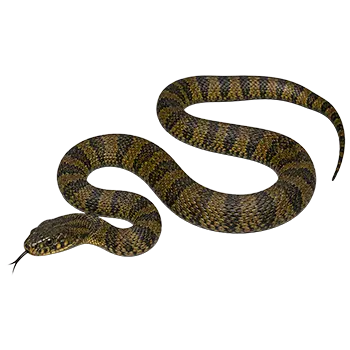
The Diamond-Backed Water Snake occupies a standard entry in virtually every major field guide to the reptiles of North America, the southeastern United States, and the states within its range. From the foundational Peterson Field Guide series to the comprehensive Snakes of the United States and Canada by Ernst and Ernst, the species receives consistent attention as the largest and one of the most commonly encountered members of its genus. Field guide treatments typically emphasize the species' distinctive diamond-shaped dorsal pattern, its heavy body, its strongly keeled scales, and the key morphological features that distinguish it from the venomous Cottonmouth, reflecting the practical identification challenge that these guides are designed to address.

Beyond standard field guides, the Diamond-Backed Water Snake appears in a substantial body of herpetological literature that ranges from academic monographs and regional surveys to popular natural history writing. Roger Conant and Joseph Collins's A Field Guide to Reptiles and Amphibians of Eastern and Central North America, one of the most widely used and frequently revised field guides in American natural history, has included detailed accounts of the species through multiple editions, contributing to its recognition among amateur and professional herpetologists alike. More specialized works on the genus Nerodia have provided exhaustive treatments of the species' morphological variation, geographic distribution, and ecological relationships.

The species also appears in the broader genre of regional natural history writing that celebrates the landscapes and wildlife of the American South and the Mississippi Valley. Authors writing about the ecology and culture of bayous, bottomland forests, and the great river systems of the continental interior frequently mention the Diamond-Backed Water Snake as a characteristic and conspicuous element of these environments. These literary treatments, while less technical than field guide entries, play an important role in shaping public awareness of the species and its habitats by reaching audiences that might never pick up a herpetological reference.

Children's and young adult literature on reptiles has increasingly included the Diamond-Backed Water Snake in books designed to foster interest in herpetology and dispel common fears about snakes. Several educational publishers have produced titles that feature Nerodia species prominently, using the water snake group as a case study in the ecological importance of misunderstood and unfairly maligned wildlife. These publications contribute to a long-term cultural shift in how young audiences perceive snakes, potentially influencing attitudes that will persist into adulthood and shape future conservation outcomes.

Digital Media & Online Communities

The rise of digital media and social networking platforms has transformed the public visibility of the Diamond-Backed Water Snake in ways that would have been unimaginable a generation ago. Species-specific identification groups on platforms such as Facebook, Reddit, and iNaturalist receive a continuous stream of photographs and queries from users across the snake's range, and the Diamond-Backed Water Snake is among the most frequently submitted species in groups dedicated to snake identification in the southeastern and south-central United States. These submissions provide a revealing snapshot of public attitudes toward the species, as many are accompanied by expressions of alarm and the assumption that the photographed animal is a venomous Cottonmouth.

Online snake identification communities have emerged as one of the most effective channels for public education about the Diamond-Backed Water Snake and its distinction from venomous species. Experienced herpetologists, wildlife biologists, and knowledgeable amateurs who moderate and contribute to these groups provide rapid and accurate identifications accompanied by explanations of the diagnostic features that separate harmless water snakes from pit vipers. The sheer volume of these interactions, multiplied across dozens of active groups and forums, represents a grassroots educational effort of remarkable scale, reaching audiences that formal outreach programs often fail to engage.

Video-sharing platforms have also contributed to the Diamond-Backed Water Snake's digital footprint. Amateur naturalists, professional herpetologists, and wildlife enthusiasts have uploaded thousands of videos documenting encounters with the species in the field, ranging from brief smartphone clips of basking snakes to polished educational productions that discuss the species' ecology, behavior, and conservation in detail. The most successful of these channels have built substantial followings, demonstrating genuine public appetite for accurate, engaging content about species that traditional media often overlooks or misrepresents.

Citizen science platforms represent another significant dimension of the Diamond-Backed Water Snake's digital presence. Observation databases such as iNaturalist and HerpMapper have accumulated tens of thousands of georeferenced records of the species, contributed by users ranging from casual hikers to dedicated field surveyors. These datasets provide researchers with distribution and phenology data at spatial and temporal scales that would be impossible to achieve through professional survey efforts alone, and they simultaneously engage the contributing public in a form of direct participation in the scientific study of the species.

Photography & Visual Arts

Wildlife photography has played a significant role in reshaping public perceptions of the Diamond-Backed Water Snake over the past several decades. Where earlier visual representations of the species were largely confined to preserved museum specimens and illustrative plates in field guides, the proliferation of high-quality digital photography has made it possible to present the Diamond-Backed Water Snake as a living, dynamic animal in its natural habitat. Skilled photographers working along the rivers, swamps, and bayous of the species' range have produced images that reveal the subtle beauty of the snake's patterning, the intensity of its gaze, and the grace of its movements through water, challenging the widespread perception of water snakes as ugly or frightening animals.

The Diamond-Backed Water Snake presents both opportunities and challenges as a photographic subject. Its habit of basking in exposed positions on logs, rocks, and overhanging branches makes it more accessible than many snake species, and individuals in established basking sites can often be approached with patience and appropriate fieldcraft. However, the species' wariness and rapid flight response when disturbed require photographers to work quietly and at a respectful distance, often employing telephoto lenses and low-profile hides to obtain intimate portraits without provoking a defensive response or driving the animal into the water.

Beyond documentary wildlife photography, the Diamond-Backed Water Snake has appeared in fine art photography and mixed-media visual art that explores themes of wildness, the relationship between human communities and the natural world, and the aesthetic qualities of organisms that mainstream culture tends to overlook or actively revile. Southern and Midwestern artists working in photography, painting, and printmaking have drawn on the visual richness of the species' diamond-patterned scales, its association with the iconic landscapes of the Mississippi Valley, and its cultural baggage as a feared and misunderstood animal to create works that invite viewers to reconsider their assumptions about beauty, danger, and the value of unloved wildlife.

The growing availability of high-resolution macro photography and underwater imaging technology has opened new dimensions for the visual documentation of the Diamond-Backed Water Snake. Macro photographs revealing the intricate scale architecture, the coloration of individual scutes, and the fine details of the species' facial features have circulated widely on social media and in print, providing a level of visual intimacy that helps audiences connect with an animal they might otherwise dismiss. Underwater imagery capturing the species hunting, swimming, and navigating its aquatic environment has proven particularly effective at conveying the ecological context that is essential to understanding the Diamond-Backed Water Snake as more than a basking silhouette on a distant log.

Educational Programming & Outreach

The Diamond-Backed Water Snake has become a staple of live-animal educational programming throughout its range, featuring in presentations conducted by nature centers, state parks, wildlife rehabilitation facilities, herpetological societies, and individual educators who use live reptiles as teaching tools. The species' robust constitution, impressive size, and direct relevance to the venomous-versus-harmless identification challenge that concerns so many members of the public make it an effective and engaging subject for educational encounters. Audiences that arrive with preconceptions rooted in fear and misinformation frequently leave with a fundamentally altered understanding of the species and its ecological role.

State wildlife agencies across the southeastern and south-central United States have invested in outreach materials and programs specifically designed to address the misidentification of water snakes as venomous species. Brochures, posters, web pages, and social media campaigns comparing the physical characteristics of Nerodia species and Cottonmouths have become standard components of these agencies' public education portfolios, and the Diamond-Backed Water Snake appears prominently in these materials as the largest and most commonly misidentified member of the water snake group. Several states have developed comprehensive online resources that include identification guides, range maps, and frequently asked questions sections addressing common misconceptions about water snakes.

University-based extension services and museum outreach programs have also contributed to the Diamond-Backed Water Snake's visibility in educational contexts. Herpetology courses at colleges and universities throughout the species' range routinely include the Diamond-Backed Water Snake in their laboratory and field components, providing students with hands-on experience identifying, handling, and studying a species that many will encounter throughout their lives. Museum collections house extensive series of preserved specimens that support taxonomic research and serve as reference material for training the next generation of herpetologists and wildlife managers.

The growth of nature-based tourism and outdoor recreation across the American South has created new contexts for educational encounters with the Diamond-Backed Water Snake. Guided kayaking tours, birding excursions, swamp boat trips, and fishing charters all provide opportunities for guides and outfitters to introduce their clients to the species in its natural habitat, and many operators have embraced this educational role enthusiastically. The transformation of a fearful encounter with a large water snake into a teachable moment that leaves participants better informed and more appreciative of aquatic biodiversity represents one of the most effective forms of conservation education available for this species.

The Species in Popular Imagination

The Diamond-Backed Water Snake occupies a curious position in the popular imagination of the American South and Midwest. It is at once one of the most frequently encountered large snakes in the region and one of the most persistently misidentified, a paradox that has shaped the species' cultural profile in ways both predictable and unexpected. For millions of people living within the snake's range, the Diamond-Backed Water Snake is the animal behind their most vivid and frightening snake encounter, even though the encounter involved no actual danger. The species functions, in effect, as the unwitting understudy for the Cottonmouth in the theater of southern snake anxiety.

This case of persistent mistaken identity has had complex consequences for the species' cultural status. On one hand, the Diamond-Backed Water Snake inherits the fear and hostility that regional culture directs toward venomous snakes, resulting in unnecessary persecution and a deeply negative public image. On the other hand, the frequency and intensity of human encounters with the species have ensured that it occupies a vivid and prominent place in the lived experience of rural and suburban communities across the lower Mississippi Valley and the Gulf Coastal Plain. The Diamond-Backed Water Snake is not an obscure or forgotten animal. It is a conspicuous presence in the landscapes where people fish, swim, boat, and spend time outdoors, and its encounters generate stories, debates, and strong emotions that keep the species firmly embedded in regional culture.

The emergence of social media as a primary platform for sharing and discussing wildlife encounters has amplified the Diamond-Backed Water Snake's cultural presence dramatically. Photographs and videos of the species generate thousands of comments, shares, and heated debates about identification, danger, and appropriate responses to snake encounters. These digital conversations, while often marked by misinformation and emotional reactions, have also created unprecedented opportunities for accurate information to reach audiences that traditional educational channels rarely penetrate. The sheer virality of water snake content on social media has made the Diamond-Backed Water Snake one of the most discussed reptile species in the digital public sphere, if not always for the reasons that herpetologists would prefer.

Looking forward, the Diamond-Backed Water Snake's place in popular culture is likely to continue evolving as public attitudes toward wildlife shift and as digital media platforms create new modes of encounter and engagement with the natural world. The species' visibility, its ecological importance, and the ongoing challenge of correcting its persistent misidentification ensure that it will remain a culturally significant animal for generations to come, serving as a test case for society's ability to replace fear and ignorance with understanding and coexistence in its relationship with the non-human world.

Always consult a qualified professional before making any health-related decisions. This content is provided for informational reference only and should not replace professional guidance specific to your animal.