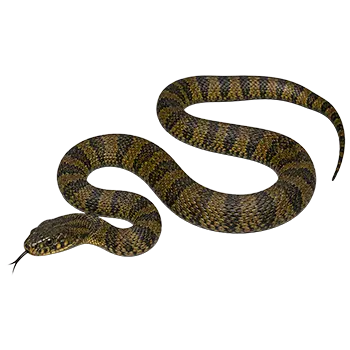

The Diamond-Backed Water Snake (Nerodia rhombifer) is the largest member of the genus Nerodia, a group of heavy-bodied, non-venomous colubrid snakes found exclusively in North America. Its native range stretches across the central and southern United States, following the major river systems of the Mississippi, Ohio, Missouri, and their countless tributaries from southern Illinois and Indiana southward through the Gulf Coastal Plain to the lowlands of eastern Texas and northern Mexico. The species is fundamentally tied to freshwater habitats, occupying rivers, oxbow lakes, bayous, swamps, marshes, and the margins of reservoirs and farm ponds throughout the warm, humid lowlands of its range.
The species was formally described by the American naturalist John Edwards Holbrook in 1842 in his landmark work North American Herpetology, a multi-volume treatise that represented the most ambitious attempt to catalog the reptiles and amphibians of the continent up to that time. Holbrook assigned the snake to the genus Tropidonotus, the broadly defined Old World water snake genus that was then used as a catch-all for aquatic and semi-aquatic colubrid snakes worldwide. The specific epithet rhombifer, derived from the Latin for diamond-bearing, referenced the distinctive chain-like pattern of dark, diamond-shaped dorsal markings that distinguish the species from all other North American water snakes.
Holbrook worked from specimens collected in the lower Mississippi River valley, a region that was already well traveled by naturalists drawn to its extraordinary biological richness. The vast floodplain forests, cypress-tupelo swamps, and sluggish bayous of the Mississippi Delta supported staggering densities of aquatic and semi-aquatic wildlife, and the Diamond-Backed Water Snake was among the most conspicuous reptilian inhabitants of this landscape. Holbrook's description noted the species' robust build, strongly keeled dorsal scales, and its habit of basking in aggregations along fallen logs and overhanging branches above the water.
Subsequent decades of taxonomic revision moved the species through several genera as herpetologists worked to untangle the relationships among the world's water snakes. The genus Nerodia was eventually separated from Old World Natrix and other related groups, reflecting the growing recognition that the North American water snakes represented a distinct evolutionary lineage. The Diamond-Backed Water Snake settled into its current classification as Nerodia rhombifer, where it stands as the type species and the largest representative of a genus that includes approximately ten recognized species distributed across eastern and central North America.