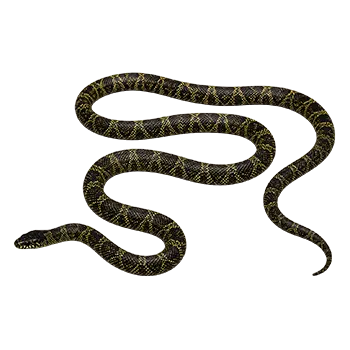

The Desert Kingsnake (Lampropeltis splendida) is a non-venomous colubrid native to the arid and semi-arid landscapes of the American Southwest and northern Mexico. Its range extends from central and western Texas through southern New Mexico and Arizona, dipping south into the Mexican states of Sonora, Chihuahua, and Coahuila. The species inhabits a broad spectrum of dry environments including creosote flats, mesquite grasslands, rocky desert canyons, dry riverbeds, and the margins of irrigated agricultural land, reflecting a remarkable adaptability to some of North America's most demanding terrestrial habitats.
For much of its taxonomic history, the Desert Kingsnake was classified as a subspecies of the Common Kingsnake, Lampropeltis getula, under the trinomial Lampropeltis getula splendida. The subspecific epithet splendida, meaning splendid or brilliant in Latin, was applied by the American herpetologist Spencer Fullerton Baird in 1859. Baird described the animal from specimens collected during the United States and Mexican Boundary Survey, one of the great natural history expeditions of the mid-nineteenth century that accompanied the post-war delineation of the international border. His description emphasized the snake's striking dorsal pattern of dark brown to black ground color densely speckled with bright yellow or cream markings, a coloration that distinguishes it immediately from other kingsnake populations.
The elevation of the Desert Kingsnake from subspecies to full species status came in the early twenty-first century, driven by advances in molecular phylogenetics. Genetic analyses published in the 2000s and 2010s demonstrated that the getula kingsnake complex comprised several distinct evolutionary lineages that warranted recognition as separate species. Lampropeltis splendida was formally recognized as a full species by most major taxonomic authorities, reflecting its genetic distinctiveness from the Eastern Kingsnake (Lampropeltis getula sensu stricto) and other members of the complex. This reclassification placed the Desert Kingsnake on firmer taxonomic footing and acknowledged the evolutionary significance of the geographic and ecological barriers that had shaped its divergence.
The species had been known to the indigenous peoples of its range for millennia before European naturalists encountered it. Archaeological evidence from desert sites across the Southwest suggests that snakes, including kingsnakes, featured in the material culture and cosmological frameworks of pre-Columbian societies. Spanish colonial records from the sixteenth and seventeenth centuries occasionally mention serpents encountered in the despoblado, the uninhabited desert wilderness, though specific identification of species from these early accounts is rarely possible.