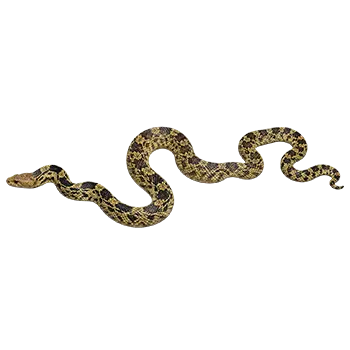

The Bull Snake (Pituophis catenifer sayi) is a large, nonvenomous colubrid native to the central and western regions of North America. It belongs to the genus Pituophis, a group commonly known as gopher snakes or pine snakes, which has a fossil record stretching back millions of years across the continent. The species was formally described in the early nineteenth century and has undergone several taxonomic revisions, at times being classified as its own full species and at other times as a subspecies of the broader Pituophis catenifer complex.
The Bull Snake's range extends from southern Canada through the Great Plains of the United States and into northern Mexico. This vast distribution across prairies, grasslands, and semi-arid scrublands made it one of the most frequently encountered large snakes in agricultural regions during the westward expansion of European settlers. Early naturalists documented the species extensively, noting its impressive size and its dramatic defensive displays, which include loud hissing, body inflation, and tail vibration.
The common name "Bull Snake" likely derives from the species' deep, resonant hiss, which some early observers compared to the bellow of a bull. Other regional names have included "gopher snake" in reference to its habit of pursuing burrowing rodents underground. This diversity of common names reflects the wide geographic area the species covers and the many human communities that have interacted with it over the centuries.
Taxonomically, the Bull Snake sits within a broader group that includes the Pacific Gopher Snake, the Sonoran Gopher Snake, and the Louisiana Pine Snake, among others. Genetic studies in recent decades have helped clarify the relationships within this group, though debate about subspecific boundaries continues among herpetologists. Regardless of where the taxonomic lines are drawn, the Bull Snake remains one of the most iconic and well-studied snakes in North America.