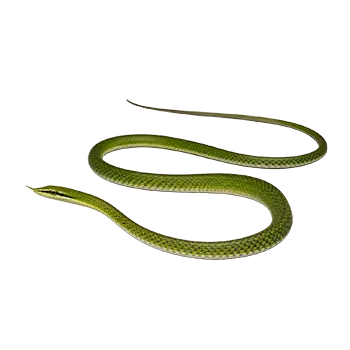

The Asian Vine Snake has become one of the most widely photographed snake species in the world, a status earned not through size or danger but through sheer visual magnetism. Its luminous green coloration, its impossibly slender proportions, and its habit of extending itself in dramatic linear poses across branches and vines create compositions that are immediately arresting even to viewers with no particular interest in herpetology. The snake's horizontally oriented keyhole-shaped pupils, unique among Asian colubrids, add a striking focal point to close-up portraits that has made images of the species perennial favorites in wildlife photography competitions and exhibitions.
Professional wildlife photographers working across South and Southeast Asia have long recognized the Asian Vine Snake as a reliable subject capable of producing portfolio-caliber images. The snake's tendency to hold its position when encountered, relying on camouflage rather than flight as its primary defensive strategy, gives photographers the time needed to set up compositions, adjust lighting, and work through a range of focal lengths and angles that would be impossible with more skittish species. This behavioral cooperativeness, combined with the species' widespread distribution in accessible habitats including gardens, plantations, and forest edges, means that dedicated photographers can encounter vine snakes with reasonable regularity across much of tropical Asia.
The rise of digital photography and high-quality macro lenses has amplified the Asian Vine Snake's visibility in the photographic community. The snake's intricate scale patterns, its binocular facial grooves, and the remarkable textural contrast between its smooth dorsal scales and the rough bark or glossy leaves of its perching sites all reward the kind of detailed, close-range examination that modern macro photography excels at capturing. Online photography communities and social media platforms have become important vectors for the distribution of vine snake imagery, with exceptional photographs regularly accumulating thousands of engagements and introducing the species to audiences far beyond its native range.
The photographic appeal of the Asian Vine Snake has also made it a signature species for nature photography workshops and tours operating in countries such as Sri Lanka, Borneo, Thailand, and Costa Rica, where related vine snake species occur. Tour operators specifically advertise the possibility of photographing vine snakes as a selling point, and the species has become one of the iconic targets of the growing reptile photography tourism sector, contributing to local economies and to the broader argument that living wildlife has economic value that extends beyond consumptive uses.