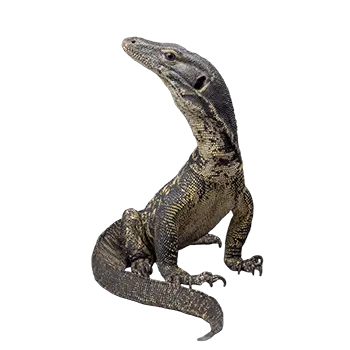

Folklore, Literature & Traditional Storytelling

The Asian Water Monitor has occupied a place in the oral and written traditions of Southeast Asia for centuries, appearing in folk tales, proverbs, and cautionary stories across the region. In the Malay literary tradition, the biawak features in animal fables that often use the monitor lizard as a character embodying cunning, persistence, or greed, depending on the narrative context. These stories, passed down through generations of oral storytelling before being transcribed by colonial-era scholars and modern folklorists, reflect a deep familiarity with the animal's behavior and ecological role. The monitor's scavenging habits, its boldness around human settlements, and its ability to exploit a wide range of food sources provided rich material for storytellers seeking to draw moral lessons from the natural world.

In Thai folklore, the monitor lizard occupies an ambivalent position that reflects the complex cultural attitudes surrounding the animal. Folk stories sometimes cast the monitor as a trickster figure or an animal associated with the uncanny, drawing on the widespread Thai cultural association between the word hia and ill fortune. Despite this negative linguistic connotation, the stories themselves often portray the animal with a degree of grudging respect for its resourcefulness and tenacity. In some regional traditions, encountering a water monitor at certain times or in certain places is interpreted through a system of folk omens, with the meaning varying depending on the specific circumstances of the encounter.

Philippine folk literature includes stories featuring the bayawak, the local monitor lizard, in roles ranging from guardian spirit to cautionary example. In some Visayan traditions, monitor lizards are associated with the protection of waterways, and stories caution against harming them unnecessarily. Ilocano folk tales occasionally feature the monitor as a creature of the liminal spaces between water and land, village and forest, reflecting the animal's genuine ecological preference for edge habitats. These literary traditions, while not always distinguishing between the Asian Water Monitor and other monitor species present in the Philippines, collectively demonstrate the degree to which large varanid lizards have captured the narrative imagination of Philippine cultures.

In the modern era, the Asian Water Monitor has appeared in published natural history writing by both regional and international authors. Travel narratives, natural history compendiums, and popular science books set in Southeast Asia frequently mention the species, often in the context of urban wildlife encounters that surprise Western visitors unfamiliar with the scale and boldness of these animals. The monitor's presence in the literary landscape has been amplified by the growth of nature writing as a genre, with authors increasingly using the water monitor as a symbol of the complex, often surprising coexistence between large wildlife and dense human settlement that characterizes much of tropical Asia.

Documentary & Natural History Programming

The Asian Water Monitor has been a frequent subject of natural history documentaries and wildlife television programming, owing to its dramatic size, photogenic behavior, and accessibility to film crews. Unlike many large reptile species that inhabit remote or inaccessible terrain, the Asian Water Monitor's tolerance of human proximity and its presence in urban and peri-urban environments across Southeast Asia make it a comparatively easy subject to film in the wild. This accessibility has resulted in extensive documentary coverage, with the species appearing in productions by major broadcasters including the BBC, National Geographic, and various regional networks across Asia.

BBC Natural History Unit productions have featured the Asian Water Monitor in several landmark series. The species has appeared in episodes exploring the wildlife of Southeast Asian cities, where footage of monitors navigating canal systems, climbing buildings, and foraging in public parks has served to illustrate the broader theme of wildlife adaptation to urban environments. These segments have introduced the Asian Water Monitor to global audiences who might otherwise have no awareness of the species, and the striking visual contrast between a two-meter reptile and the modern cityscape of Bangkok or Singapore has proven to be compelling television.

National Geographic has similarly featured the species in both television programming and its print and digital publications. Coverage has ranged from ecological profiles focusing on the animal's role as a top predator in wetland ecosystems to human-interest stories about the cultural dynamics of living alongside large monitors in urban Southeast Asia. The organization's photography teams have produced widely reproduced images of water monitors in action — swimming, foraging, and engaging in the dramatic ritualized combat that occurs between rival males during the breeding season.

Regional documentary producers in Thailand, Singapore, Malaysia, and Indonesia have given the Asian Water Monitor even more sustained and nuanced coverage than international broadcasters. Thai-language nature programs have explored the species' ecology, its cultural significance, and the management challenges posed by large urban monitor populations. Singaporean productions have documented the water monitors of the city-state's parks and nature reserves, framing the species as an emblem of Singapore's efforts to maintain biodiversity within a densely urbanized landscape. These regional productions often provide cultural context and local perspectives that are absent from internationally produced content, offering a more complete picture of the species' relationship with the human communities that share its habitat.

The rise of streaming platforms has created additional venues for Asian Water Monitor content. Nature documentary series produced for or distributed through streaming services have included the species in episodes covering Southeast Asian biodiversity, urban ecology, and reptile biology. The on-demand nature of streaming has allowed viewers to seek out content about specific species in ways that traditional broadcast schedules did not accommodate, and the Asian Water Monitor has benefited from this shift as a species with broad name recognition and strong visual appeal.

Viral Moments & Social Media

The Asian Water Monitor has become one of the most frequently viral reptile species on social media platforms, driven by the striking visual impact of encounters between large monitors and unsuspecting members of the public. Videos of water monitors entering convenience stores in Thailand, swimming through flooded streets during monsoon season, raiding outdoor food stalls, and confronting domestic animals have collectively accumulated hundreds of millions of views across platforms including YouTube, TikTok, Instagram, and Facebook. These viral moments have made the Asian Water Monitor one of the most recognizable reptile species in the world, even among audiences with no particular interest in herpetology.

The city of Bangkok has been a particularly prolific source of viral water monitor content. The Thai capital's extensive canal network and public parks support large populations of monitors that frequently interact with residents and tourists in ways that generate dramatic footage. Videos from Lumphini Park, where monitors regularly exceed 1.5 meters in length and show minimal fear of humans, have become a staple of both travel content and wildlife channels. The juxtaposition of these prehistoric-looking reptiles against the backdrop of a modern metropolitan center has proven to be an endlessly appealing visual formula, and the content shows no signs of diminishing in volume or viewership.

Social media has also served as a platform for the captive-keeping community to share content featuring pet and captive-bred Asian Water Monitors. Keepers post videos and images of their animals demonstrating trained behaviors, exploring supervised outdoor environments, and interacting with their owners in ways that highlight the species' intelligence and apparent capacity for individual recognition. These posts generate substantial engagement and serve a dual function: entertaining casual viewers while also transmitting husbandry information and behavioral insights to fellow keepers. Prominent monitor keepers on platforms such as Instagram and YouTube have developed significant followings, and their content has contributed to a growing public perception of monitor lizards as cognitively sophisticated animals capable of nuanced interactions with humans.

The viral nature of Asian Water Monitor content has not been without controversy. Some viral videos depict encounters in which monitors are harassed, cornered, or provoked by bystanders seeking dramatic footage, and animal welfare advocates have criticized the sharing and amplification of such content. Conservation educators have expressed concern that viral videos emphasizing the dramatic or startling aspects of monitor encounters may reinforce fear-based attitudes toward the species, potentially undermining efforts to promote coexistence in urban areas where human-monitor conflicts are managed through tolerance and education rather than removal.

Despite these concerns, the net effect of social media exposure has arguably been positive for the species' public profile. The Asian Water Monitor has transitioned from a species known primarily to herpetologists and Southeast Asian residents to one with broad global name recognition. This increased visibility has generated public interest in monitor biology, urban ecology, and the conservation challenges facing large reptiles in human-dominated landscapes, creating opportunities for educators and conservationists to reach audiences that might not otherwise engage with reptile conservation issues.

Appearances in Film, Television & Gaming

The Asian Water Monitor's cinematic appearances have been more indirect than direct, a reflection of the general tendency within the entertainment industry to treat monitor lizards as interchangeable stand-ins for generic large reptiles rather than as distinct species with their own identities. In film and television, water monitors and other varanid species have frequently served as visual references for fictional reptilian creatures, with their body shape, movement patterns, and general appearance influencing creature design in both practical effects and digital animation. The distinctive head shape, forked tongue, and powerful limbed locomotion of varanid lizards have informed the design of dragons, alien creatures, and prehistoric animals across decades of genre filmmaking.

In practical effects-driven productions of the mid-to-late twentieth century, live monitor lizards — including water monitors — were occasionally used as photographic references or even filmed directly as stand-ins for larger or fictional reptiles. This practice, more common in lower-budget productions, involved filming monitors against miniature sets or compositing footage to create the illusion of enormous reptilian creatures. While the specific species used in such productions was rarely documented, the Asian Water Monitor's availability in the Southeast Asian wildlife trade made it a likely candidate for productions filmed in or sourcing animals from the region.

Television programming beyond the documentary sphere has included the Asian Water Monitor in various capacities. Travel shows, adventure series, and reality programs filmed in Southeast Asia frequently feature encounters with water monitors as dramatic wildlife moments, often accompanied by breathless narration that emphasizes the animal's size and vaguely threatening appearance. While this treatment sometimes veers into sensationalism, it has contributed to the species' recognition among general television audiences. Cooking and food tourism programs have also touched on the species, particularly when exploring the traditional food cultures of communities where monitor meat is consumed.

In the gaming industry, monitor lizards have served as design inspirations for enemy creatures, companion animals, and environmental fauna in numerous titles spanning multiple genres. Open-world survival games set in tropical environments frequently include monitor-like reptiles as part of their ecological simulation, and the visual design of these in-game animals often draws clearly on the proportions and movement patterns of real varanid species. Role-playing games and fantasy titles have similarly drawn on monitor lizard anatomy when designing dragon-like or dinosaur-like creatures, though the connection to any specific real-world species is typically abstracted. The Asian Water Monitor's cultural visibility has increased the likelihood that game designers working on Southeast Asian-inspired settings will include recognizable monitor lizards as environmental elements.

The species has also appeared in educational and simulation games designed to teach players about ecology, conservation, and wildlife management. These titles, often developed with input from conservation organizations or academic institutions, present the Asian Water Monitor as part of broader ecosystem models and challenge players to manage habitats, balance predator-prey relationships, or navigate the complexities of wildlife trade regulation. While these games reach a smaller audience than mainstream entertainment titles, they represent a meaningful intersection of media, education, and conservation outreach.

Photography, Art & the Cultural Imagination

The Asian Water Monitor has inspired a substantial body of photographic work, ranging from scientific documentation to fine art and photojournalism. Wildlife photographers working in Southeast Asia have found the species to be a rewarding subject, not only because of its dramatic physical presence but also because its tolerance of close approach allows for the kind of intimate, detailed imagery that is difficult to achieve with more wary animals. Published photographic work featuring Asian Water Monitors has appeared in the pages of major natural history magazines, photographic anthologies, and conservation publications, and the species has been the subject of dedicated photographic essays exploring its urban ecology, its behavioral repertoire, and its relationship with human communities.

The visual appeal of the Asian Water Monitor lies in part in the contrast it presents: an animal whose body plan has remained largely unchanged for millions of years, moving through environments that are utterly modern. Photographs of water monitors crossing busy roads, perched on concrete walls, or swimming through the manicured waterways of public parks carry an inherent visual tension that photographers have exploited to powerful effect. This juxtaposition has made the species a favorite subject for photographers working at the intersection of wildlife and urban documentary traditions, and some of the most widely circulated images of the species emphasize precisely this collision of the ancient and the contemporary.

In the visual arts beyond photography, the Asian Water Monitor has appeared in traditional and contemporary work across Southeast Asia. Traditional artisans in parts of Indonesia, the Philippines, and Malaysia have incorporated monitor lizard imagery into carved panels, textile patterns, and metalwork, drawing on the animal's cultural significance and its striking physical form. Contemporary artists in the region have used the water monitor as a subject or symbol in work that engages with themes of urbanization, environmental change, and the complex negotiations between human development and wildlife persistence. These artistic engagements range from realistic portraiture of individual animals to more conceptual work that uses the monitor as a metaphor for resilience, adaptation, or the uncanny presence of wildness within domesticated landscapes.

The Asian Water Monitor has also found its way into the visual culture of the global reptile-keeping community. Keeper-produced artwork, including digital illustrations, paintings, and graphic designs featuring the species, circulates widely on social media and through online marketplaces. Reptile expos and herpetoculture events frequently feature vendor artwork depicting popular species, and the Asian Water Monitor is among the most commonly represented varanids in this commercial art ecosystem. This community-generated visual culture reinforces the species' identity within the hobby and contributes to its broader cultural visibility.

The cumulative effect of the Asian Water Monitor's presence across photography, traditional art, contemporary art, and community visual culture is the creation of a layered visual identity that extends well beyond the scientific illustration and field-guide portraiture that once constituted the primary visual record of wild animal species. The Asian Water Monitor is now a species with a rich and diverse visual legacy, one that reflects both its ecological reality and the multiplicity of human perspectives brought to bear on an animal that has shared space with human civilizations for millennia.

Always consult a qualified professional before making any health-related decisions. This content is provided for informational reference only and should not replace professional guidance specific to your animal.