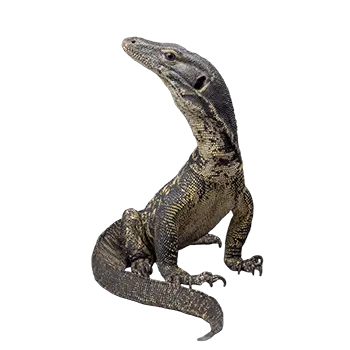

Origins & Natural Range

The Asian Water Monitor (Varanus salvator) is the second-largest living lizard species on Earth, exceeded in maximum length only by the Komodo dragon. Its native range is one of the broadest of any varanid, stretching from the eastern coast of India and Sri Lanka through Bangladesh, Myanmar, Thailand, Cambodia, Laos, Vietnam, peninsular Malaysia, and across the vast island archipelagos of Indonesia and the Philippines. Isolated populations also occur on the Andaman and Nicobar Islands, numerous smaller islands throughout the Malay Archipelago, and parts of southern China. This extraordinary geographic spread has produced a species that thrives in a remarkable variety of habitats, from dense lowland rainforest and mangrove swamp to agricultural land, canal systems, and the parks and drainage infrastructure of major cities.

The species is fundamentally tied to water, a trait reflected in nearly every common name applied to it across its range. In the wild, Asian Water Monitors are most frequently encountered near rivers, streams, estuaries, marshlands, and coastal mangrove forests. They are powerful swimmers, capable of crossing substantial bodies of open water, and this aquatic proficiency is believed to be a primary factor behind their successful colonization of so many islands across Southeast Asia. Their semi-aquatic lifestyle allows them to exploit food resources unavailable to purely terrestrial predators, including fish, crabs, freshwater mussels, and the eggs of waterbirds and turtles. On land, they are opportunistic and omnivorous, consuming everything from insects, frogs, and rodents to carrion, refuse, and the eggs of ground-nesting birds.

Ecologically, the Asian Water Monitor occupies a position near the top of the food chain in most of its habitats. Adults of the largest subspecies can exceed two meters in total length and weigh upward of twenty kilograms, and animals of this size have few natural predators aside from large crocodilians and, historically, tigers. Their role as scavengers and generalist predators places them in a functionally important position within their ecosystems, and their tolerance of human-modified landscapes means they remain common in areas where other large reptiles have declined or vanished entirely.

The species-level taxonomy of Varanus salvator has been subject to considerable revision. As many as seven subspecies have been recognized at various points, including the nominate Varanus salvator salvator of Sri Lanka and southern India, Varanus salvator macromaculatus of mainland Southeast Asia, and several island forms such as Varanus salvator marmoratus of the Philippines and Varanus salvator bivittatus of Java. Molecular studies in the twenty-first century have suggested that the Varanus salvator complex may in fact represent multiple distinct species, and some researchers have elevated certain subspecies to full species status. This taxonomic complexity reflects the deep evolutionary history of a lineage that has diversified across one of the most geographically fragmented regions on the planet.

Cultural Significance Across Southeast Asia

Throughout its vast range, the Asian Water Monitor has occupied a prominent place in human culture for millennia. In many Southeast Asian societies, the animal is regarded with a mixture of familiarity, respect, and wariness that reflects its conspicuous presence in both wild and settled landscapes. Unlike many large reptiles that have retreated from human habitation, the Asian Water Monitor has remained a visible and often abundant neighbor to human communities, patrolling riverbanks, scavenging in markets, and basking along canals and drainage ditches. This persistent proximity has woven the species into the daily life, language, and belief systems of dozens of cultures across the region.

In Thai culture, the water monitor occupies a notably complex linguistic and social position. The Thai word for monitor lizard, hia, has acquired strong negative connotations and is considered one of the most offensive insults in the Thai language. The origins of this association are debated, with some scholars suggesting links to the animal's scavenging habits and its historical presence around cemeteries and areas of decomposition, while others point to older folk beliefs connecting the lizard to misfortune. Despite this linguistic stigma, the animals themselves are widely tolerated in Thai public spaces, and large populations inhabit the canal systems and parks of Bangkok, including the famous Lumphini Park, where monitors coexist with joggers, families, and office workers in remarkable proximity.

Across the Malay world and the Indonesian archipelago, monitor lizards feature in traditional medicine, folklore, and artisanal craft. In parts of Indonesia, monitor skin has been used for centuries in the construction of traditional drums, and the leather trade remains an economically significant industry in some regions. In the Philippines, the bayawak, as the monitor is known in Tagalog, appears in folk stories and is sometimes associated with spiritual guardianship of waterways and forests. In parts of Borneo, indigenous Dayak communities have traditionally regarded large monitors with a degree of spiritual significance, incorporating monitor imagery into beadwork, tattoos, and longhouse carvings.

In the Indian subcontinent, the water monitor and its close relative the Bengal Monitor have both figured in Ayurvedic medicine and local folk practice for centuries. Various body parts of monitor lizards have been attributed medicinal or aphrodisiac properties, a belief system that has contributed to hunting pressure on wild populations. In Sri Lanka, the kabaragoya, as the water monitor is known in Sinhala, is a culturally familiar animal frequently encountered in rural and semi-urban environments, and its image appears in traditional art and storytelling. The breadth of cultural engagement with this single species across so many distinct societies is a testament to its ecological ubiquity and the deep, layered history of human coexistence with large reptiles in tropical Asia.

Buddhist traditions across mainland Southeast Asia have also influenced human attitudes toward the water monitor. In Thailand, Myanmar, and Cambodia, Buddhist principles of compassion toward all living beings have contributed to a general tolerance of monitors in public and temple spaces, even where the animals grow to imposing sizes. Monitors are frequently observed on the grounds of Buddhist temples, where they benefit from both the presence of food offerings and a cultural disinclination to harm them. This dynamic illustrates the way in which religious and philosophical frameworks can shape the ecological fortunes of a species, creating informal sanctuaries in the heart of otherwise heavily urbanized landscapes.

Western Scientific Discovery & Classification

The Asian Water Monitor entered the Western scientific record relatively early in the history of herpetological taxonomy. The species was first described by the Swedish naturalist Carl Linnaeus in 1768 in the twelfth edition of his foundational work Systema Naturae, under the name Stellio salvator. Linnaeus based his description on accounts and specimens from the East Indies, and the species was subsequently transferred to the genus Varanus as the modern framework of varanid classification took shape in the nineteenth century. The specific epithet salvator, meaning savior or deliverer in Latin, is thought to derive from a local belief recorded by early European travelers that monitor lizards would warn people of the presence of crocodiles, though the accuracy and origin of this etymology have been questioned by later scholars.

The nineteenth century saw a proliferation of described forms as European naturalists working in the colonial administrations of British India, the Dutch East Indies, the Spanish Philippines, and French Indochina encountered water monitors across their respective territories. Many of these described forms were later consolidated as subspecies of Varanus salvator, but the process of taxonomic revision was slow and contentious. The sheer geographic range of the species, combined with substantial variation in size, coloration, and scalation across populations, made it difficult to determine which differences warranted taxonomic recognition and which fell within the range of normal intraspecific variation.

The twentieth century brought more systematic approaches to the taxonomy of the Varanus salvator complex. Herpetologists such as Walter Auffenberg, whose extensive fieldwork in the Philippines and Indonesia produced some of the most detailed ecological studies of wild monitor populations ever conducted, contributed both distributional data and behavioral observations that informed taxonomic decisions. Auffenberg's 1988 monograph on the Gray's Monitor also provided comparative data relevant to understanding the broader radiation of Southeast Asian varanids. By the late twentieth century, the consensus recognized a handful of subspecies within Varanus salvator, though the boundaries between them remained imprecise in many contact zones.

Molecular phylogenetic research beginning in the early 2000s has reshaped understanding of the Varanus salvator complex in fundamental ways. Studies using mitochondrial and nuclear DNA markers have revealed deep genetic divergences among populations that were previously lumped under a single species, suggesting that the complex may contain several cryptic species. The Philippine populations, in particular, appear to represent a distinct evolutionary lineage, and some researchers have advocated for the recognition of Varanus marmoratus as a full species. The Sulawesi and Moluccan populations have also shown significant genetic differentiation. This ongoing taxonomic revision has practical implications for conservation planning, as species-level recognition can influence the allocation of protection resources and the design of management strategies.

The scientific study of Asian Water Monitors has extended well beyond taxonomy into behavioral ecology, physiology, and urban ecology. Research conducted in Singapore, Bangkok, and other Southeast Asian cities has documented the remarkable behavioral flexibility of urban monitor populations, including their use of storm drains as movement corridors, their exploitation of anthropogenic food sources, and their apparent habituation to high levels of human activity. These studies have contributed to a growing body of literature on reptilian behavioral ecology and have challenged earlier assumptions about the cognitive limitations of lizards.

Historical Exploitation & Trade

The Asian Water Monitor has been subject to one of the most intensive and sustained commercial harvests of any reptile species in the world. For centuries, the species has been hunted and trapped across its range for its skin, its meat, its fat, and various body parts attributed medicinal value. The scale of this exploitation is difficult to overstate: during the peak decades of the international reptile skin trade in the mid-to-late twentieth century, millions of Asian Water Monitors were harvested annually, primarily for the production of leather goods including watch straps, belts, wallets, handbags, and shoes. Indonesia alone exported skins numbering in the hundreds of thousands per year throughout the 1980s and 1990s, making the Asian Water Monitor one of the most heavily traded wild animal species on the planet.

The skin trade has deep historical roots in Southeast Asia. Long before the globalization of the leather industry, monitor skins were used locally for the manufacture of traditional items including drum heads, sheaths, and decorative elements. The arrival of European colonial traders and the subsequent development of industrial tanning and manufacturing processes transformed what had been a local craft into a global commodity market. By the mid-twentieth century, tanneries in Singapore, Jakarta, and Bangkok were processing enormous volumes of monitor skins for export to fashion houses and leather goods manufacturers in Europe, Japan, and North America.

The meat of the Asian Water Monitor has also been consumed across much of its range, both as a subsistence food source and as a commercial product. In parts of Indonesia, Thailand, and the Philippines, monitor meat is sold in local markets and is considered a legitimate food item, though attitudes toward its consumption vary significantly between and within cultures. In some communities, monitor meat is regarded as a delicacy or attributed health benefits, while in others it carries social stigma or is subject to religious dietary restrictions. The fat of the water monitor has been used in traditional medicine across multiple cultures, applied topically for skin conditions or consumed as a supposed remedy for respiratory ailments.

The impact of centuries of intensive harvesting on wild Asian Water Monitor populations is a subject of ongoing scientific and conservation debate. The species' remarkable reproductive capacity — females can lay clutches of fifteen to forty eggs, and some populations may reproduce more than once per year — has provided a biological buffer against overexploitation that has allowed many populations to persist despite heavy harvest pressure. However, localized declines have been documented in areas of particularly intense collection, and the long-term sustainability of current harvest levels is not assured for all populations, particularly those on smaller islands with more limited habitat.

The transition from purely extractive exploitation to captive breeding and regulated trade represents one of the more significant shifts in the recent history of the species' relationship with humans. While wild-caught animals still constitute a substantial portion of the international trade, particularly in the skin and meat markets, the growth of captive breeding programs for the pet trade has introduced a new dimension to the commercial landscape. Captive-bred Asian Water Monitors are now produced by breeders in the United States, Europe, and parts of Asia, and the availability of purpose-bred animals has reduced demand for wild-caught specimens in the hobbyist market, though it has done little to affect the much larger-volume skin trade.

Rise in Modern Herpetoculture

The Asian Water Monitor's entry into the world of modern herpetoculture — the keeping and breeding of reptiles and amphibians in captivity — followed a trajectory distinct from that of many other popular monitor species. Unlike the Savannah Monitor or the Ackie Monitor, which gained hobbyist followings primarily through the pet trade, the Asian Water Monitor was known to Western science and zoos long before it became a species of interest to private keepers. Zoological institutions in Europe and North America maintained water monitors throughout the twentieth century, and these institutional animals provided early insights into the species' captive requirements, lifespan, and behavioral repertoire. However, the sheer size of adult animals and the considerable space and environmental controls required to house them properly meant that private keeping remained relatively uncommon until advances in enclosure design and husbandry knowledge made the species more accessible.

The growth of the internet and online reptile communities in the late 1990s and early 2000s was a catalytic force in the expansion of Asian Water Monitor keeping. Forums and websites dedicated to varanid husbandry allowed keepers to share information about diet, enclosure construction, thermoregulation, and medical care in ways that had previously been impossible. Experienced keepers who had maintained water monitors for years could now communicate their hard-won insights to newcomers across the globe, and the resulting improvement in husbandry standards was reflected in better survival rates, more successful breeding outcomes, and a growing appreciation for the species' intelligence and behavioral complexity.

The captive breeding of Asian Water Monitors has produced a diverse array of selectively bred color morphs and locality-specific lines that have expanded the species' appeal within the hobby. While wild-type animals display the characteristic dark olive to black dorsal coloration with yellow ocelli and banding, captive breeding programs have produced animals in a range of color expressions, from intensely golden and high-contrast patterned individuals to darker, melanistic variants. Locality-specific animals, particularly those from island populations such as Sulawesi or the Philippines, have attracted premium interest from collectors seeking to maintain genetically distinct lines.

The community of Asian Water Monitor keepers has developed its own set of informal standards and best practices that, while not codified in the manner of domestic animal breed standards, nonetheless exert significant influence over husbandry norms and breeding decisions. Experienced keepers and breeders are expected to provide enclosures that accommodate the species' large adult size and semi-aquatic habits, typically incorporating substantial water features, climbing opportunities, and basking areas with appropriate thermal gradients. Dietary recommendations emphasize variety and whole-prey feeding, with an awareness of the species' susceptibility to obesity in captivity if fed excessively rich diets without adequate activity. The reptile expo circuit, social media groups, and dedicated online communities serve as the primary venues for knowledge exchange, animal sales, and the kind of peer accountability that functions as an informal quality-control mechanism within the hobby.

The Asian Water Monitor's reputation as one of the most intelligent and interactive reptile species available to private keepers has been a central factor in its sustained popularity. Keepers frequently report that their animals recognize individual people, respond to their names, and display problem-solving behaviors that exceed the expectations typically held for reptiles. This behavioral richness, combined with the species' imposing physical presence and the genuine challenge of providing appropriate long-term care, has positioned the Asian Water Monitor as a flagship species within the advanced monitor-keeping community — an animal that demands respect, commitment, and expertise, and rewards those qualities with a uniquely engaging captive experience.

Always consult a qualified professional before making any health-related decisions. This content is provided for informational reference only and should not replace professional guidance specific to your animal.