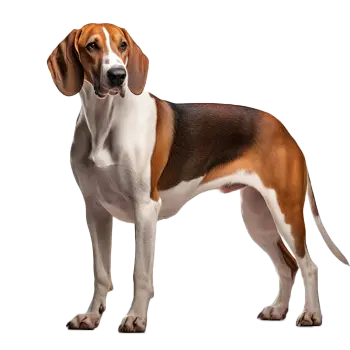

The American Foxhound traces its lineage to English foxhounds brought to the American colonies in the mid-1600s. Robert Brooke is widely credited with importing the first pack of English hunting hounds to Maryland in 1650, and these dogs formed the foundation stock from which the American Foxhound would eventually emerge. Over the next century, colonial breeders selectively bred these hounds to suit the rougher terrain, warmer climate, and different quarry of the New World.
By the eighteenth century, a distinctly American type had begun to take shape. French hounds gifted by the Marquis de Lafayette to George Washington in 1785 were crossed into existing colonial lines, introducing greater speed and a more refined build. Washington himself kept meticulous breeding records at Mount Vernon, and his kennel journals reveal a deliberate effort to develop a hound that was faster and more independent than its English ancestor while retaining the stamina needed for long hunts across the Virginia countryside.
Other influential imports followed throughout the 1800s. Irish hounds contributed endurance and a keener nose, while additional French bloodlines added voice and drive. Regional strains began to emerge — the Walker, Trigg, Goodman, and Penn-Marydel lines each reflected the preferences of different hunting communities. Despite these regional variations, all shared the lean, long-legged frame and melodious bay that distinguished the American Foxhound from its heavier English cousin.
The American Kennel Club recognized the breed in 1886, making it one of the earliest breeds in the AKC registry. Yet the breed's identity remained closely tied to the field rather than the show ring, and many of the most prized lines were kept by hunting families who valued performance above conformation standards.